Don’t Debate, Rehabilitate.

“Don’t debate religion with fundamentalists: what they need is rehabilitation”

by Saad A Sowayan

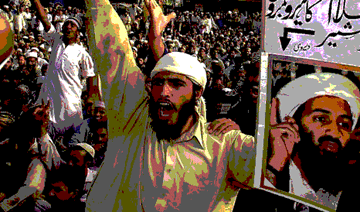
Fundamentalism is a cultural phenomenon, though it dons religious garbs. It is a mode of consciousness shaped by cultural values, not religious principles. Thus we can understand it only if we examine it in its cultural context as a sociological rather than a theological question.

So, I will begin by taking a close look at the social incubators most likely to hatch fundamentalism.

I understand by fundamentalism strong adherence to an archetypal point of view and a fierce conviction of its fundamental truth, to the exclusion of any other alternate idea. Any alternative is resisted by a fundamentalist and treated not as a legitimate substitute stemming from a rational free choice, but as a detrimental antithesis of the fundamental truth of the archetype. The archetype is a model to be emulated and reproduced, not dissected or scrutinized. Continue reading Don’t Debate, Rehabilitate.
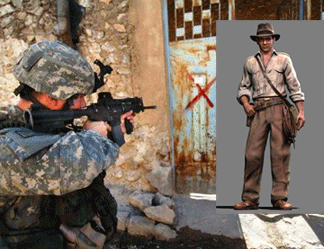
Anthropo covertus: A Disputed Species

Get ready for a shock. Anthropology (the best kept discipline secret in American academics) made the front page of today’s New York Times. And, believe it or not in the Ripley tradition, it was not about finding the “missing link” or “Noah’s ark”. In a report filed by David Rohde and entitled “Army Enlists Anthropologists in War Zones,” the focus is on the Pentagon’s newly instituted “Human Terrain Teams,” a kind of social science intellectual swat team approach, in which the military uses experts on the local culture. In a video on the website, an American officer explains that his soldiers no longer routinely break down doors of houses and violate the cultural space of Afghan homes, but let their Afghan counterparts knock first while they wait respectfully outside. While I am not sure it takes an anthropologist to point out what should be obvious through simple experimentation, the basic argument of the article is that the military is being coached to listen and work with the local population rather than play knee-jerk mercenary search and destroy games.

It is hard to argue with the sentiment that talking and negotiating are better ways to accomplish a proposed peace-building mission than assuming everybody in sight is a terrorist or is hiding one. So anthropologists, especially recent graduates who have a hard time finding jobs, should be pleased that supply actually might be influenced by a newfound demand for their services. Take Marcus B. Griffin, for example, an embedded anthropologist in Iraq who has a blog discussing his work. Continue reading Anthropo covertus: A Disputed Species

Afghanistan: The Vaudeville Version

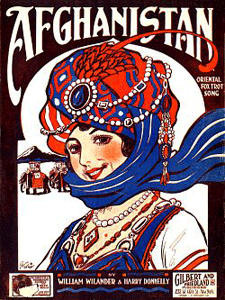
America not only flexes its military muscles and economic clout around the world, but at times takes the rest of the world for a song and dance. Vaudeville, the early 20th century dance hall and stage phenomenon, lyrically used and abused the world as a stage. But it seldom looked much like the real world of the time, and certainly not after almost a century later. Here was popular Orientalism, in the Valentino Sheik mode, for anyone who could afford sheet music. One of the wonderful nostalgic websites documenting this era is Parlor Songs, which publishes an online magazine.

If you would like to see how Vaudeville treated the Orient, check out the article by Richard A. Reublin in the 2005 issue. Among the songs discussed is “Afghanistan” written in 1920 by William Wilander and Harry Donnelly. Click here to listen to the song as you read the lyrics:

Afghanistan
A Romance of Asia
Words and Music by
William Wilander & Harry Donnelly
Published 1920 by Gilbert & Friedland, Inc.

[Verse 1]
In the land of Afghanistan,
There’s a Hindu maid and a man,
She swore by the stars up above her,
That he was the one to love her. Continue reading Afghanistan: The Vaudeville Version

Tenure Crashers Gone Wrong

In a previous post I commented on the media-made controversy over the tenure case of anthropologist Nadia Abu El-Haj at Barnard College. In noting a pingback to my post on another blog, I discovered that those who would try to interrupt the tenure process at Barnard have gone even further into the wrong territory. The “Deny Abu El Haj Tenure Committee” has created a website using Prof. Abu El-Haj’s name (http://www.nadiaabuelhaj.com/) in order to attack her. The url has even been copyrighted. For a group that claims to be interested in restoring “honor” to Barnard, it appears any means justifies their tenure crashing end. I am not a lawyer (as my salary would well document), but this site seems a prime case for a libel suit. How can a group copyright a person’s name for a website and use that to attack? Forget the bulldozer, this is what the bull drops on the ground and it sure doesn’t smell like a fact.

Daniel Martin Varisco

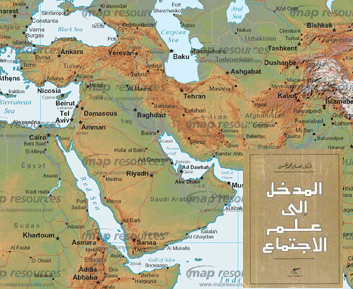
Sociology or Anthropology? What’s the Difference?

Note: The following is an excerpt from my Islam Obscured (New York: Palgrave, 2005, 137-138). I invite comments from both sociologists and anthropologists to help bridge the disciplinal gap in our joint interest and intellectual history over the Middle East.]

What is the difference between the anthropology of Islam and the sociology of Islam?

It is the character of lived experience I want to explore, not the nature of man. Michael Jackson (the ethnographer)

Whether or not an approach to religion is anthropological or sociological is a bit of a red herring. To a certain extent the answer is as trite as the discipline in which a researcher has been trained. But the interchange of labels is too rampant to be dismissed as simple cross-border interchange. Consider that French scholar Jean-Pierre Digard provides “perspectives anthropologiques” in a French journal of “sociologie,” while calling what he does “ethnologie.” In France Jacques Berque and Pierre Bourdieu teach “sociologie.” In Britain a number of social anthropologists regard what they do as a type of sociology, a notable example being Ernest Gellner. Since Gellner was trained as a philosopher and harbored lifelong suspicions of any notion that could be called Wittgensteinian, I suppose one category is as good for him as another. American academics are generally more disciplined. Clifford Geertz is an unabashed anthropologist, although he relies to a great extent on sociologists like Weber and Parsons. Even in formal ethnographies, the bread and butter of anthropological communication, the distinction can be fuzzy. Dale Eickelman, who conducted an ethnographic study of a pilgrimage center in Boujad, Morocco, identified his primary goal as making “sociological sense.” Given that most readers have a relatively clear idea of what sociology is about but little knowledge of what anthropologists do, the word choice may in fact be pragmatic rather than programmatic. Continue reading Sociology or Anthropology? What’s the Difference?

Hip Hop Hijab Jabbing

To veil or not to veil: in Iran that is a question seemingly more relevant than getting an A-bomb. It is not so much the option of veiling as it is how to veil, how much to cover. With reports of a crackdown on what constitutes proper dress for Muslim women in public, the media has been flooded with stories of women with loose hijabs being harassed. For those who have bad feelings about Islam such stories add fuel to the fire of prejudice. But a toll is also taken on Muslims, especially in the West, who see themselves judged by the actions of an extreme case. Not surprisingly, some Muslims who do not see naked eye to veiled eye with the fashion enforcers in Iran are speaking hip hop to power.

Here on the Youtube Watch is an anti-hijab film by Mani Turkzadeh with a hip hop tune from GOZAR.

The Immovable East


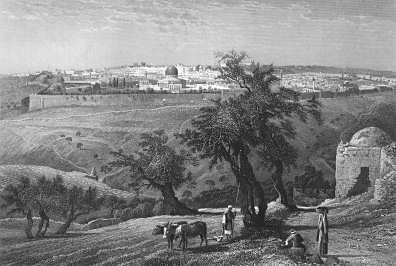
Jerusalem from the Mount of Olives

It is easy to dismiss past travel writing about the “Orient” as mere “Orientalism,” the kind that Edward Said disparaged as a style for dominating the supposed “Oriental” other. But viewing such texts through a politicized post-colonial lens thus becomes a kind of scorched-earth form of literary criticism. True enough, there are many narratives, especially by Christian writers, that approach the physical ‘Holy Land’ with a schizophrenic ax to grind: an over-appreciation of the biblical character of the land coupled to an under-valuing of the people who lived in the land at the time. But occasionally there are texts that dig beneath the surface if the reader has the patience to read beyond the surface rhetoric. One of these is a delightful first-person narrative by Philip J. Baldensperger, published in 1913 about experiences in Palestine during the last half of the 19th century. Continue reading The Immovable East

The Letters of Badr Shakir al-Sayyab: #5


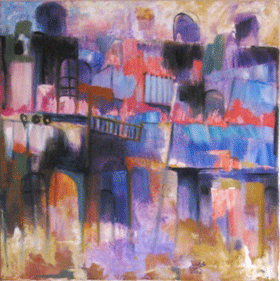
Mohammed Jafaar, Baghdad Things, Oil on Canvas, 2006

[Note: This is the fifth in a series of translations of selected letters of the noted Iraqi poet Badr Shakir al-Sayyab. For more information on the poet, click here.]

Letter #5 (6//19/1947)

Baghdad

My Kind and Respected Brother, Dr. Suheil Idris,

My sincere best wishes and scented greetings to you.

Your kind letter has overwhelmed me with joy. I am very appreciative of your good opinion of me, and I hope to remain worthy.

In your letter, you inquire as to what our brother, Kathem (Jawad), and I meant when we said in our commentary on your splendid novella, “A letter to My Mother,” that it appeared at the most opportune time. Explaining this could be very lengthy, but trust me that we intended to speak to you about this even if you had not asked. This is a topic that concerns every man of letters and every man who is faithful to his people and nation and who is concerned with their future and the future of Arabic literature. Continue reading The Letters of Badr Shakir al-Sayyab: #5