Reporting the Golf between Us

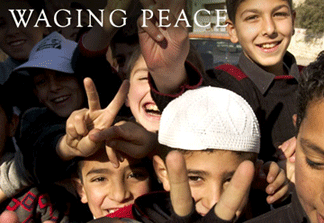
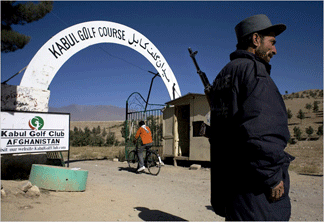
What might be the top story coming out of Afghanistan today? Another Korean missionary kidnapped by the Taliban, a new estimate of a bumper poppy crop, yet again a suicide bombing in Kabul? These are too obvious to be news anymore. How about the largely unused and downright laughable Kabul Golf Course? This is the front-and-center story with two color pictures on the front page of today’s New York Times. And for those who can click a mouse, there is a slide show with thirteen (not a lucky number for an amateur) photographs.

This is no ordinary golf course, which is one of the reasons it makes the first page. Here is the description reported today by Kirk Semple:

It is the Kabul Golf Course, Afghanistan’s only one, and Mr. Abdul, who picked up a putter for the first time when he was 10, is its director and golf pro.

The nine-hole course is extraordinarily rugged by any standard. Continue reading Reporting the Golf between Us

Right along with the Bible”: Innocents Abroad


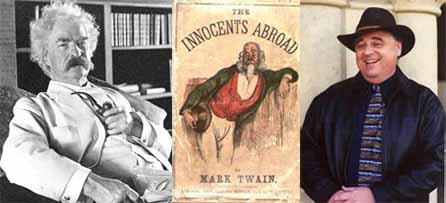
[Mark Twain, left; early cover of ‘Innocents Abroad’, center; Hilton Obenzinger, right]

by Hilton Obenzinger, Stanford University

Innocents Abroad’s manufacture of “Mark Twain” as the surrogate for the reader’s “own eyes” was immensely popular. The travel book, whose sales reached 100,000 even before the second anniversary of its publication, launched, even more than his celebrated jumping frog, Mark Twain’s national career. “Popular as are Mark Twain’s books at home,” an unidentified correspondent for the Hartford Courant reported in 1872, Innocents Abroad is “still more so abroad.”

“It sells right along just like the Bible,” Mark Twain remarked to William Dean Howells. Indeed, half a million copies had been sold by Twain’s death in 1910, at which time Innocents Abroad, with its central organizing principle of “Mark Twain” as “one of the boys” joined Adventures of Huckleberry Finn and The Adventures of Tom Sawyer as the titles (and two other boys) most commonly worked into political cartoons memorializing the author in the press. Today Innocents Abroad, still a pleasure to read despite the complications and vexations of history, remains durable, continuing to be hailed as “the most popular book of foreign travel ever written by any American.” Continue reading Right along with the Bible”: Innocents Abroad

A Qibla Query: Facing Mecca and Fasting in Outer Space


(left to right) Sheikh Muszaphar Shukor of Malaysia, Yury Malen¬chenko of Russia, and Peggy Whitson of the US will fly on a Russian rocket.

How does an Islamic astronaut face Mecca in orbit?

Decisions by a conference of Muslim leaders and scientists will help a Malaysian doctor stay observant in outer space.

By Bettina Gartner | Contributor to The Christian Science Monitor

Allah is watching – even in outer space. And that poses a problem for a devout Muslim astronaut who is scheduled to fly to the International Space Station (ISS) aboard a Russian rocket this week.

Imagine trying to pray five times a day in zero gravity while having to face an ever-shifting Mecca hundreds of miles below. How do you ritually wash yourself without water? And, now that it’s Ramadan, how do you fast from sunrise to sunset when you see a sunrise and a sunset every 90 minutes? Sheikh Muszaphar Shukor, a Malaysian astronaut, must decide before the Oct. 10 launch.

“I am Islamic,” Sheikh Shukor told a press conference in Moscow, according to the Associated Press, “but my main priority is more of conducting experiments.” Continue reading A Qibla Query: Facing Mecca and Fasting in Outer Space

Hear Ye, Hear Ye

One of the most common complaints about “Islam” from politicians and other truth-bending members of our society is that mainstream Muslims do not speak out when fellow Muslims commit atrocities such as suicide bombings. Muslims do, of course, both to their friends and neighbors and in forums that usually fail to reach the public at large. But often no one takes the time to listen or to find where these voices can be heard loud and clear. So it is not fair to ask why Muslims are failing so speak out against extremism without also asking why so little attention is paid in the mainstream media when they do. Well, hear ye, hear ye, there is a letter to prominent Christian leaders, including Pope Benedict and the leader of the Baptist church, from a broad spectrum of Muslim intellectuals and leaders, as reported Thursday on the BBC and The Guardian.

A pdf version of the English translation of the letter can be found on a website dedicated to the letter. The letter begins:

“Muslims and Christians together make up well over half of the world’s population. Without peace and justice between these two religious communities, there can be no meaningful peace in the world. The future of the world depends on peace between Muslims and Christians.”

Continue reading Hear Ye, Hear Ye

Innocent with no chance to be proven guilty


Khaled El-Masri with two of his children

Perhaps it is time to stop asking “Why do they hate us?” and consider “why do we hate ourselves?” America does stand for something, as it has for generations of immigrants (including my grandfather from Sicily and my wife from Lebanon). That something, enshrined in our sacred documents promoting liberty and justice for all, is a much-needed system of checks and balances to keep any particular part of our governing system from monopolizing its power at the expense of the citizens. If, as President Bush insists, they hate us because we have liberty, then the decision Tuesday by the Supreme Court not to hear the case of Khaled al-Masri must be good news. We no longer have liberty, so “they” should have nothing to hate. Let’s declare an end to the War of Terrorism, keep our shoes on the next time we board a flight, and take all those with the suspicious name of Muhammad or Ali off the Homeland Security list of the unwanted.

The editorial in today’s New York Times cuts through the liberal vs. conservative crap shoot of opinion mongering to a sober assessment of the case in question. Take a look for yourself, before I comment further. Continue reading Innocent with no chance to be proven guilty

It’s a Crime, Especially in Fiction

by Reeva S. Simon

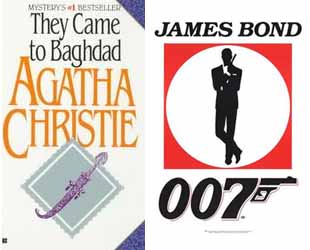
This perennial Western fear, that of a resurgent Islam, is a part of the Western historical memory. The sword-wielding Muslim thundering across the Straits of Gibraltar or laying siege to Vienna, the Old Man of the Mountain’s Assassins high on drugs launched to kill political leaders, white slavers, and Barbary pirates have been reincarnated as plane hijackers, embassy bombers, and nefarious creators of long gas lines. In the fiction of the “paranoid” and “vicious” categories, the conspiracy, the hero, and the villain are basic elements for thriller/spy novel success…

Thus, in fiction, anyone’s life can have meaning in the anonymous industrial and terrifying nuclear age. The reader identifies with the hero whose exploits become his own, and the fictional conspiracy becomes a personal threat on a world scale. Beating the gas lines during an oil embargo is transformed via fiction into vicarious vengeance against the villains, perceived as wealthy petrosheikhs who have created the oil crisis. But identification of the villain alone is not enough. In order to be thoroughly imbued with evil and to maintain credibility as a villain, the villain must be an impersonal figure; he is a stereotype; he mirrors the reader’s personal prejudices and fears. Only then is the reader hooked his villainy as he must also be on the hero’s noble character to such a degree that he can instantly and unconsciously root for the salvation of one and the damnation of the other. Continue reading It’s a Crime, Especially in Fiction

Chew Some Qat

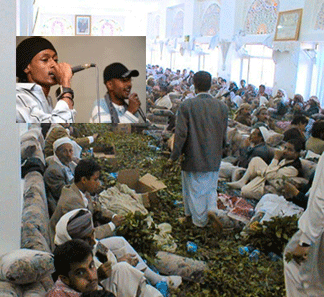
One of the unique aspects of living in Yemen is chewing qat, the tender young leaves of the shrub Catha edulis. In the late afternoon Yemenis often get together with their supply of qat, a water-pipe (narghila) and plastic bottles of spring water. Much has written about the plant and its use. For starters, check out the Qatalog on Yemen Webdate.

Youtube now brings you rap versions by Yemeni artists. Chew on this or this for awhile.

The Letters of Badr Shakir al-Sayyab: #6


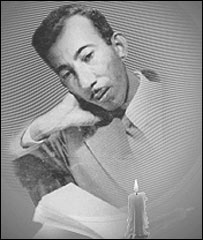
The Iraqi Poet Badr Shakir al-Sayyab

[Note: This is the sixth in a series of translations of selected letters of the noted Iraqi poet Badr Shakir al-Sayyab. For more information on the poet, click here.]

Letter #6 3/4/1956

Directorate of Public Trading, Baghdad

My Kind Brother, Dr. Suheil (Idris),

Sweet Arab greetings to you. Yesterday I received your kind letter and welcomed your decision to entrust “the reading of the previous issue” to Mr. Abdul Sabour. We hope that he will be fair in his criticism. Otherwise, our pens are ready, and we look forward to the precious opportunity to reevaluate much of the criteria and points of view. This is my opinion and it is also shared with our brother, Muhyyi al-Din (Ismai’l).

As for our brother, Kathem (Jawad), he blames you because you entrusted the “reading” of the issue of al-Adaab to “a person who is even ignorant of prosody,” but we, brother Muhyyi al-Din and I, have convinced him of the importance of the rationale that prompted you to do this: namely, to reveal the truth through the struggle between values and criteria. As of yet, we have not seen the last issue of “al-Adaab” – we have learned from trusted sources that it will imminently appear in the market. Continue reading The Letters of Badr Shakir al-Sayyab: #6