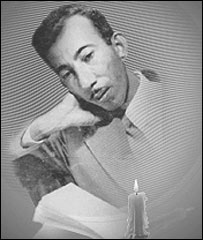
The Letters of Badr Shakir al-Sayyab: #13


The Iraqi Poet Badr Shakir al-Sayyab

[Note: This is the 13th in a series of translations of selected letters of the noted Iraqi poet Badr Shakir al-Sayyab. For more information on the poet, click here.]

Letter #13

Basra 7/13/1961

My Dear Brother Abdel Karim (al-Na’im),

I send you an Arab greeting.

It was good of you to write to me again especially after I lost, along with a number of papers and poems, your previous letter in which you mentioned your new address.

Regarding the campaign of “al-Adaab” against me, let me explain. About two years ago, Suheil Idris requested my approval to let Dar al-Adaab publish my poetry collection. I promised they could, and he was waiting for me to send him the drafts. However, I had no drafts except the poems that had been previously published in the journals “al-Adaab” and “Shi’r,” etc. Then the “Shi’r” journal volunteered to search for my poems and collect them. In the meantime, my collection, “Hymn of the Rain,” was published. All of this together with my decision to cease publishing in al-Adaab and limit my publishing only to “Shi’r” angered Suheil Idris. Furthermore, it is clear that Mr. (Elie Hawi) wanted – in his criticism – to prove that his brother, Khalil Hawi, was a better poet than I. Continue reading The Letters of Badr Shakir al-Sayyab: #13 →
Norma’s Take on Carthage

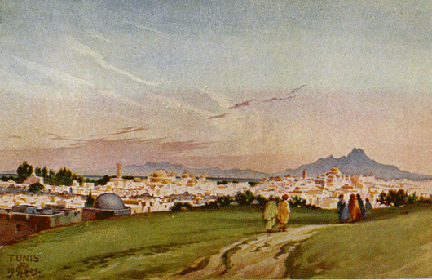
Thousands of English and American travelers have written about their experiences in the Arab World. Quite a few are worth reading, but the majority deserve obscurity. In a recent book sale at my university library, a pitiful travel account of the roaring 20s was remaindered. It bodes well for my institution that it was never checked out, although I wonder how it entered the stacks in the first place. The book in question is By the Waters of Carthage, by Norma Octavia Lorimer, following on her By the Rivers of Sicily and By the Rivers of Egypt. Why she never set sail down the Tigris by the reggae-beloved rivers of Babylon is anyone’s guess. This baneful little volume about a fickle English lady set loose in Tunis represents just about everything wrong with Orientalist inferiorizing of cultures in the Middle East. The only redeeming features are the colorful frontispiece (shown above) and black-and-white photographs of life in Tunisia around 1920.

Sometimes it is useful to read bad text in order to appreciate good travel writing all the more. There is probably no bias that does not surface in Lorimer’s diary-prone prose, all the more chauvanized by her style of filling her chapters with letters to her dear husband. Consider the following tidbits… Continue reading Norma’s Take on Carthage →

A Rose for the Last Days

by Rana al-Tonsi [Translated from Arabic by Sinan Antoon]

On one foot
like a humiliated beggar I limp
past all the swinging doors
and the flags that are taken down from their masts . . .
The sidewalk was never my friend
but it embraced me those times
when the crying was tough and bitter

In my country
soldiers go to a war
where they never fight
In every coffeehouse or square
under the feet of the sick, the sad and insane
you can glimpse the trace of a rose
thrown into the arms of nurses
in lonely rooms inhabited by wailing,
a rose drawn in blood. Continue reading A Rose for the Last Days →

What is There to Study?

Tomorrow I am scheduled to teach a class on the political advice of Niccolo Machiavelli, some five centuries removed. If this noted Florentine were alive today, he would probably display an unseemly Italian gesture at the political disarray of his beloved Italy and the ineptness of the world’s remaining superpower’s involvement to his geographic Orient. Can you imagine this advice in an updated edition of The Prince: when in doubt or unwilling to act, form a study group. Just over a year ago we had the highly touted and now conveniently shelved Iraq Study Group. The media touted the prominent bipartisan members, the report was available free to the public, and the sitting President more or less brushed aside any recommendation that did not flatter him. This would no doubt please Machiavelli’s realism. He just surged ahead, sending more troops rather than admitting a flawed policy in the first place.

Each day the news media report suicide bombings, now more commonly in Pakistan and Afghanistan. For some this might mean the surge is working. But what about the surge in violence outside Iraq, especially in Afghanistan, the place it all started. Somebody forgot to form a study group for Afghanistan, but now we have it. Continue reading What is There to Study? →

The Girl of Qatif


Saudi judge ignores Quranic rights in harsh decision over the ‘Girl of Qatif’

By Khalid Chraibi
Arablife.org, Tuesday, 22 January 2008

In a memorable scene in Ingmar Bergman’s movie Wild Strawberries, Isak, the central character, dreams that he is standing in court, waiting to be sentenced. But he has no clue as to the charges against him. When the judge declares him guilty, he asks, bewildered: “Guilty of what?” The judge replies flatly: “You are guilty of guilt”. “Is that serious?” asks Isak. “Unfortunately,” replies the judge.

The verdict in the case of the ‘Girl of Qatif’, as the incident has become known worldwide, is as bewildering to most people as the judge’s verdict was to Isak. How can a young bride of 18 who has been subjected to the harrowing experience of being blackmailed by a former ‘telephone boyfriend’, then gang-raped 14 times in a row by seven unknown assailants, be further brought to trial for the offence of khalwa and condemned to 90 lashes? How does one justify raising the punishment to 200 lashes and 6 months in jail when she appealed the first sentence?

The case had all the necessary ingredients to become an instant cause célèbre, when word of it reached the global news agencies. It received very large coverage in the media, with the verdict being criticized by commentators, politicians and citizens in all walks of life, within the region and in far away countries.

Amnesty International protested against the flogging verdict (which was also applicable to the men involved in the case), observing that “the use of corporal punishment constitutes cruel, inhuman and degrading punishment.” It added that “the criminalisation of khalwa is inconsistent with international human rights standards, in particular, an individual’s right to privacy.” The sentence against the ‘Girl of Qatif’ and the boy who sat with her in the car “should therefore be declared null and void”. Continue reading The Girl of Qatif →

The Letters of Badr Shakir al-Sayyab: #12


The Iraqi Poet Badr Shakir al-Sayyab

[Note: This is the twelfth in a series of translations of selected letters of the noted Iraqi poet Badr Shakir al-Sayyab. For more information on the poet, click here.]

Letter #12

Baghdad 3/12/1960

My Dear Beloved, Adunis,

Your letter arrived a long time ago. I would have responded to it before now had it not been for the mid-year examinations and the numerous corrections of notebooks that accompany it. I work now as a lecturer and not as an employee in the secondary schools due to the dire need for English teachers. I am one of them.

It is kind of you to remember your brother who loves you immensely and who respects you greatly both as a person and a poet.

I am still of the same opinion concerning my trip to Lebanon. It will take place during the summer, God willing. Would I succeed in finding a job sufficient to sustain me, my wife and my child? I do not know. However, I am prepared to teach even if that is my least desirable wish. Continue reading The Letters of Badr Shakir al-Sayyab: #12 →

Suharto’s Legacy

By Timothy Daniels

Former President Suharto, long-time dictator of Indonesia, has passed away on January 27, 2008. He came to power during a shadowy “coup” in 1965 which resulted in the charismatic first president, Bung Sukarno, being unseated and imprisoned and in the massacre of thousands of people in what came to be known as the “year of living dangerously.” Bung Sukarno was a leader of the non-aligned movement during the Cold War era and architect of an unifying ideology (nasakom) which sought to include nationalists, religious organizations, and communists—the three main streams of the anti-colonial movement—within national governing units. US political officials viewed Bung Sukarno as a threat to the “free” and “democratic” First World and Suharto, an opportunistic lower-ranked colonel, as the military strongman to keep Indonesia under western influence. Continue reading Suharto’s Legacy →

Raw Footage


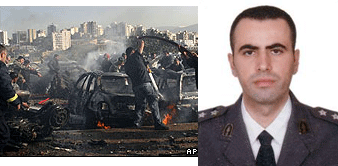
Blast site in Beirut, left; Wissam Eid, right

Another city, another bomb, more deaths. It could be anywhere in the Middle East these days, but I am referring to a bomb that went off in a Christian neighborhood of Beirut yesterday. If you lived in Beirut you would see the devastation without media cleansing. An Arabic report is viewable at http://www.liveleak.com/view?i=70b_1201323034 and needs no translation, but the BBC also has a video report at http://www.liveleak.com/view?i=fc6_1201258935. For the raw footage of the aftermath another video is also on the net at http://www.liveleak.com/view?i=010_1201257690.

According to the latest reports at least five people died, including Wissam Eid, a senior intelligence officer, as well as more than 40 wounded. It was shocking enough in a country that has witnessed so many bombings and bloodshed, most recently the loss of Major General Francois al-Hajj, who was killed on Wednesday by a car bomb. Prime Minister Fouad Siniora has declared today, Saturday, a national day of mourning in Lebanon.

Look at the picture of Wissam Eid, posted above. Look beyond this one face to the mutilated bodies of thousands that die each year from bombs and guns, not just in the Middle East. Are there any tears in your eyes today or is this just somebody else’s problem because it is somebody else’s face? Continue reading Raw Footage →