New Life for the Dead Sea Scrolls


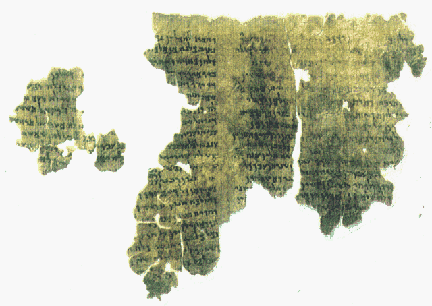
Book of Enoch, Copied ca. 200-150 B.C.E.


Israel to Display the Dead Sea Scrolls on the Internet

By ETHAN BRONNER, The New York Times, August 27, 2008

JERUSALEM — In a crowded laboratory painted in gray and cooled like a cave, half a dozen specialists embarked this week on a historic undertaking: digitally photographing every one of the thousands of fragments of the Dead Sea Scrolls with the aim of making the entire file — among the most sought-after and examined documents on earth — available to all on the Internet.

Equipped with high-powered cameras with resolution and clarity many times greater than those of conventional models, and with lights that emit neither heat nor ultraviolet rays, the scientists and technicians are uncovering previously illegible sections and letters of the scrolls, discoveries that could have significant scholarly impact. Continue reading New Life for the Dead Sea Scrolls
Water Scarcity in Yemen


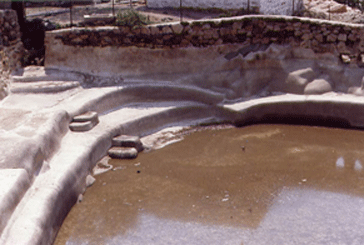
Cistern collecting water in Hayfan

Tomorrow morning I will be giving a presentation at USAID in Washington on the development problems surrounding water resources in Yemen. As almost anyone involved in Yemen’s development knows, the country is rapidly running out of water. The handwriting has been on the wall for some time now, as the following quotes show:

“In general, the cultivators make good use of the water available. What is mostly needed is an increase in supply.” FAO Mission to Yemen, 1955

“Water is the limiting factor in most of the Yemen development projects.” Water Resources Sector Study in the YAR, USAID, 1977

“Water is a scarce resource in Yemen; there is not enough to satisfy present and potential demand.” Water Policy Initiatives for Yemen, CID for USAID, 1980

“… available information indicates that groundwater has been severely overdeveloped.” Irrigation Sector Study, World Bank, 1980

How did this happen? Continue reading Water Scarcity in Yemen

Moroccan Gold in Bahrain

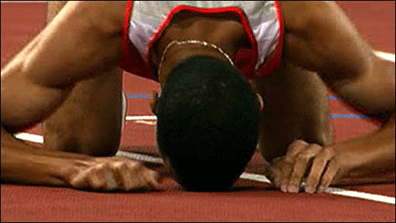
Ramzi storms to 1500m gold medal

BBC News, 19 August, 2008

Bahrain’s Rashid Ramzi held off Kenya’s Asbel Kipruto Kiprop down the final straight to win gold in the 1500m.

Ramzi hit the front with 200m to go and although Kiprop, who set the pace for the first two laps, burst clear of the pack he could not hunt Ramzi down.

Nicholas Willis of New Zealand came third while Great Britain’s Andrew Baddeley finished down in ninth.

Ramzi, who used to compete for his native Morocco, claimed Bahrain’s first Olympic gold medal. Continue reading Moroccan Gold in Bahrain

A Century Ago in Biskra


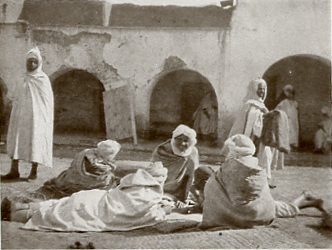
Outside a café: Biskra

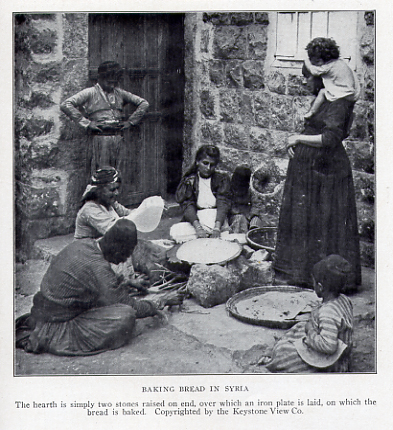
A century brings change, yet memories of the past can still bring life to a quickly forgotten past. Exactly one hundred years ago, if you were to visit your doctor and pick up the latest issue of National Geographic Magazine, you would find a story about Biskra, the oasis in Algeria. Pre-Valentino’s The Sheik, this is rather pedestrian travel dialogue from an author who survives in the text only as a Mrs. But the pictures are truly marvelous and make returning to this century-old magazine well worthwhile. Webshaykh

A visit to the market place during the morning is one of the sights of the town and oriental in every tone. Squatting groups and bronzed-legged Bedouins, in brown and white camel’s-hair burnouses, are selling cous-cous, dried peppers, and of course dates. Bunches of fresh grass and green barley and thistles are heaped in one corner of the inclosure, Moorish slippers here and a pile of red fezzes there, and souvenirs for the tourist not lacking. For fifty centimes one may purchase a set of graceful gazelle horns, and curious knives and Arabian guns tempt the collector on the way. An ebon negress is selling oranges, an Arab boy in a red fez, and not much else, carries a basket of purple fruit in green leaves, while cloaks, burnouses, turbans, and yakmahs, purple, blue, deep red, and spotless white all crushed together, make a kaleidoscopic color in the whitewashed square. Bags of henna leaves, for staining the nails in Arab fashion, send forth their pungent odor, and the aroma of coffee and cigarettes fills the air. A Kabyle girl in red gown, tattooed bluely as to her forehead and cheeks, stained yellow as to her finger tips, passes us, cigarette in mouth, her bangles and anklets clanking as she goes. Continue reading A Century Ago in Biskra

Animal House in the 15th Century: Part 2

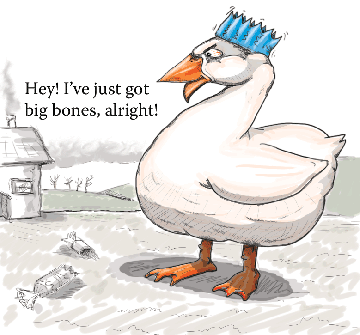
The late 14th century Egyptian savant al-Damiri was introduced in a previous post. His massive Hayat al-hayawan, mostly unknown in English texts, is a treasure trove of esoterica. One way of looking at esoterica is that it is useless information, frivolous and entertaining with little or no pedagogical value. I suppose the same could be said for many of the subjects taught on college campuses, past or present. The previous post focused on remarks about camels, but al-Damiri is not without his pragmatic advice for humans. After all, animals should be our friends and not just our dinner. The following recipe may have few takers in contemporary society, especially the overweight citizens of America; but just in case you ever wanted to know, here is advice on how to get fat:

If you wish a woman to become fat, take the fat of a goose (female), pound it and mix with it borax, Karmânî cummin-seed, and the flour of fenugreek, then mix all together with water, make it into bullets and get a black fowl to swallow them for seven consecutive days, after which it is to be killed and roasted; whoever partakes of it or its gravy will become so fat, as almost to be overpowered by the fat, whether the eater is a man or a woman; but if you wish a person to be still fatter than that, take human bile and place it over as much wheat as can be easily prepared with a little water, then wait until the wheat swells out, after which feed a black fowl on it, and do with the fowl as described before; whoever partakes of that fowl whether a man or a woman will see a wonder of wonders in the shape of obesity and fatness, so much so that he or she will not be able even to stand up; this is a wonderful and tried secret.

Given obesity rates in the United States, I would say that either al-Damiri’s secret is out or it really would be useless advice today.

The World’s Top Intellectual is …

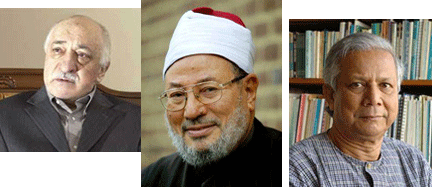
In a world dominated by media celebrities little space is left for intellectuals. Undergraduate students multiple-choice their way through the great lights of the academic past: Freud, Marx, Heidegger, Derrida, Foucault and the list goes on. But who among the living tops the list of brain savy heroes? Foreign Policy held a referendum for four weeks earlier this year in which 500,000 people responded. The idea was to create a list of the world’s top 100 intellectuals. But surprise, the list would seem more a result of who was motivated to respond than anything else. Write down your top three (or at least think about three prominent living intellectuals) and compare to the Foreign Policy list. Continue reading The World’s Top Intellectual is …

Have Felix, will travel

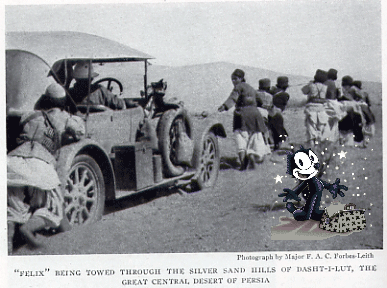
In 1924 Major F. A. C. Forbes-Leith decided to drive a “motor-car” from London to India, a journey that took almost half a year to traverse ten countries. Overall, a total of 8,527 miles were covered, with 3,000 of them devoid of road or track and 1,500 over desert, not to mention detouring around 150 broken bridges. This was three years before Lindy flew from Mitchell Field (next to the university I currently teach at) to France. The rationale for a ridiculously long auto adventure? That was simple: no one had done it before. As Major Forbes-Leith puts it, “Airplanes had already flown to India on several occasions, airships for a regular mail service were in the course of construction, even one of the submarines of the Royal Navy was on its way, but as yet no effort had been made to bridge the distance by mechanical transport.”

Attempting such an adventure at the time no doubt took a sense of humor. In this case the auto was labeled “Felix” after the cartoon character Felix the Cat. Continue reading Have Felix, will travel