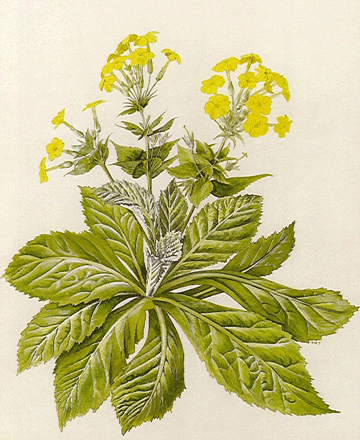
Flora primulaceae


Drawing of a Yemeni primula plant by Hugo Haig-Thomas

Hugo Haig-Thomas–A Biography of a Special Artist
Painter and Diplomat of Her Majesty Queen Elizabeth II. of Great Britain

By John Gilbert Bodenstein, President of The European Art Foundation

It is a pleasure to read the biography of Hugo Haig-Thomas, a special artist of our time. Some artists combine their creative activity with a normal career. In Germany Johann Wolfgang Goethe, for example, produced some of his literary works whilst holding an appointment which occupied him during the day. In France the German writer Rainer Maria Rilke was secretary to the sculptor Auguste Rodin. And the famous European author Ernst Juenger was an officer in both World Wars.

Haig-Thomas likewise was for a number of years a member of Her Majesty’s Diplomatic Service, but throughout his service he continued to paint and draw. Continue reading Flora primulaceae →

Yes, We Qat no Grapes

Yemeni farmers threaten to swap grapes for qat
Saddam Al-Ashmori, The Yemen Times, October 11, 2008

SANA’A, Oct 11 – Yemeni raisin producers have threatened to replace grapes with qat in their plantations after the loss they sustained this year as a result of not being able to sell all their produce.

Nasser Al-Khawlani, owner of a vineyard, said that the reason behind the low demand for local raisins this year was the presence of other cheap and attractive raisins in the markets, smuggled into Yemen from China.

He further said that, if the government didn’t take steps to prevent the smuggling of Chinese raisins into the country, farmers would replace grapes with qat in their lands. Continue reading Yes, We Qat no Grapes →

The PKK as a burden on Iraqi Kurds


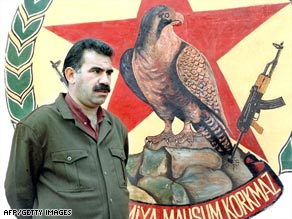
Former PKK leader Abdullah Ocalan, pictured in 1992.

The PKK as a burden on Iraqi Kurds

by IHSAN DAÄžI, Today’s Zaman, October 14, 2008

The outlawed Kurdistan Workers’ Party’s (PKK) attacks from northern Iraq on Turkish targets have turned the Kurdish region in Iraq into a primary target of Turkey.

It is time for the regional Kurdish administration to stop using the PKK as a bargaining chip against Turkey; it is not a time for the Kurdish people of Iraq to side with the PKK out of Kurdish sentimentality. While the former produces no advantages and incites the animosity of Turkey and pressures of the US, the latter ignores the fact that the PKK threatens to undo the gains Iraqi Kurds have made through their long struggle.

What Iraqi Kurds have today, after decades of struggle, is certainly worth preserving and consolidating, and those gains should not be risked by protecting the PKK. Continue reading The PKK as a burden on Iraqi Kurds →

In Jesus’ Name?

As I write this, being Sunday, I have no doubt that we could wipe out the National Debt and bail out every Wall Street firm if we only had a dollar for each time someone recited “in Jesus’ name” today alone. Since Jesus has not yet returned (or surely Pat Robertson would have told us), there is no end of WWJD speculation over this election. In some parts of this country there is an idea that being Christian is the same as being Republican. Blessed are those who smear the character of their opponents: that’s what the Bible ought to say, according to Karl Rove. In the nation’s tightening Bible Belt there are those who think a Christian should never vote for a democrat, as though politics can be read the same way as apocalypse. So it should not be a surprise that the vitriolic rhetoric of Sarah Palin results in the kind of hate speech that makes Obama the same as Osama and rekindles the kind of KKK racism that used to lynch “uppity” black folk. Not long ago a black man could be beaten to death simply for daring to vote, so imagine how grating it must be to the kind of racists who are scared a black man might actually president. Didn’t God curse Ham?

There is no question that prayer is a much better option for this campaign than the hate speech heard at Palin and McCain rallies during the past week. But then, as the country song reminds us, be careful what you pray for. On Sunday at a McCain event in Davenport, Iowa, the crowd was warmed up by a local pastor of the Evangelical Free Church. Here was his prayer, as reported by a blogger at the event:

“There are plenty of people around the world who are praying to their god, be they Hindu, Buddah, or Allah, that (McCain’s) opponent wins. I pray that you step forward and honor your own name.” Ends with “in Jesus’ name.”

Continue reading In Jesus’ Name? →

McCain and Palin Are Playing With Fire

McCain and Palin Are Playing With Fire

By Khaled Hosseini, The Washington Post, Sunday, October 12, 2008; B05

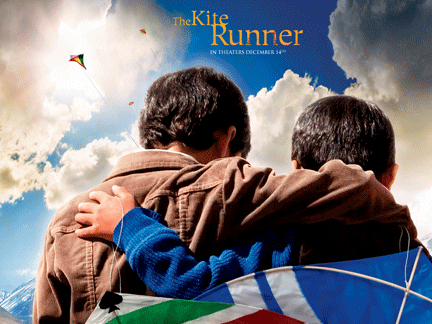
I prefer to discuss politics through my novels, but I am truly dismayed these days. Twice last week alone, speakers at McCain-Palin rallies have referred to Sen. Barack Obama, with unveiled scorn, as Barack Hussein Obama.

Never mind that this evokes — and brazenly tries to resurrect — the unsavory, cruel days of our past that we thought we had left behind. Never mind that such jeers are deeply offensive to millions of peaceful, law-abiding Muslim Americans who must bear the unveiled charge, made by some supporters of Sen. John McCain and Gov. Sarah Palin, that Obama’s middle name makes him someone to distrust — and, judging by some of the crowd reactions at these rallies, someone to persecute or even kill. As a secular Muslim, I too was offended. Obama’s middle name differs from my last name by only two vowels. Does the McCain-Palin campaign view me as a pariah too? Do McCain and Palin think there’s something wrong with my name? Continue reading McCain and Palin Are Playing With Fire →

The Great Chain of Being Racist

Let’s start with the Bible. “Whatsoever a man soweth,” says the King James Version, “that shall he shall reap.” I doubt the Apostle Paul would mind if this verse was clarified for 2008 as “Whatsoever a politician sayeth, that shall he also reap bigtime.” For the past week, as Wall Street was dodging fire and brimstone economic news, the McCain/Palin campaign let loose the doggone attack dog one-liners, claiming that Obama was “pallin’ with terrorists,” mocking the idea of an American with a middle name of Hussein, and asking rhetorically “Who is Barack Obama?” For the vast undercurrent of racist attitudes in America this was red heifer meat, fear mongering in raw form. So who do at least a few (and it seems more than a few) of those listening to McCain and Palin think Senator Obama is? Why, he’s an Arab, of course.

To his credit, John McCain stepped back from the flames of the fire he himself set and set the record straight that his opponent is a “decent man” and a family man and not a scary man. To his discredit, this racist comment is the logical conclusion of many who have listened to his “I am John McCain and I approve this ad” campaign spin. While the government was scrambling to bail out the major financial institutions, in some of the redder side roads off Main Street the Straight Talk Express was spewing out Rove-driven poisonous carbon-copy monoxide. Continue reading The Great Chain of Being Racist →

New Website on Islamophobia in the 2008 Election


[The following statement has been issued by a number of scholars of Islam and Muslim societies to set the record straight on the unfortunate Islamophobia in the current U.S. election. For the statement webpage and a list of the scholar supporting the statement, as well as further resources on the false claim that Senator Obama is a stealth Muslim and distribution of the Islamophobic film “Obsession”, click here.]

Statement of Concerned Scholars about Islamophobia in the 2008 U. S. Election Campaign

Not since the election of John F. Kennedy in 1960 has the religious faith of a U.S. presidential candidate generated so much distortion as the false claims generated by extremist critics that Senator Barack Obama, the candidate of the Democratic Party, is a stealth Muslim. This is part of an Islamophobic hate campaign that fuels prejudice against Americans who practice their Islamic faith and Muslims worldwide. As scholars of Islam and Muslim societies and concerned citizens for a fair and honest electoral process, we wish to set the record straight.

1. Senator Obama has spoken eloquently and widely of his Christian faith and shared his personal beliefs in public forums during the campaign on religious values in American life, including a Compassion Forum on April 13 and a Saddleback Forum on August 16.

2. Senator Obama carries the same exact name as his father, Barack Hussein Obama, who was considered to be an agnostic and not a practicing Muslim by the time he met Senator Obama’s mother. Senator Obama’s mother did not convert to Islam, nor was he raised as a practicing Muslim while growing up in Indonesia and Hawaii.

3. The claim that Obama would be considered an “apostate” by Muslims is false. The vast majority of Muslims accept the Qur’anic message there there is no compulsion in Islam (Qur’an, 2:256). Since Senator Obama was not raised as a Muslim, he cannot be held accountable for the religious status of his father.

4. The politically motivated attack on Senator Obama as a radical Muslim is part of an Islamophobic prejudice in this campaign against American Muslims as anti-American and unfit to hold public office. During the primary season several candidates fueled resentment of all Muslims in politicizing the terrorist attack of 9/11. Recently the anti-Muslim propaganda film Obsession has been sent as an unsolicited DVD to voters in several states. It does not matter if a political candidate is Muslim or Jewish or Catholic or Mormon or Baptist. The President of the United States serves all its citizens, regardless of their religious beliefs. As a state senator and United States senator, as well as in his two books, Senator Obama expresses his belief in the separation of church and state, while accepting the need for greater dialogue between members of all faiths.

5. Regardless of your final choice for the voting booth on November 4, the decision should be based on the crucial issues facing the nation and the individual character of each candidate rather than spurious hate speech that demonizes the faith of some eight million citizens of the United States and more than a billion adherents worldwide.
Literacy through Poetry


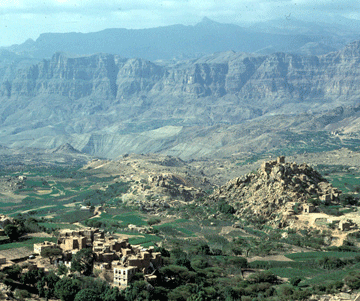
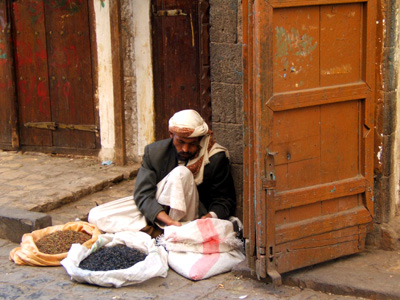
Highland valley of al-Ahjur in central Yemen

The following report was recently published online by dvv international at the Institut für Zusammenarbeit des Deutschen Volkshochschul-Verbandes. It can be read in English, French or Spanish. The report describes an innovative World Bank-funded literacy project coordinated in Yemen by anthropologist Najwa Adra in 2002/2003.

Learning through Heritage, Literacy through Poetry
by Najwa Adra

I have just read Henrik Zipsane’s fascinating article on heritage learning (Zipsane 2007) in the latest issue of this journal. Zipsane describes several highly effective programs for lifelong learning provided by Jamtli Open Air Museum in Sweden. He argues that each person’s heritage includes “many coexisting histories” and that there is a need to provide diverse learning experiences. He suggests that one can learn “through cultural heritage” and not only about this heritage. In a part of the world far from Sweden, geographically and culturally, I too have found that heritage can be an effective learning tool “in the present” and not just an interesting artifact of the past.
The Project

In 2002-2003, I piloted a literacy project for adults in Yemen, on the SW corner of the Arabian Peninsula, in which learners created their own texts through their stories, poems and rhyming proverbs (Adra 2004). 2 Classes began with a discussion of a photograph of a scene familiar to the students or a topic of their choice. Students were encouraged to insert poetry and proverbs into their discussion, as is their custom when discussing issues of importance to them. With the teacher’s help, the class developed a short story based on the discussion. This story, which was written on large paper taped to the wall, along with poems and proverbs generated by the discussion, became the text through which students learned to recognize and read phrases, words and letters of the alphabet. In order to reinforce letter and word recognition, texts often focused on particular letters, words or syllables. Continue reading Literacy through Poetry →