Bashing the academic Left

by David Newman, The Jerusalem Post, April 14, 2009

For the past two years I represented Israel’s universities in the UK in the debate surrounding the proposed academic boycott. There were many who could not accept the fact that a professor with left-of-center views should fill this role. The Department of Politics at Ben-Gurion University where I work has been described by its detractors as being the most left-wing academic department in Israel. After all, they would argue, people like myself are part of the problem, not the cause, and as proof of their argument they would roll out the same two or three names of Israeli academics (most notably Ilan Pappe) who had taken the unprecedented step of actually supporting the boycott. The proposed boycott proved to be a great opportunity for some left-wing bashing rather than focusing on the real problem – the growth of anti-Israel sentiment among specific groups within the UK university faculty union.

The last few years have been “in season” for attacking the academic left, a form of academic McCarthyism that is hard to recollect going back 10 or 20 years. Most pernicious and consistent is the self-styled Campus Watch, created by the neo-con critic of the Israeli left, Daniel Pipes. It uses students and faculty to spy on those teaching courses on Israel and the Middle East. Anyone who so faintly utters a word of criticism is immediately labeled as such, including some of the best critical scholars of Israel today. Continue reading Bashing the academic Left →

Blessed are the Peacemakers?

The Bible is a big book with plenty of quotations for politicians and other enemies of clear thinking. Thomas Jefferson came up with his abridged Bible based solely on the Gospels. He saw value in the ethics but not much in the legal wrangling and superstitions. Now it appears that former Secretary of Defense Donald Rumsfeld took the opposite approach, striking out the blessed beatitudes like “Blessed are the peacemakers” (Matthew 5:9) and “love your enemies” (Matthew 5:44). Who needs that when there is all that hellfire and brimstone and enemy bashing early on? Apparently not Mr. Rumsfeld, nor his adoring boss, Mr. Bush.

It appears that even though the Defense Secretary was not very adept at devising a plan for post-war Iraq security, he did know a thing or two about Photoshop. You can see a slide show of the illustrated covers of his “Worldwide Intelligence Update” (oxymoron that it was) on the GQ website. It is not hard to see why it was given “no distribution” classification. Continue reading Blessed are the Peacemakers? →

An Evening of Gulf Music


Souhail Kaspar

Alwan for the Arts Presents:

Concert: Master Percussionist Souhail Kaspar and Rachid Halihal: An Evening of Gulf Music

Souhail Kaspar – Percussion
Rachid Halihal – Voice and ‘Oud
and special guest artists

Saturday, May 16, 2009 9:00 pm
Doors open at 8:30 p.m.
$20/$15 students with I.D.
Purchase tickets online here: www.alwanforthearts.org/event/348

Watch/Listen to Souhail: youtube.com/watch?v=p6cByvRheZw

The term “Khaliji” has come to represent the culture of the Arab nations of the Persian/Arabian Gulf. The music of these nations has gained tremendous popularity throughout the Arab World in recent years. Continue reading An Evening of Gulf Music →

Gender and Justice in Palestine


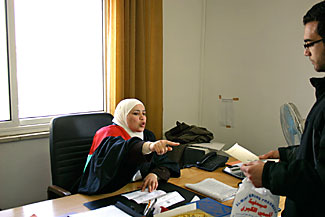
Khouloud el-Faqeeh argues a legal point in her West Bank office. In March, she became one of the two first female Islamic judges in the Middle East.

New female judge transforms Islamic court

Khouloud el-Faqeeh is part Judge Judy, part Sunday School teacher.
By Ilene R. Prusher,The Christian Science Monitor, May 10, 2009

Ramallah, West Bank:

Khouloud el-Faqeeh has shattered the glass ceiling of Islamic jurisprudence.

After years of pushing to break into the all-male ranks of sharia judges in the Palestinian territories, she finally secured a post after scoring among the best – along with another woman – in a recent test for new jurists. They are widely considered to be the first female sharia judges in the Middle East.

Now, Ms. Faqeeh is setting a new tone in her Ramallah courtroom, where defendants are often shocked to see a woman on the bench. With a style that’s part Judge Judy, part Sunday School teacher, she’s on a mission to change her society, case by case. But sometimes, even the most progressive intentions won’t overcome powerful social forces, such as those driving Miryam Abed-Nabi, a newlywed who came to court recently to finalize a divorce. Her husband – Fahmi Awadullah, a man twice her age – took her as a second wife just a few months ago. But the marriage infuriated his adult sons, who worried about their portion of his inheritance. Continue reading Gender and Justice in Palestine →

Bremer vs. History: There Lies the Problem

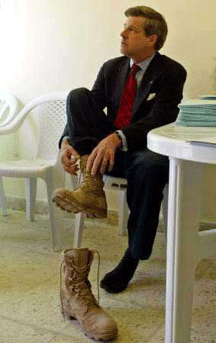
The Iraq War will not go away with a whimper. There are too many callous individuals with a vested interest in suicide bombing and too little real progress in everyday security and opportunity. The pundits, some swirling like vultures and others cooing like doves, are picking apart the pieces of the Bush administration’s bungling. One of the main players, who probably was not booted out too soon, was Paul Bremer, the Old West style sheriff of Iraq from May, 2003 until June, 2004. Among the more controversial decisions made under Bremer was the dissolution of the Iraqi Army. It is hard to find anyone these days who thinks this was a good idea, given that it was an army of conscripts who were quite likely to follow orders and help restore order. But Bremer is cashing in on the pundit circuit. Here is an interview given to the newspaper Asharq Alawsat. Some of the insights are enlightening. For instance, the military found Saddam by getting information freely given by an insurgent with no waterboarding in sight. But on other matters, Bremer lives up to the old saw that history is a pack of lies agreed upon. The only problem is that few people, and certainly few historians, will agree with Bremer. There, of course, lies the problem.

Asharq Al-Awsat Talks to Paul Bremer (Part One)

By Talhah Jibril, Asharq Alawsat, May 12, 2009

Washington, Asharq Al-Awsat – Paul Bremer was the de-facto Governor of Iraq between 11 May 2003 and 28 June 2004 in his role as the head of the Coalition Provisional Authority. As US Administrator of Iraq Bremer was the chief executive authority in the country and was effectively in charge of all Iraqi civil administration following the collapse of Saddam Hussein’s regime, and prior to the creation of the Iraqi Interim government. Bremer’s stewardship of Iraq was plagued with controversy, particularly his decision to disband the Iraqi army, as well as his implementation of the policy of Debathification. Critics have attributed the strength of the insurgency and the worsening situation in Iraq during this period to some of his policies. Continue reading Bremer vs. History: There Lies the Problem →

Advice for the former Vice President

The Old Faithful of Nonsense

By Eugene Robinson, The Washington Post, Tuesday, May 12, 2009

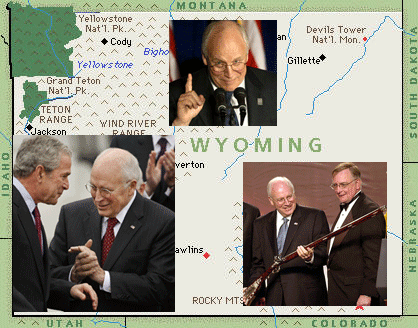
Can’t we send Dick Cheney back to Wyoming? Shouldn’t we chip in and buy him a home where the buffalo roam and there’s always room for one more crazy old coot down at the general store?

For the final act of his too-long public career, Cheney seems to have decided to become an Old Faithful of self-serving nonsense. His latest in a series of eruptions came Sunday on “Face the Nation,” when he continued to press his revisionist case for torture — and, for good measure, counseled his beloved Republican Party to marginalize itself even further from public opinion and common sense. Continue reading Advice for the former Vice President →

Tarim, Islamic cultural capital for 2010


Al-Midhar mosque, Tarim, Hadramawt, Yemen

by Abdulaziz Oudhah, Yemen Observer, May 7, 2009

The Islamic Educational Scientific and Cultural Organization (ISESCO) chose Tarim as an Islamic cultural Capital for 2010, after an agreement was reached during a meeting of Islamic Cultural Ministers in Algiers in 2004. A number of Islamic, Arab, Asian, and African towns were nominated in the process to choose three towns each year to be recognized as Islamic culture capitals.

ISESCO General Manger Abdulaziz al-Tawijri, said that the Islamic capitals program aims to promote the spread of Islamic culture, renew its content, perpetuate its message, and revive the cities’ glorious culture and civilization. The capitals are chosen according to specific standards, which consider the role that they have played in serving Islamic culture, art, science, and knowledge throughout their history. The legacy of these cultural capitals is important to the construction of present and future memory, which is inspired by Islamic civilization. Continue reading Tarim, Islamic cultural capital for 2010 →

When the Fat Lady Sings

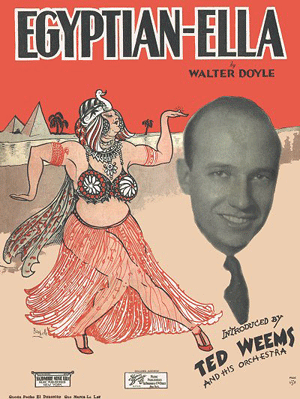
For those fortunate enough to own a MAC computer there is the digital blessing of ITunes. One of the stations listed under “Eclectic” is “The 1920’s Radio Network” which features jazz and vaudeville songs from the 20s through the 40s. Every once in awhile along comes one of those “Oriental” tunes, usually riding stereotypes into the desert on a sand-blasted camel of Araby. One I recently heard manages to offend both Egyptians and obese women (not to mention any serious poet). This is Egyptian Ella, not to be confused with Ella Fitzgerald, who did not debut until four years after this tune was written by Walter Doyle and popularized by Ted Weems and his orchestra.

Egyptian Ella

by Walter Doyle

Ella was a dancing girl who started getting fat
Every day saw three more pounds on Ella
Until one day she found she’d lost her job because of that
And to make it worse, she’d lost her fella
She took a trip to Egypt to forget
And she made such a hit that she’s there yet … Continue reading When the Fat Lady Sings →