Welcome to Ungodly America


Just before the election last November there was an attempt by the extreme religious right to literally do a Jeremiah on candidate Barack Obama. One of the more bemusing commentaries, still prominently posted on the web on an apocalyptic website, is by a Protestant prophet whose visions from God have all come true, as he believes. Thus, either God’s message got garbled in the prophet Steve’s ears or we are living under the most ungodly president ever, in which case the rapture is only a nanosecond away (which may be the real reason Sarah Palin resigned). Take your pick and enjoy (probably not the right word here) the read:

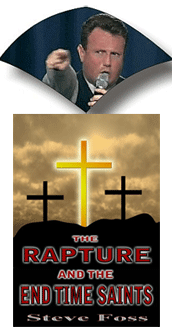
A Prophetic Warning from Pastor Steve Foss

Date: Saturday, October 25, 2008, 12:49 PM

I am writing to you today an urgent message concerning the coming American election. God has released me to share with you a powerful prophecy He gave me eight years ago. I have shared this prophecy in a number of public meetings, but I have never published it for all our friends and partners.

In January of 2000 God gave me an incredible insight into what was about to happen in the coming elections in America over the next decade. I am not using this e-mail to tell you, who are citizens of America, who to vote for. However, you need to hear what the Holy Spirit is saying. Never in my 22 years of ministry have I seen such a spirit of delusion released upon our country. Continue reading Welcome to Ungodly America
The Fortress of Saone and Salah al-Din, 2


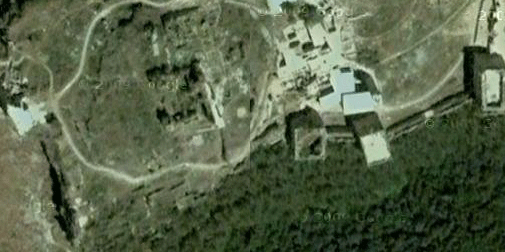
Figure 1: Google Earth map of the southern edge of the fortress area, with north to the top of the picture

[Note: This is the second in a series on a visit to the fortress castle known as Qa‘lat Salah-al-Din, near Lattakiya Syria. For the first, click here.]

Before continuing with my recollections of a tour of the castle fortress of Robert of Saone and Salah al-Din, it might be useful to take an aerial view. Thanks to Google Earth, you can get a bird’s eye view of the fortress, indicated in the above photo (Figure 1) only partially, but available with functions here.

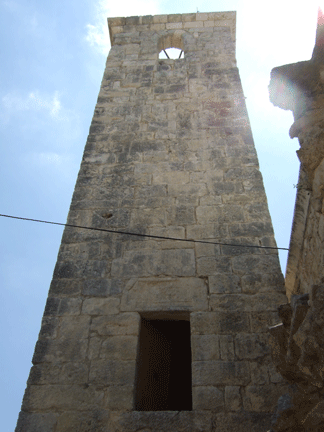
In the Google Earth image above, the formal entrance today is through the tower in the bottom center of the picture, with the mosque and madrasa to the north. The mosque and madrasa were reconstructed with support by the Aga Khan Trust for Culture in 2000. This involved a careful rebuilding of the minaret, which had partially collapsed (Figure 2).


Figure 2: Reconstructed Ayyubid minaret

Continue reading The Fortress of Saone and Salah al-Din, 2

Documenting the Study of Islam

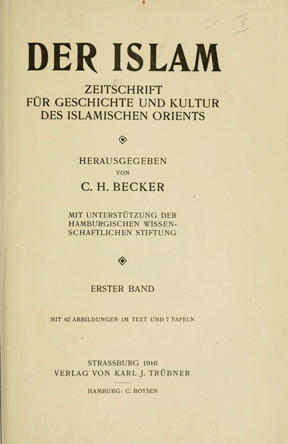
The Internet has become the ultimate research library, especially for older and rare volumes that one used to have to look at only in rare book collections or major university libraries. I noticed recently that several of the earliest journals devoted to the study of Islam now have their earliest versions available online. The extraordinary site, The Internet Archive, now has the first 11 volumes of Der Islam, the first 6 volumes of Die Welt des Islams, and the first 12 volumes of The Moslem World. This is a great resource for scholars, but also worth a browse, especially if you know some German. There is much of value, historical as well as continuing scientific, in these early volumes.

This Ain’t Your Mama’s Revolution: Or Is It?


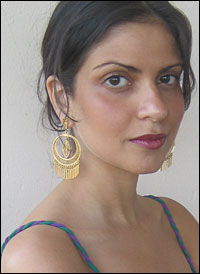
Melody Moezzi, writer, activist, author and attorney

by Melody Moezzi, NPR, July 10, 2009 ·

It has been reported to death since last month’s Iranian presidential election: Young Iranian women are at the forefront of the opposition movement, maybe even at the forefront of the next revolution. What hasn’t been effectively reported, however, is the fact that this isn’t some new, mysterious phenomenon. As an Iranian woman, I can assure you, we weren’t just drinking tea and doing our makeup in the lead-up to all of this.

Women have been fighting for equal rights in Iran for years. Even during the Islamic revolution, women helped lead the struggle against imperialism, for a free and independent nation. They also made huge strides in improving reproductive rights by getting the government to subsidize birth control (hence the acute drop in birthrates after the revolution), and they began entering the work force and universities in ever-increasing numbers. Continue reading This Ain’t Your Mama’s Revolution: Or Is It?

Timbukto and Manuscripts too

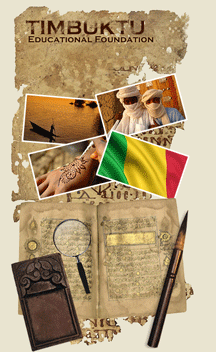
The following information comes from a website devoted to the preservation and digitalization of the many Arabic manuscripts archived in Mali. The main website is http://www.timbuktufoundation.org.

The Timbuktu manuscripts are a symbolic representation of the impact of the early schools and universities (XII-XVIth century) that existed in West Africa (Timbuktu-Gao-Djenné-Kano). However, the manuscripts that remain in Timbuktu are only part of the intellectual heritage of the region because other manuscripts can be found throughout West Africa.

Today, this entire African intellectual legacy is on the verge of being lost. The brittle condition of the manuscripts i.e. pages disintegrate easily like ashes. The termites, insects, weather, piracy of the manuscripts, and the selling of these treasures to tourists for food money pose a serious threat to the future of the manuscripts of Timbuktu. Continue reading Timbukto and Manuscripts too

Poster Martyrs


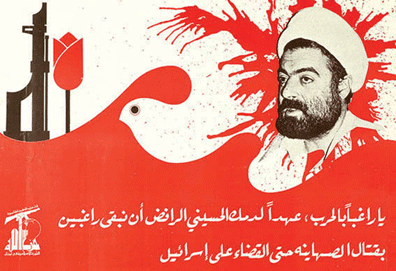
A poster commemorating the second anniversary of the assassination of Sheikh Ragheb Harb, by Merhi Merhi, 1986 (Hizballah Media Office)

by Hicham Safieddine, The Electronic Intifada, July 6

Author Christopher Hitchens might have saved himself a beating had he read Zeina Maasri’s book Off the Wall: Political Posters of the Lebanese Civil War. Hitchens, a self-proclaimed expert on all matters theological and Middle Eastern, was attacked in the streets of Beirut last February after defacing a political poster. The power of posters apparently touched Hitchens himself, who felt compelled to express his vindictiveness by attacking an image. But in a war-ravaged place like Lebanon, images can be a lot more than mere symbols. As Fawwaz Traboulsi explains in Off the Wall’s forward, they can serve as weapons, and Hitchens’ attackers must have understood that quite well.

The power of posters, as not merely symbolic weapons but also sites of hegemonic struggle during Lebanon’s civil war, is a central theme of Maasri’s book. A mix of text and image, the book is a rich and visually engaging work that tackles a dimension of war long-neglected by Lebanese historians. A sample of 150 posters (out of 700 the author has examined) in full color and printed on laminated paper occupies the center of the book and it is hard to begin reading before going through them: portraits of “heroic” leaders of all factions, clenched fists facing enemy guns, silhouettes of martyrs and landscapes of religious and nationalist symbols overlooked by dominant war figures, many marked with slogans that range from the racist to the revolutionary. But the book is a lot more than a slideshow of images summing up defining moments of the war or a straightforward critical review of the posters. Maasri delves into questions of theory, representation and meaning that shaped and defined the art of poster-making and the politics of their interpretation during times of conflict.

For the rest of this article, click here
.

Transhumance in Tarkumia

Transhumance in Tarkumia: An Exploration of Aspects of Palestinian Summer Identity This Week in Palestine

“Exploration is not so much a covering of surface distance as a study in depth: a fleeting episode, a fragment of landscape or a remark overheard may provide the only means of understanding and interpreting areas which would otherwise remain barren of meaning.” Claude Levi-Strauss, Tristes Tropiques (1955)

The three-month summer vacation from schools liberates Palestinian families from the constraint of the temporal rhythm of school and from the constriction of space. The students are free, but the parents are equally liberated. This temporal space provides ample opportunities for exploration of self, of other, of place, and of time by means of travel. Travel is usually thought of as a displacement in space. This is an inadequate conception. A journey occurs simultaneously in space, in time, and in the social hierarchy. Each impression can be defined only by being jointly related to these three axes, and since space is itself three-dimensional, five axes are necessary if we are to have an adequate representation of any journey.

Travel is a form of exploration, a spark to the imagination, a quest, commerce, escape, and a means of self-discovery. Continue reading Transhumance in Tarkumia

Tracing the History of Qat


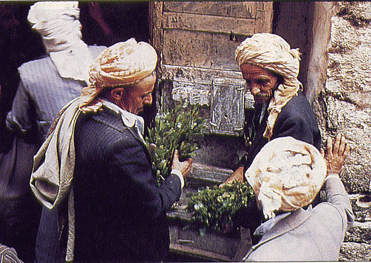
Selling qât in Yemen. Photo by Pascal Maréchaux

Much has been written, pro and con, about the chewing of qât leaves in Yemen. In addition to the economic and social problems over qat, there is a historical puzzle. When and how did the plant Catha edulis come from Ethiopia, its botanical origin, to Yemen? Yemeni legend and folkore suggest that the stimulant qualities of qat leaves were first discovered by a goatherd who noticed the effect on goats who browsed on the plant. A variant of this goat legend, told to me in 1979 by a poet from Husn al-‘Arus, suggests that an Ethiopian came along to explain to the goatherd what was happening. The goat is one of the few animals that can be seen occasionally eating qât leaves, but the story is surely apocryphal. Sometimes it is told for the origin of coffee, another stimulant brought from East Africa. Continue reading Tracing the History of Qat