Waking from its sleep

[Webshaykh’s Note: This week’s Economist has a special section on the Arab World that is well worth reading. Here is the teaser online.]

from The Economist print edition, July 23, 2009

WHAT ails the Arabs? The United Nations Development Programme (UNDP) this week published the fifth in a series of hard-hitting reports on the state of the Arab world. It makes depressing reading. The Arabs are a dynamic and inventive people whose long and proud history includes fabulous contributions to art, culture, science and, of course, religion. The score of modern Arab states, on the other hand, have been impressive mainly for their consistent record of failure.

They have, for a start, failed to make their people free: six Arab countries have an outright ban on political parties and the rest restrict them slyly. They have failed to make their people rich: despite their oil, the UN reports that about two out of five people in the Arab world live on $2 or less a day. They have failed to keep their people safe: the report argues that overpowerful internal security forces often turn the Arab state into a menace to its own people. And they are about to fail their young people. The UNDP reckons the Arab world must create 50m new jobs by 2020 to accommodate a growing, youthful workforce—virtually impossible on present trends. Continue reading Waking from its sleep
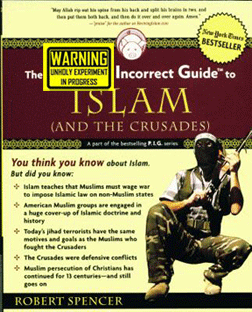
Watch Out for Jihad Watch

Among the cyber Islamophobes, few are more obsessed than Robert Spencer, a self-styled expert whose The Politically Incorrect Guide to Islam (and The Crusades) should be published in a new version without the word “Politically” in the title. Spencer writes for a specific audience, either those who already hate Muslims or others lacking the knowledge and common sense to see through his rhetorical jihad against Islam. There are numerous rebuttals to Spencer’s work available on the web. Some of the best comes from the pen of Dr. Khaleel Mohammad, whose website is worth looking at.

I attach below an excerpt from Khaleel Mohammad’s “Robert Spencer’s Obsession With Islam: What Would Jesus Do?” published in The American Muslim, September 30, 2008.

Here is something that Spencer might consider next time he chooses to pray to the Creator—while ranting and raving about Islamic radicalism and the threat it presents. Spencer should examine himself and his agenda and motivation closely. The danger to this country presented by radical Islamists is an overt one and is being confronted. Spencer, on the other hand, turns a blind eye to the extremists who are not Muslim who would see this country turned into a theocracy that imprisons people simply because they are Muslim. Continue reading Watch Out for Jihad Watch

Even Iraqi Snakes are Terrorists


The Desert Horned Viper lurks in sand, only eyes, nostrils and horns above the surface.

Webshaykh’s Note: Cyberspace harbors a host of apocalyptic websites that relate current events in the Middle East to biblical prophecy. From the site Heaven Awaits it would seem that even Iraqi snakes are suspected of being terrorists… after all these snakes have horns. The following commentary stems from a news item in The Independent.

Snakes preparing the way for demons?

from Heaven Awaits website

The Desert Horned Viper lurks in sand, only eyes, nostrils and horns above the surface. Interesting ….that it has “horns.”

The Bible predicts that the Euphrates River will dry up, and demons will come out. See the latest headlines from Iraq. Continue reading Even Iraqi Snakes are Terrorists

Smoke Rises in the Middle East


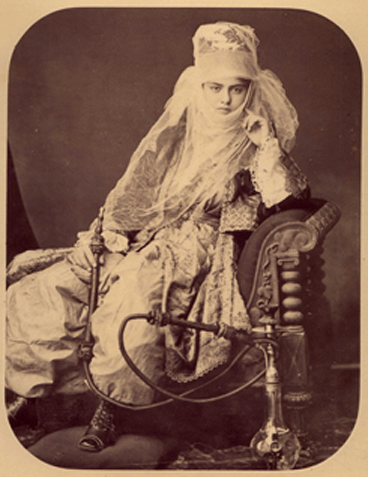
Hooked on Hookah, 1909

No, this is not another post about terrorism, nor the violent protests following the recent Iranian election, nor more reports of suicide bombs in hotel lobbies. The smoke from these tragedies is not about to disappear any time soon. The smoke I am talking about is from the tobacco industry. Newsweek (July 27 issue) provides a breakdown of smokers worldwide. While China leads all populations with almost 334 million smokers (32% of the overall population), they are actually lower percentage wise than Turkey with its 19 million users, accounting for 36% of the population. Other Middle Eastern countries surveyed fare a bit better than the United States (24% of the population) with 21% (28 million users) in Pakistan, 17.6% (9 million users) in Iran and only 14.2% (2.4 million users) in Iraq. I suspect even these numbers are under reported, given the ubiquity of cigarettes in the region. Health warnings or not, tobacco is still sultan in the Middle East and indeed the entire world. Continue reading Smoke Rises in the Middle East

Eyes Wide Shut

Eyes wide shut in the Islamic world

by Tarek Fatah, Globe and Mail, Toronto

THE CRISIS IN ISLAMIC CIVILIZATION by Ali A. Allawi. Yale University Press, 320 pages, $33.50

LOST IN THE SACRED: Why the Muslim World Stood Still by Dan Diner. Princeton University press, 214 pages, $35.95

The Muslim world seems to be caught up in a crisis that shows no end in sight. If there is a single image that reflects this ongoing catastrophe, it is captured in the haunting eyes of a dying Neda Soltani, the 24-year-old woman shot dead on the streets of Tehran.

Since Bernard Lewis’s tome What Went Wrong, much has been written on this subject. Now, two books shed new light on the fall and decline of Muslim civilization. Both authors, Ali Allawi, an Iraqi politician-academic who teaches in the U.S., and Dan Diner, a Jewish professor of modern history in Germany, not only study the decline, but also look into the reasons why attempts to resuscitate the Ummah have failed. Continue reading Eyes Wide Shut

Flipping through Late 19th Century Yemen

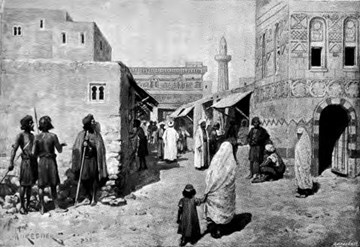
My fascination with flipbooks continues. For an interesting read about Yemen just over a century ago, check out the flipbook version of Walter Harris’s travel account. This has a number of illustrations, as illustrated above.

Among his exploits, Harris obtained an interview with the Sultan of Lahj at the time. Here is his description of the trial of smoking a hubble bubble:

The hubble-bubble was a sore trial. I was gradually, under the guidance of Said, learning to inhale it; but to have constantly to fill my lungs with the strong smoke was by no means a pleasant task to a novice like myself. Continue reading Flipping through Late 19th Century Yemen