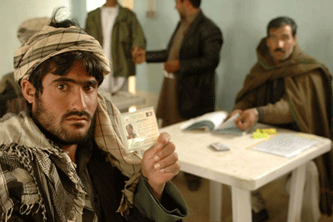
Burns on Afghanistan
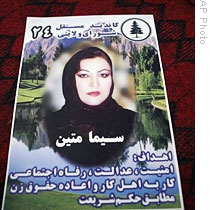
An election poster in Kapisa province for Sima Matin, a female candidate in a provincial council election, 28 Jul 2009
John Burns Answers Your Questions on Afghanistan
By John F. Burns, The New York Times, August 19, 2009
After more than 30 years as a Times foreign correspondent, I’ve grown used to looking out of the aircraft or jeep or train on arrival in unfamiliar and often inhibiting terrain, and wondering with a mixture of anticipation and anxiety how quickly, and capably, I’ll get my professional bearings — and justify the editors’ faith in assigning me. The boundary I’ll be crossing with this new venture for “At War,†our new and expanded blog on the conflicts of the post-9/11 era, is a different kind of challenge — but just as daunting, in its way, as those old forays into unknown lands.
In the first 48 hours after our Web editors invited readers to send in their questions, more than 220 of you responded, a degree of interest that is encouraging for what it suggests about the potential for us at the Times of this kind of interactive journalism. Just as much, the flow of questions, and the sophisticated commentaries woven into many of them, have been a reminder of how much many of our readers already know about the complex challenges America confronts abroad. Continue reading Burns on Afghanistan
Islam gets a Saudi facelift
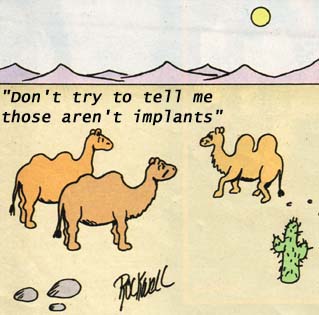
Under the Veil, Nip and Tuck Makes New Saudi Faces
Asharq Alawsat, March 8, 2009
RIYADH, Saudi Arabia, (AP) — Does Islam frown on nose jobs? Chemical peels? How about breast implants?
One of the clerics with the answers is Sheik Mohammed al-Nujaimi, and Saudi women flock to him for guidance about going under the knife. The results may not see much light of day in a kingdom where women cover up from head to toe, yet cosmetic surgery is booming.
Religion covers every facet of life in Saudi Arabia, including plastic surgery. Al-Nujaimi draws his guidelines from the consensus that was reached three years ago when clergymen and plastic surgeons met in Riyadh to determine whether cosmetic procedures violate the Islamic tenet against tampering God’s creation. Continue reading Islam gets a Saudi facelift
On Fascist-Islamophobia
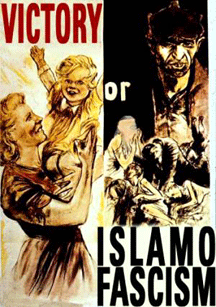
The Self-Fulfilling Prophecy of a Clash of Civilizations
Excerpt from “Fascist-Islamophobiaâ€: A Case Study in Totalitarian Demonization by Dr. Robert Dickson Crane, published in The American Muslim, October, 2007. To read the entire article, click here.
The future of America and of global civilization will depend on whether and when the leaders of each of the world’s nations can join to bring out the best of each civilization in order to build a single civilization of global pluralism. The purpose must be to bring out the best of the past in order to build both for the present and the future a global federation of independent nations in the pursuit of peace through compassionate justice.
The opposite alternative is mutual demonization whereby members of one civilization join the extremists of another in supporting the extremists’ perversion of their own religion. In practice this would bring out the worst of the past to paralyze the present and destroy the future.
The many books by Robert Spencer and a host of lesser professionals in demonization typify a genre of books that have captured the imagination of an entire nation. Amazon’s list of books on Islam and Muslims available for purchase in the Year 2007 exceeds 75,000. Of the first 400 listed, fifty could be classified as Islam-bashing, and half of these are militantly or extremely so. A critique of any one of them could serve as a critique of them all, though Robert Spencer’s book is perhaps the most sophisticated in its virulence. The basic theme is a self-fulfilling prophecy that brands Islam as inherently terrorist and thereby provokes Muslims to become exactly what they are said to be. Continue reading On Fascist-Islamophobia
Hubble Bubble among the Rubble

A picture is worth a thousand words. Here we see the hubble bubble among the rubble. Only in Lebanon.
Hashish in the Muslim World
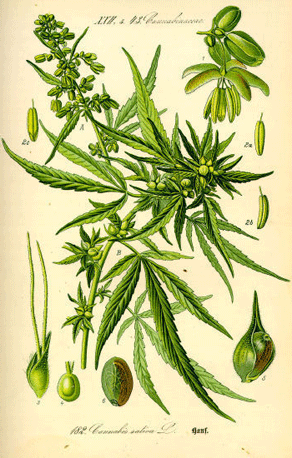
Webshaykh’s note: In the process of researching the medical aspects of the chewing of qât (Catha edulis) leaves in Yemen, I consulted an important study published almost forty years by the distinguished historian Orientalist (in the best sense — and there is a best sense — of the word) Franz Rosenthal. This was his The Herb: Hashish versus Medieval Muslim Society (Leiden: Brill, 1971). Appearing at a time when hashish had become a household word in America, Rosenthal sorts through legal, medical and literary sources to provide a historical overview of the issues surrounding the use of hashish, the plant known as qinnab in Arabic (Cannabis sp). This is a valuable resource, but also worth a good read to get a sense of how an addictive socially popular drug was viewed for almost the last full millennium. Fortunately for those of us who cannot afford massive libraries, this book is available as a Google Book online. I quote from the conclusion.]
Hashish, the Individual, and Society
In conclusion we must state again that our knowledge is very limited. The gaps are tremendous. The nature of the information we do have is not easily assessed. Its applicability to the realities prevailing over the immense extension in time and space of medieval Islam is often suspect. Partisanship pro or con, coupled with a seemingly widespread ignorance of hard facts, obscures everything. Statistics naturally are non-existent.
Our sources give the impression of a westward march of hashish that had its serious beginnings int he twelfth century and gathered speed during the thirteenth century. Continue reading Hashish in the Muslim World
Iranians in The Mist
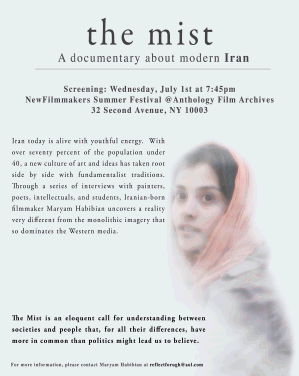
Demystifying Iran
by Noor Iqbal, Foreign Policy in Focus, July 29, 2009
Post-election turmoil in Iran has brought the country closer to the top of America’s foreign policy concerns. More importantly, though, it has piqued the interests of the American public. Green is the new black, Moussavi and Khamenei have become household names, and tweeting about Iranian politics has never been more popular.
But what is Iran like beyond its politics and the Western media hype? Iranian-born filmmaker Maryam Habibian tackles this question in her most recent documentary, The Mist. The film delves into the lives of young artists, poets, playwrights, and intellectuals in Iran whose creative energy flourishes alongside fundamentalist traditions. It explores the balance they reach between artistic expression and the limitations of a conservative political regime. Habibian shows her viewers another side to Iran, one that has been largely overlooked by conventional media. She is committed to showing her audience that a society cannot be defined solely by its political system and that when it comes to Iran, we are not facing a clash of civilizations.
Her film was recently screened in New York City as part of the NewFilmmakers Summer Festival.
NOOR IQBAL: What motivated you to make this film? Continue reading Iranians in The Mist
Love Trumps Religion in Yemen
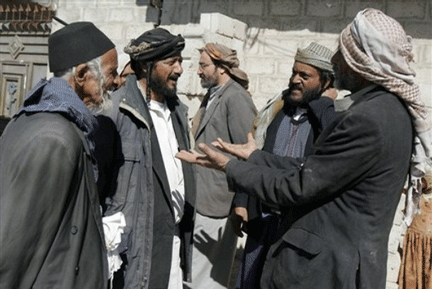
Yemeni Jews and Muslims talk at the village of Kharef, 50 miles, 80 kilometers, north of the capital Sanaa, Yemen, Monday, Dec. 15, 2008. Photograph by Mohammad al-Qadhi, AP
Complete Story of Jewish Liya’s Islam, Divorce and Marriage
Yemen Post, July 26, 2009
Over the recent period, the issues of Jewish minority have been hitting the titles in media outlets and their news is widely covered at local and international levels.
These news stories range from “Ninawa†embracing Islam and getting married to “Hani Saranâ€, forced migration of “Al Salem Jews†from Sa’ada and granting them apartments in the Sana’a Tourism City after being threatened by Houthis, killing incident of Masha Ya’aish at the hands of a former military pilot to the two-time marriage of “Liya†bint Sa’eed in a week and later her elopement with her Muslim husband to the nearby Arhab tribe and later on to the Al-Souk Al-Jadid in Amran’s Kharef area. Continue reading Love Trumps Religion in Yemen