From Islamist Watch to Islamic Mimbar: The Politics of Hypocrisy


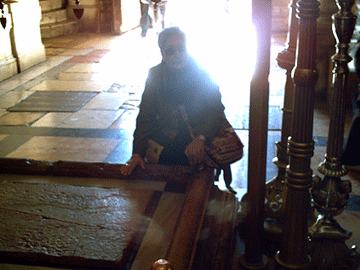
Raheel Raza at the Church of the Holy Sepulchre in Bethlehem

by Huma Dar, Dept. of South and Southeast Asian Studies, University of California at Berkeley

On Thursday, June 10, 2010, Jerome Taylor, the Religious Affairs Correspondent of The Independent posted an article headlined, “First Woman to Lead Friday Prayers in UK.” Two-thirds of the way down this article, we find that:

“Ms Raza’s appearance in Oxford is a repeat of a similar prayer session in 2008 which was led by Amina Wadud, an American-born convert and Muslim feminist. But this is the first time a Muslim-born woman will lead a mixed prayer service in Britain.”

Taylor’s differentiation between “American-born convert” and “Muslim-born woman” and labeling of the latter as the “first woman” in the headline create a false hierarchy and subtly delegitimize Dr. Wadud, a leading Muslim scholar and author of Qur’an and Woman: Rereading the Sacred Text from a Woman’s Perspective, a path-breaking text in the study of gender and Islam. Taylor’s late admission of “repeat” after the (mis)leading announcement of “First” in the headline does not quite cover up for the critical sins of omission and commission, especially as Raheel Raza, the Pakistani-Canadian woman leading the prayer at Oxford, is neither an ‘Alima or a scholar of Islam nor is she known for her advocacy of Muslims at large.

In fact Raza is a rather polarizing figure amongst Muslims in North America and her record does not indicate much learning in the letter or spirit of Islam, as in speaking truth to power and standing with the oppressed. Continue reading From Islamist Watch to Islamic Mimbar: The Politics of Hypocrisy

Death to Arabic?


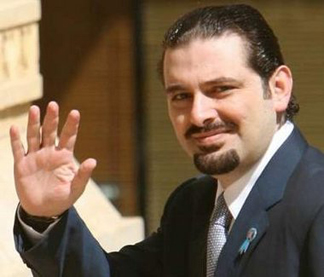
Saad Hariri


Arabic will die out if it is locked up in classrooms
by Achraf El Bahi, The National, April 08. 2010

In his inaugural address to parliament last December, the Lebanese prime minister Saad Hariri kept mispronouncing words and whole phrases in Arabic, smirking the entire time.

Not only did the Georgetown-educated, English-speaking Mr Hariri laugh at his mistakes, but he also cackled when Nabih Berri, the speaker of parliament, asked him if he needed someone to help him out.

Being bad at Arabic is almost like being bad at an obscure sport, say croquet: no one particularly cares if you fail to grasp the quaint and overly complex techniques needed for mastery of the subject.

In Lebanon, French is the language of the learned and the sophisticated. The same is true in Algeria, Tunisia, Morocco and other former French colonies in the Arab world. Failing to speak proper French in those countries is a handicap in professional and social life. Continue reading Death to Arabic?

Satire is Religion


Birth and Origin of the Pope by Lucas Cranach, illustration for Martin Luther’s “Against the Papacy at Rome, Founded by the Devil,” 1545

Satire is Religion

By Austin Dacey, Religion Dispatches, May 12

Scatological humor. Crude drawings mocking revered religious figures. I am speaking, of course, of Lucas Cranach’s Birth and Origin of the Pope [image above], one in a series of woodcuts commissioned by Martin Luther in the 1540s under the title “The True Depiction of the Papacy.” In it, an enormous grinning she-devil squats in the foreground, excreting the Pope along with a heap of bishops while in the background another infant pontiff suckles at the teat of a serpent-haired wet nurse.

Forget the South Park dust up; forget Everybody Draw Muhammad Day. If you want to see truly shocking anti-religious cartoons, you have to go back to the sixteenth century. Near the end of Luther’s life, his propaganda campaign against Rome grew increasingly vitriolic and his language grotesquely pungent. He took to calling his ecclesiastical enemies ‘asses,’ ‘dogs,’ ‘pigs,’ ‘blockheads,’ ‘basilisks,’ and ‘pupils of Satan,’ and the Pope himself ‘Her Sodomitical Hellishness’ and ‘fart-ass’ (no, it doesn’t sound much more dignified in German—fartz-Esel). Eric Cartman would be in awe. Continue reading Satire is Religion

Last day in Lamu


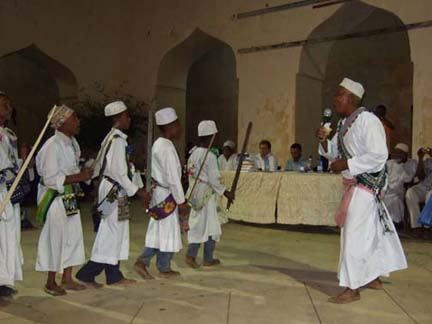
Chamba dance in Lamu Fort

I am sitting in the lobby of Lamu House on the delightful Swahili island of Lamu, my last day after a seminar sponsored here by the Rift Valley Institute on the Horn of Africa. On Wednesday night I attended a reception given by the Lamu museum and other respected officials and members of Lamu town. The highlight of the evening was a performance in “The Fort” of the Chamba wedding dance, a slow-moving line dance with swords and sticks held steadily. On Saturday I went on a dhow trip with Captain Abu (anyone going to Lamu should ask for Abu; he is superb and knows the area well, and the Rasta man Hasan is a fantastic cook) and met Muhammad Famou Othman, head of the dance troop, who took us on a tour of his village.

On Monday I delivered a talk to the Lamu community in The Fort. The talk was in English and I will post it here anon. But I also gave a brief introduction in Arabic, which was well appreciated. I would very much like to learn Swahili now and inshallah return to Lamu to do research on those here who have Yemeni ancestors.

My last day, chilling in a rather warm climate but with a strong breeze.

Eclipse of the Greater Jihad

Eclipse of the Greater Jihad
by Syed Manzar Abbas Zaidi, Journal of Religion, Conflict, and Peace, Volume 3. Issue 1, Fall 2009

[The following is a brief excerpt from an interesting article on the debate over the “greater jihad” in light of Quranic and hadith references. I recommend reading the entire article, which can be done by clicking here.]

The word jihad derives from the Arabic root jhd, signifying intense struggle or effort. It has the connotations of a moral struggle within one’s own self, besides denoting an armed struggle. It thus carries the hermeneutical meaning of a moral endeavour directed toward one’s own improvement or self-elevation on a moral plane, which Muslim jurists of eminence have been quoted as calling jihad-e-akbar, or greater jihad. On the other hand, preparations and participation for defense against an armed conflict that is the consequence of foreign aggression has been known as qitaal, or jihad-e-asghar, lesser jihad… Continue reading Eclipse of the Greater Jihad

Ibn al-Mujâwir and the al-Huthi Rebellion


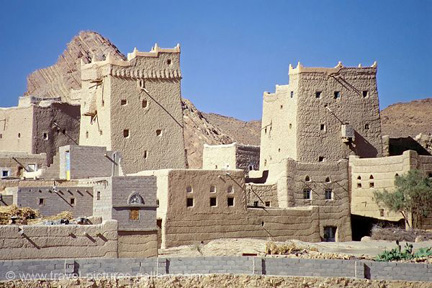
Traditional buildings in Sa‘da, Yemen

Over the past few years a major civil war has been simmering, at times brewing over into neighboring Saudi Arabia, in the north of Yemen. It has been called the al-Huthi rebellion and much of the fighting took place around the historic town of Sa‘da, the main entry of the Zaydi imams in the 10th century C.E. The exquisite travel text of Ibn al-Mujâwir, penned and quilled in the early 13th century, has a brief account of the overall region. Here is what Ibn al-Mujâwir, as ably translated by G. Rex Smith, said:

A description of these areas. The [previous] informant, [al-Kirmani], informed me as follows: All these areas [are made up of] settlements similar in size to one another to a greater or lesser degree. Each settlement has its own people. Every Arab tribal group and even bedouin section is [represented] in a settlement. As a result of their behaving badly [towards others], no one can settle with them, either on a temporary or a permanent basis.

A stronghold of stone and plaster has been built in every settlement and everyone living in the settlement has a store in the stronghold in which he keeps all his possessions, taking only from it what he needs on a daily basis. the inhabitants of the settlement surround the stronghold on all four sides. Each settlement is ruled over by an old shaykh of some power, clever and intelligent. When he gives a ruling, no one else shares in, nor opposes, what he advises them to do and what judgement he gives. There is no other authority ruling over all those in these areas and they pay no tax, nor do they hand over any levy at all, except whatever one wishes. thus they are constantly fighting, one getting the better of another’s wealth and the relatives of Zayd taking the wealth of ‘Amr. They do this all the time.

Their crops are wheat and barley; their trees are vines, pomegranates and almonds. All [kinds] of fruits and choice things are to be found among them. Their food is ghee and honey and they [bask] in their God[-given] ease and security. They are tribes who go back to Qahtân and others in their family trees.

Quoted by Ibn al-Mujâwir in his early 13th century travel text, translated by G. Rex Smith, A Traveler in Thirteenth-Century Arabia: Ibn al-Mujâwir’s Târîkh al-Mustabsir (London: The Hakluyt Society, 2008), p. 65.

Horn Talk in Lamu


Dhow near Lamu at sunset

I am writing this from the exquisite Island of Lamu in Kenya. As someone who has spent over thirty years rambling around Yemen, across the Gulf of Aden, it is quite eye-opening to take a look up at the southern part of the Arabian Peninsula from an African perspective, especially a view that has been influenced in many ways by earlier generations of migrants from Yemen. It would be nice if I was here only because it is such a beautiful tourist spot with a rich cultural heritage, and indeed all this is nice, but I am actually attending an annual seminar on the Horn of Africa hosted by the Rift Valley Institute. The organizers recognized that cultural history and contemporary politics in the Horn can hardly be separated from Yemen, which lies so close across the Red Sea and Gulf of Aden. Hence I was invited to contribute on the links between Yemen and the Horn and also to discuss the relevance of Islam and the contentious issue of “Islamism.” Continue reading Horn Talk in Lamu

Iraqi Student Project


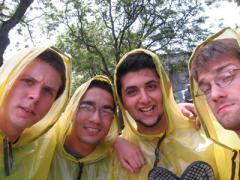
Iraqi students on road trip to Niagara Falls

[Editor’s Note: Below is information about an organization devoted to helping Iraqi students. Details are at http://iraqistudentproject.org/]

Iraq: A Cradle of Civilization in Ruins

Iraq’s people were among the first to learn irrigation, to invent the system of writing sounds that is key to our own alphabet, to create a legal system that is the foundation of modern law. During the early Islamic centuries Iraq was a center where ancient learning was translated and preserved, where poetry and music and medicine flourished. In modern times Iraqis have built a thriving system of higher education and have sent thousands of students to study all over the world, returning to teach and work in Iraq. Western institutions of higher learning benefit from the contributions to scholarship and human development that have taken place across the centuries in Iraq. Continue reading Iraqi Student Project