Berbers out of Yemen?


Why they thought the Berbers came from Yemen

by Lameen Souag, Jabal al-Lughat, June 23, 2010

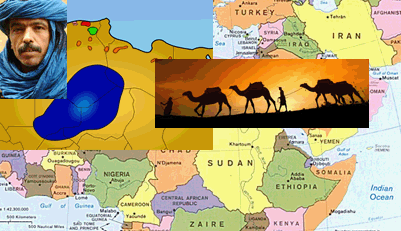
A long-standing tradition in North Africa, convincingly rejected by Ibn Khaldūn but perpetuated by poets and curricula alike, claims that some major Berber tribes descend from Yemeni Arabs through semi-mythical pre-Islamic kings and their wholly mythical vast conquests. This idea has little to support it, and probably became popular because it allowed these tribes to claim prestigious connections in the context of a high culture dominated by Arab ideas; but why should the connection be specifically Yemeni, rather than, say, North Arabian or perhaps Persian? Linguistics suggests a possible answer. Continue reading Berbers out of Yemen?
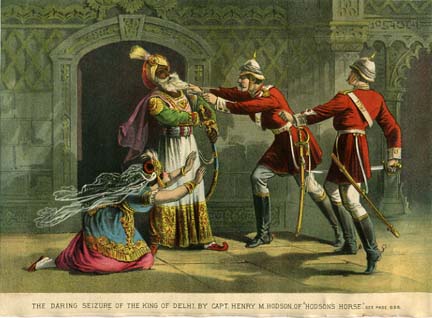
Colorful Lithographic Orientalism #4: Delhi

As noted in a previous post, I recently went through a late 19th century scrapbook that belonged to my great, great aunt. She had cut out pictures that interested or amused her. Several of these have Orientalist themes. Sometimes a picture is worth a thousand words; other times the picture says enough for itself. In this series, I leave the image to speak for itself. If you would like to comment on what you see or imagine, please do so in the comments section.

For #3, click here.

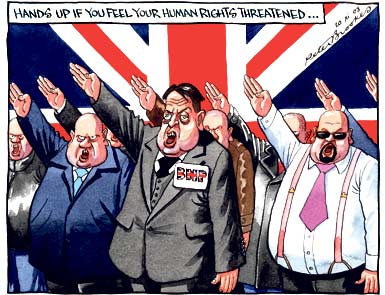
The racist fascist in the Queen’s Garden, the fundamentalist preacher on the plane


by Gabriel Marranci, Islam, Muslims, and an Anthropologist, June 21

Recently two events made me question how the UK, and Europe in general, understand the concept of ‘freedom of speech’ – the invitation to attend the annual Buckingham Palace garden party extended to white supremacist BNP’s Nick Griffin and the Home Secretary’s decision to ban the popular Muslim tele-preacher Dr Zakir Naik from entering the UK.

There is no one single definition of ‘freedom of speech’ and an attempt to formulate one can only result in empty theorizing and utopian visions. Freedom of speech is linked to local, regional and international contexts, social realities, cultural differences and an understanding of what freedom means. What for one person is ‘freedom of speech’, for another is just ‘freedom of insult’ or ‘unacceptable behavior’.

States, as well as communities, limit individual rights of expression not because of the pleasure of doing so, but for fear of seeing their status quo, and hence power, challenged or questioned. However, the limitation of individuals’ right to express their thoughts and ideas is often justified by the argument that those ideas are ‘repulsive’ or ‘objectionable’ to the system of values held by a supposed majority (i.e. power holders). Said that, many of the ideas, values and concepts that are both well accepted and well liked today have been considered ‘objectionable’ or ‘repulsive’ at one time or another. Continue reading The racist fascist in the Queen’s Garden, the fundamentalist preacher on the plane

The future of Islam in Europe


by Khalil El-Anani, Al-Ahram, 17-23 June, 2010, Issue 1003

The current Western obsession with the niqab, or full- face veil, often seems part of a subconscious plot to restrict anything Arab and Islamic, symbolic as that may be. The niqab is not really Islamic garb, this I am sure something that Western politicians know. And yet it is becoming a target of hate because it is seen as a cultural symbol that is extraneous, and indeed dangerous, to European societies.

Sometimes I wonder, what if it were Indian women, or Sikhs and Buddhists for that matter, who wore the niqab ? Would European parliaments still spend entire sessions discussing the niqab ?

Theological debate on niqab aside, Western outrage against the niqab seems to be a by-product of Islamophobia, a phenomenon that is raging like wildfire across Europe, asserting itself sometimes as mosque- phobia and at other times as minaret-phobia. Should this trend continue, the day may come when European parliaments ban men from wearing their beards long and shaving their moustaches. I wonder what kind of phobia we’ll name that one! Continue reading The future of Islam in Europe

Kafka, Egyptian Style


Atef Botros’s Kafka Study
A Jewish Writer from the Arab Perspective

Franz Kafka (1883-1924)

by Julian Tangermann, Qantara, June, 2010

Passionate literary criticism? Is this possible? As an academic discipline it is forbidden from emotion or passion. Nevertheless in Atef Botros’s Kafka, ein jüdischer Schriftsteller aus arabischer Sicht (Kafka, a Jewish writer, from the Arab perspective) this question is posed anew.

His well-founded, comprehensive critical analysis of Kafka’s reception in the Arab world closes with a passionate appeal for freedom in the Middle East. This does not, however, impair the academic rigour of the work in the slightest. In fact, his concerned, incisive view of the Middle East conflict and his excellent literary criticism feed off each other and make this work what it is.

The bulk of the book is concerned with the analysis of Kafka’s reception in the Arab world from 1939 to the present day; with how Kafka’s works have been understood and interpreted over the last seventy years in Arab countries and cultures. It posits three phases of responses to Kafka during this period, which are all examined according to their social, intellectual and literary implications. Continue reading Kafka, Egyptian Style

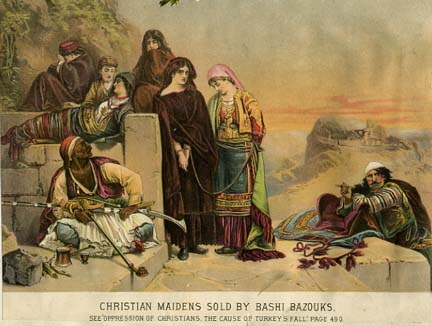
Colorful Lithographic Orientalism #3: Bazouks

As noted in a previous post, I recently went through a late 19th century scrapbook that belonged to my great, great aunt. She had cut out pictures that interested or amused her. Several of these have Orientalist themes. Sometimes a picture is worth a thousand words; other times the picture says enough for itself. In this series, I leave the image to speak for itself. If you would like to comment on what you see or imagine, please do so in the comments section.

For #2, click here.