Is there one “Islam” or many “islams”?


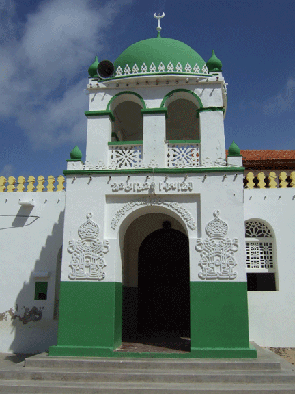
Riyadiya Mosque, Lamu

The essential problem in the study of Islam is precisely that: essentialist reduction of a diverse religious tradition across cultures into an ideal essence. In a provocative article published three decades ago, Muslim anthropologist Abdul Hamid el-Zein wondered in print “if a single true Islam exists at all.” (1) This was not an attempt to dismiss the faith of Islam, but a challenge to scholars who blithely assume the existential ‘truth’ of concepts. “But what if…” asked el-Zein, analysis of Islam “were to begin from the assumption that ‘Islam,’ ‘economy,’ ‘history,’ ‘religion’ and so on do not exist as things or entities with meaning inherent in them, but rather as articulations of structural relations, and are the outcome of these relations and not simply a set of positive terms from which we start our studies?” (2) If so, he reasoned, it would do no good to start with a textbook version of the five pillars, a famous scholar such as Ibn Khaldun, or a Western sociologist like Max Weber, because all this is what Islam is supposed to be. For el-Zein, true to his anthropological roots, it was important to start with the “native’s model of Islam” as it is articulated in a given social context. This is not because the native is “right,” a nonsensical term for non-theologian el-Zein, but in order to see how Muslims adapt what analysts call “religion” to everyday life. Continue reading Is there one “Islam” or many “islams”? →

Leaves from an old Bible Atlas #2


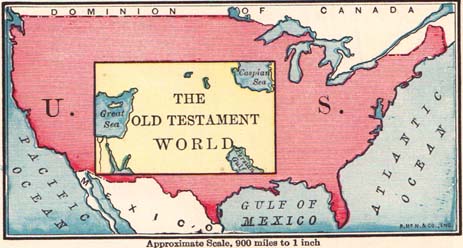
Comparative view of the United States and Old Testament world, approximate scale, 900 miles to 1 inch (in the original map which is only 3 3/4 inches across)

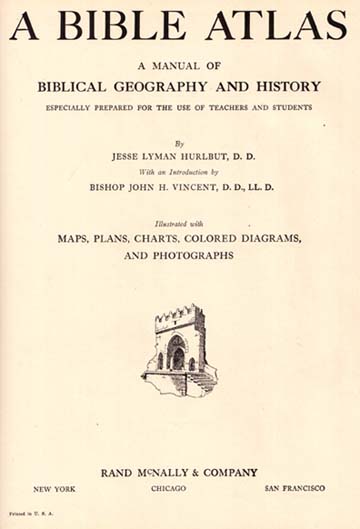
The Christian fascination with the Holy Land as a window into interpretation of the Bible has a long and indeed fascinating history of its own. Here I continue the thread on Jesse Lyman Hurlbutt’s A Bible Atlas (New York: Rand McNally & company, 1947, first published in 1882). I love the irony of the map above. Long before the political map devolved into Blue States vs. Red States, here is the Old Testament squarely in an expanded Bible Belt.

Here is Hurlbutt’s summary of the physical space defined as the Old Testament world:

The Old Testament world embraces the seas and lands between 30° and 54° east longitude, or from the mouth of the Nile to the head of the Persian Gulf; and between 27° and 40° north latitude, from the parallel south of Mt. Sinai to the north of Mount Ararat. The total extent of territory is about 1,400 miles from east to west and 900 miles from north to south, aggregating 1,260,000 square miles. If the space occupied by the Mediterranean Sea and other large bodies of water is deducted from this, the land will include about 1,110,000 square miles, or one-third of the extent of the United States, excluding Alaska. Unlike the United States, however, nearly two-thirds of this area is a vast and uninhabitable desert, so that the portion actually occupied by man is less than an eighth of that included int he American Union.

I wonder what Sarah Palin would think about Hurlbutt excluding Alaska, but at least it was not a state yet and some still referred to it as Seward’s folly.

To be continued …

Pictures at a Yemeni exhibition


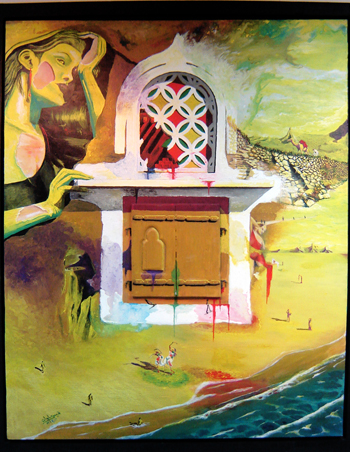
Painting by Qais Saleh Ahmed Aluan, founding member and vice-director of the Bait al-Fann (House of Art) in Yarim (Ibb Governorate)

The media focus on Muslim grievances over images of the Prophet Muhammad obscures the fact that there is a vibrant artistic tradition throughout the Islamic world. Take Yemen, for example. There are art centers in various parts of the country. Here is a Youtube trip through Bayt al-Fann (The House of Art) in Hodeidah. I only wish they had used music by Mussorgsky…

Dance Workshop & Discussion: Leila of Cairo and Anthropologist Najwa Adra


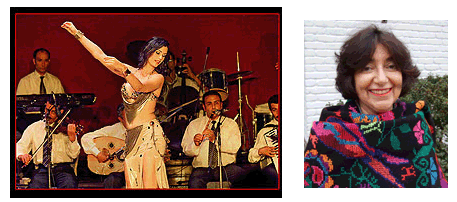
Leila, left; Dr. Najwa Adra, right

Dance Workshop & Discussion: Leila of Cairo and Anthropologist Najwa Adra
Wednesday, September 1, 2010 6:00 pm at Alwan for the Arts

Workshop: 6:00-8:30 pm
Discussion: 8:30-10:00 pm

This evening of dance and discussion provides an opportunity much needed in the bellydance scene: to both embody the feeling of Egyptian raqs sharqi through movement and music, and also to speak to the controversial issues surrounding the dance through dialogue with experts. Alwan welcomes acclaimed dancer Leila of Cairo, and esteemed scholar Najwa Adra, to kick off its 2010-2011 season of culturally contextualized, quality dance and performance.

Dance Workshop with Leila of Cairo

Understanding Classical Egyptian Music for Dance

6:00-8:30 pm

The historic songs of Oum Kalthoum, Abdel Halim Hafez and Warda can be intimidating for dancers of all levels. Join Leila as she navigates through the musical structure of these complex compositions. Explore Egyptian versus Western interpretation of these songs, and utilize Egyptian technique to express the music and ultimately, yourself, within the dance.

Take advantage this rare opportunity to learn with Cairo-based, American-born Leila, who has won over Egyptian audiences with her dance, film and stage appearances.

Discussion with Najwa Adra PhD and Leila

Raqs, What’s the Point? Diverging Bellydance Traditions in Egypt and the U.S.

8:30-10:00 pm

This discussion focuses on differences of perception, meaning, context and technique of the dance known simply as raqs or raqs sharqi in the Arab world, and as bellydance in the US. Leila draws upon her experiences as a US-born dancer who has an exceptionally successful career as a performing artist in Eygpt, while Najwa highlights related issues from her fieldwork research, writings and lifetime of participating in social dance traditions of the Arab world. The talk-back will touch upon notions of authenticity, cultural appropriation and orientalization in the dance. Come with questions and comments! Continue reading Dance Workshop & Discussion: Leila of Cairo and Anthropologist Najwa Adra →

What We Still Don’t Know About Islam


by Hussein Rashid, Religion Dispatches, August 26, 2010

Cathy Lynn Grossman, at USA Today’s Faith and Reason blog, writes about how most Americans know very little about Islam. Intentionally or not, she actually models this ignorance of Muslim traditions. Like William Dalrymple in the New York Times, she pulls out this word “sufism,” as though it is the silver bullet that will bring peace to the world. To say that Feisal Abdul-Rauf is a sufi is technically true and about as useful as saying he is male.

Sufism is theological orientation amongst Muslims that covers a wide variety of beliefs and practices. There are literally hundreds, if not thousands, of sufi orders. They range from politically quiet to very politically engaged. In many contexts they have served as the conscience of the community, speaking truth to power, whether that power was political or religious. Feisal Abdul-Rauf is not apolitical. He speaks from what we would consider to be a politically liberal perspective, and in service to the government of the United States.

Both Grossman and Dalrymple want to create a simple notion of Islam, where there are good Muslims and there are bad Muslims. In their construction, sufis are by definition “good.” This view denies the complexity of the Muslim experience and the reality of our past constructions of the “good” Muslim that have backfired. Ronald Reagan once hailed the Afghan mujahidin, the precursors to the Taliban, as the greatest freedom fighters since the American Revolution. Donald Rumsfeld has his infamous photo with Saddam Hussein.

Now New York Gov. Paterson is using the same simple constructions, comparing sufis and Shi’ah Muslims, as thought they are mutually exclusive categories. One can be sufi and Shi’ah or sufi and Sunni. For example, Khomeini, leader of the Iranian Revolution, had sufi leanings. Paterson’s ignorance conflates current concerns about Iran with the Park51 issue, and shows no understanding of the Sunni nature of Al-Qaida.

The simple categories of Muslims, without any real understanding of what they mean, does a disservice to the tradition and does not actually improve the conversation. Paterson’s comments will confuse the the conversation in New York, even if people recognize that he is simply floundering for legitimacy in the discussion. Grossman and Dalrymple’s gross generalizations tell us nothing about the drivers behind Park51 or the supporters of the center. It’s a shame that instead of focusing on battling the ignorance of Muslims, they are contributing to it.

WWGBD


Yesterday there was a rally at the Lincoln Memorial, a political act paraded as a national revival meeting. And guess who showed up? None other than Elmer Gantry. If you are too young to remember who Elmer Gantry is, Youtube comes to your rescue. Based on a novel published by Sinclair Lewis in 1927, the fictional character Gantry is a consummate hypocrite preaching against vice from the pulpit and practicing vice whenever he has a chance. Lewis wrote it as a satire on the bigoted Protestant fundamentalism of his day, and earned the mantra of “Satan’s cohort” from famed evangelist Billy Sunday. Perhaps it is time to bring the novel back to the required reading list or at least re-release the film version starring Burt Lancaster.

Glenn Gantry, I mean Elmer Beck, well you know who I mean, left the set of his Fox News extravaganza and cozy radio perch to lead a rally of Tea Party and other discontents, but claimed that God had dropped a sandbag on his head (I suspect it was rather heavy sand to cause such a reaction) and made him realize the rally should be a religious revival, getting America back to her Christian roots. The fact that it was planned on the anniversary of Martin Luther King’s memorable speech in the same place (only three years after the release of the Elmer Gantry film) is said to be accidental or divine. I suspect for showman Beck, there is little difference between the two. Continue reading WWGBD →

Leaves from an old Bible Atlas #1

Perhaps there is a geographical inclination gene in my ancestry, since I have always loved Bible atlases. Many years ago my father was given a copy of Jesse Lyman Hurlbut’s A Bible Atlas, first published in 1910; his volume was a 1947 revision. But for the most part I assume the photographs were taken around the turn of the 20th century, give or take a decade. The author lived from 1843–1930 and as early as 1882 had published a Manual of Biblical Geography, the perecursor to this atlas. The 1910 version is archived online. There is also a website devoted to maps from his 1904 Story of the Bible.

So here I begin a thread of photographs of the Holy Land from at least a century ago. Let’s begin in Tiberias … Continue reading Leaves from an old Bible Atlas #1 →

A shift in Arab views of Iran


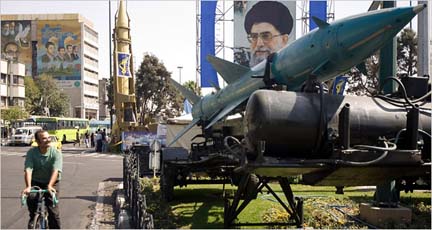
Photograph by Morteza Nikoubazl for Reuters

Anger over the Israeli-Palestinian conflict and U.S. policy is tilting public opinion in favor of Tehran and against Washington.

by Shibley Telhami, The Los Angeles Times, August 14, 2010

President Obama may have scored a diplomatic win by securing international support for biting sanctions against Iran, but Arab public opinion is moving in a different direction. Polling conducted last month by Zogby and the University of Maryland in Egypt, Saudi Arabia, Jordan, Morocco, Lebanon and the United Arab Emirates suggests that views in the region are shifting toward a positive perception of Iran’s nuclear program.

These views present problems for Washington, which has counted on Arabs seeing Iran as a threat — maybe even a bigger one than Israel. So why is Arab public opinion toward Iran shifting? Continue reading A shift in Arab views of Iran →