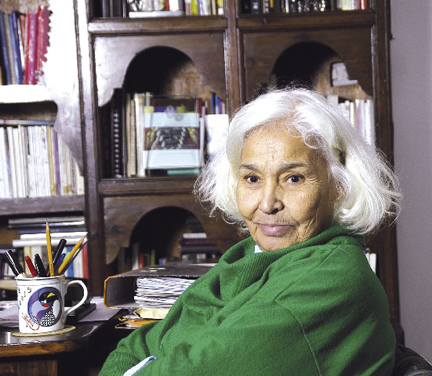
Nawal El Saadawi on Osama Bin Laden


Nawal El Saadawi


Nawal El Saadawi: Leftist support of Taliban is short-sighted

by Sahar Saba, Viewpoint, Pakistan, September 10, 2010

Award-winning Egyptian writer and feminist Nawal El Saadawi hardly deserves an introduction. Author of over forty books—-translated to over 30 languages—-she has inspired women all over the world but particularly in Muslim world with her writings as well as courageous struggle against obscurantism. She has faced threats to her life, was fired from job by Egyptian authorities and imprisoned, has seen her books banned, even went in exile but has been steadfast and vocal when it comes to women rights and socialism.

Sahar Saba:
Osama bin Laden’s act nine years ago became instantly popular all over the Muslim world. Now after nine years, in your assessment, how has the Muslim/Arab world benefitted or suffered as a result of September 11?

Nawal El Saadawi:
After nine years of September 11, nobody has benefitted from Sept 11 except global and local powers who started the colonial oil war and triggered religious conflicts in the Arab region. Continue reading Nawal El Saadawi on Osama Bin Laden
Blogging Islamophobia


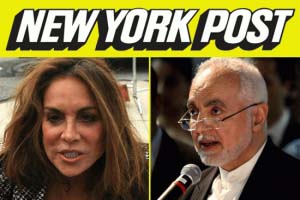
Blogger Pamela Geller and Imam Feisal Abdul Rauf

How the “ground zero mosque” fear mongering began

BY JUSTIN ELLIOTT, Salon.com

A group of progressive Muslim-Americans plans to build an Islamic community center two and a half blocks from ground zero in lower Manhattan. They have had a mosque in the same neighborhood for many years. There’s another mosque two blocks away from the site. City officials support the project. Muslims have been praying at the Pentagon, the other building hit on Sept. 11, for many years.

In short, there is no good reason that the Cordoba House project should have been a major national news story, let alone controversy. And yet it has become just that, dominating the political conversation for weeks and prompting such a backlash that, according to a new poll, nearly 7 in 10 Americans now say they oppose the project. How did the Cordoba House become so? Continue reading Blogging Islamophobia

A Comic Approach to Tragedy


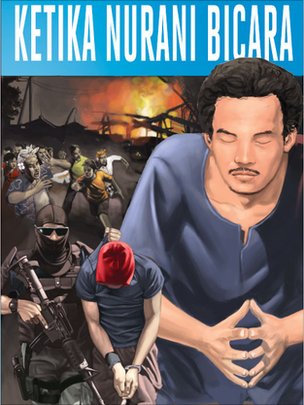
A novel, even comic, approach to combating terrorist acts by extremist Muslims in South Asia is currently underway in Indonesia. This is a comic book about Ali Imran, who engineered the 2002 bombing of a hotel in Bali. Through the life story of the bomber, the story urges young Muslims not to be duped by anyone praising suicide bombing as an Islamic duty. For a video account of the book on Al Jazeera, click here.

Spiritual Malaria?


by Nadeem F. Paracha, blog.dawn.com, July 1
 
A recent fatwa from a ‘Saudi Council of Muftis’ has this advice for fellow
Muslims: Do not say [or write] ‘mosque.’ Always say ‘masjid’ because mosque
may mean mosquito. Another myopic case of Saudi malaria perhaps?

Certainly. But that’s not all. The grand fatwa goes on to suggest that
Muslims should not write ‘Mecca’ but Makkah, because Mecca may mean ‘house
of wines.’ I am serious. But then so are the Muftis. They certainly need to
get a life.

But I’m not all that surprised by such fatwas that usually emanate from
Saudi Arabia. While vicious reactionary literature originating in
totalitarian puritanical Muslim states impact and mutate the political
bearings of various religious parties and groups in Pakistan, ‘social
fatwas’ like the one mentioned above also began appearing in the early 1980s
to influence the more apolitical sections of Muslim societies.

Reactionary literature generated by the Saudi propaganda machine started
being distributed in Pakistan from 1979 onwards, mostly in the shape of
pamphlets and books.

Duly translated into Urdu, they glorify and propagate violent action (jihad)
not only against non-Muslims (or infidels) but also against those Muslims
who fail to follow the thorny dictates of a certain puritanical strain of
the faith. Continue reading Spiritual Malaria?

Camels in Vienna


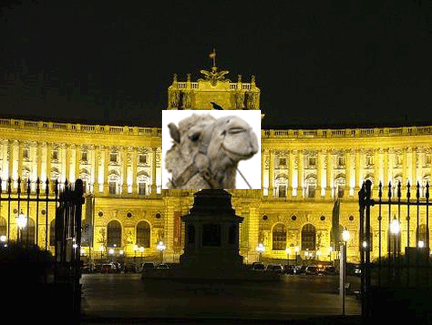
Today I am leaving for Vienna and the forthcoming “Camels in Asia and North Africa
Interdisciplinary workshop” to be held Tuesday & Wednesday 5-6 October, 2010 at the
Austrian Academy of Sciences, AAS, Dr.-Ignaz-Seipel-Platz 2, 1010 Vienna. If you have an interest in any aspect of camels and are near Vienna, Austria, you might want to join in.

Here are the details, also available in pdf from the website.

This workshop aims at a comprehensive discussion on Old World camels (Dromedary and Bactrian camel) including the following topics:
• Origin and domestication
• Conservation of the wild Bactrian camel
• Veterinary folk medicine
• Socio-economic significance: Breeding, caring, trading
• Art: Petroglyphs, poetry and music
• History and Symbolism of camels in Asia and Austria

These issues will be addressed by scholars from the natural sciences as well as from the social sciences and humanities Continue reading Camels in Vienna

Leaves from an old Bible Atlas #5


Hurlbutt’s Atlas, p. 118


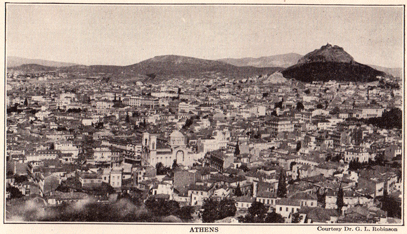
Athens, Hurlbutt’s Atlas, p. 119

The Christian fascination with the Holy Land as a window into interpretation of the Bible has a long and indeed fascinating history of its own. Here I continue the thread on Jesse Lyman Hurlbutt’s A Bible Atlas (New York: Rand McNally & Company, 1947, first published in 1882). One of the interesting aspects of the accompanying illustrations is the sense that what you see in the photograph is essentially unchanged from the days of Paul’s missionary journeys. Both these images appear to have been taken before the turn of the 20th century.

To be continued …

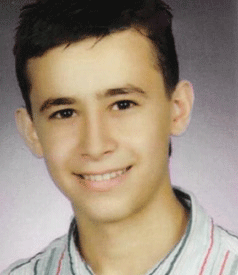
UN Fact-Finding Mission Says Israelis “Executed” US Citizen Furkan Dogan


Furkan Dogan, a 19-year-old US citizen of Turkish descent, was aboard the Mavi Marmara when he was killed by Israeli commandos. (Photo: freegazaorg; Edited: Jared Rodriguez / t r u t h o u t)

by Gareth Porter, t r u t h o u t Monday 27 September 2010

The report of the fact-finding mission of the Office of the United Nations High Commissioner for Human Rights (OHCHR) on the Israeli attack on the Gaza flotilla released last week shows conclusively, for the first time, that US citizen Furkan Dogan and five Turkish citizens were murdered execution-style by Israeli commandos.

The report reveals that Dogan, the 19-year-old US citizen of Turkish descent, was filming with a small video camera on the top deck of the Mavi Marmara when he was shot twice in the head, once in the back and in the left leg and foot and that he was shot in the face at point blank range while lying on the ground.

The report says Dogan had apparently been “lying on the deck in a conscious or semi-conscious, state for some time” before being shot in his face. Continue reading UN Fact-Finding Mission Says Israelis “Executed” US Citizen Furkan Dogan

Art Territories

Check out this new website, initiated by Ursula Biemann and Shuruq Harb, this month: ArtTerritories is conceived as an independent platform for artists, thinkers, researchers and curators to reflect on their art practice and engage in critical exchange on matters of art and visual culture in the Middle East and the Arab World. Dedicated to the interview format, the initiative encourages discussion of artistic process with an emphasis on discursive art and media practices, collaborative initiatives, and cultural and institutional politics. ArtTerritories aims to define, connect and expand already existing art communities in the region as well as an ever-growing invested international arts community.”


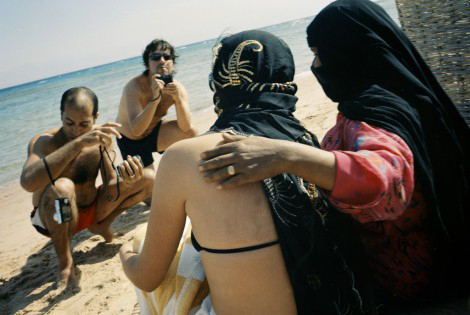
Photograph by Ahmad Hosni, from his Go Down, Moses project

The following is a sample of an interview with photographer Ahmad Hosni.

Ursula: The book is the result of intense but somewhat undirected exposure to desert experience with its chance encounters, local stories and tourist ethnographies, tinted by a literary reading of an eclectic range of writers, some of whom are discussed in the book. Continue reading Art Territories