The Poet Adonis


A Revolutionary of Arabic Verse
By CHARLES McGRATH, The New York Times, October 17. 2010

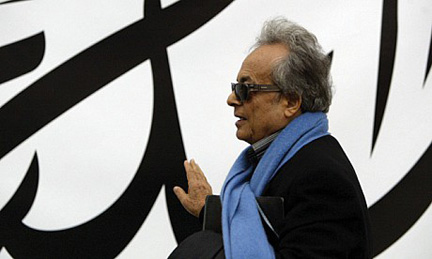
ANN ARBOR, Mich. — Every year around this time the name of the Syrian poet Adonis pops up in newspapers and in betting shops. Adonis (pronounced ah-doh-NEES), a pseudonym adopted by Ali Ahmad Said Esber in his teens as an attention getter, is a perennial favorite to win the Nobel Prize in Literature. This year Ladbrokes, the British bookmaking firm, had his chances at 8-1, which made him seem a surer bet than the eventual winner, Mario Vargas Llosa, a 25-1 long shot. Why Adonis appeals to the oddsmakers, presumably, is that he’s a poet, and poets have been under-represented among Nobelists lately; that he writes in Arabic, the language of only one Nobel winner, Naguib Mahfouz; and that as is the case with so many recent winners, most Americans have never heard of him.

In the Arab world it’s a very different matter. There he is a renowned figure, if not everywhere a beloved one. He is an outspoken secularist, equally critical of the East and West, and a poetic revolutionary of sorts who has tried to liberate Arabic verse from its traditional forms and subject matter. Some of his poems are immensely long and immensely difficult and resemble Pound’s Cantos at their most impenetrable. Others reveal a Paul Muldoonish playfulness, a Jorie Graham-like expansiveness and fascination with blank space. His poems are as apt to cite Jim Morrison as the Sufi mystics, and his 2003 volume “Prophesy, O Blind One” includes some long, leggy lines about traveling that could have been written by Whitman, if only Whitman had spent more time in airports. Continue reading The Poet Adonis

Selma and the Madrasa


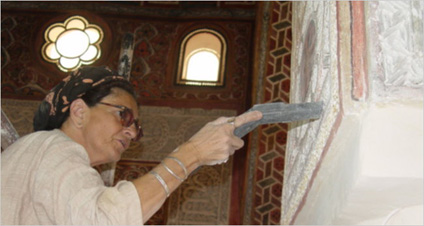
Selma Al-Radi at work at the Amiriya Madrasa; photo by Qais al-Awqati

In addition to the obituary previously posted, the New York Times has recently published this account of Dr. Selma Al-Radi.

Selma Al-Radi, Restored Historic Madrasa, Dies at 71

By MARGALIT FOX, The New York Times, October 14, 2010

On certain dark nights, as a Yemeni legend tells it, Sultan Amir ibn Abd Al-Wahhab would command his servants to set lanterns in the windows of the Amiriya Madrasa, the ornate palace complex he had commissioned at Rada, in southern Yemen. Then, with his daughter by his side, he would ride into the hills above town, to behold his vast edifice ablaze with light.

The sultan was a historical figure, the last ruler of the Tahirid Dynasty, which flourished in Yemen from the mid-15th to early 16th centuries. The Amiriya Madrasa, erected in 1504 and named for him, was then and is now again one of the great treasures of Islamic art and architecture.

Solidly built of limestone and brick, the Amiriya seemed destined to endure as the sultan’s monumental legacy. But after he was killed in battle in 1517, the complex was left to decay. The more puritanical rulers who followed him deemed its lavishness a distraction from the sober business of prayer.

That the Amiriya today stands resplendent after five centuries of neglect is due almost entirely to the efforts of one woman, the Iraqi-born archaeologist Selma Al-Radi, who was for many years a research associate at New York University’s Institute of Fine Arts. Continue reading Selma and the Madrasa

If war is still hell, does that mean it no longer exists?


If you are bored enough to follow the cable or evening news, the top stories these days are all about politics. At this point we are all suffering from a Tea Party hangover, candidates who make ads claiming they are not witches or Nazi sympathizers, conspiracy theories of foreign money buying congress, and the latest notes inscribed on Sarah Palin’s million-dollar hands. It is as though the media has outsourced its integrity, what little it ever had in the broad historical sweep of journalism in this country. I remember an old saying in the days when people actually thought about peace: what if they started a war and nobody came? Well, now it seems that the mantra is what if a war is going on and no one cares. The two ongoing wars started during the Bush years are falling off the radar, as two recent polls have voiced:

In a nationwide New York Times/CBS News poll conducted last month, 60 percent of Americans said that the economy or jobs were the most important problems facing the country. A mere 3 percent mentioned Afghanistan or the war. Continue reading If war is still hell, does that mean it no longer exists?

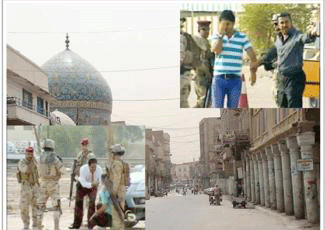
When the humor bombs …


Scene from the show

Laugh! There is a Bomb in your Car
by Sinan Antoon, al-Jadaliyya.com, September 11, 2010

Ramadan is a very special time of year for Muslims and it is impossible to overestimate its socio-cultural importance. Additional time and effort are invested in its daily rituals and practices. Familial and social bonds are augmented and celebrated. Traditional games used to be an important facet of the month’s celebratory and festive mood culminating in the feast marking the month’s end. While these games are still popular and are still played in many parts of the Islamicate world, they have been largely eclipsed by visual entertainment. Thus, Ramadan is the month to watch TV and follow the new shows and soap operas. It is the month with the highest rates of viewership as families and friends gather around TVs. Stations and satellite channels invest heavily in their Ramadan productions. It is also the perfect time of year to take the political and cultural pulse. For Iraqis, Ramadan has been more of a challenge this year than it usually is. The country is still without a government after more than five months of fruitless negotiations. Despite claims to the contrary, the government has failed miserably in providing security for its citizens as suicide attacks continue. Continue reading When the humor bombs …

Leaves from an old Bible Atlas #6


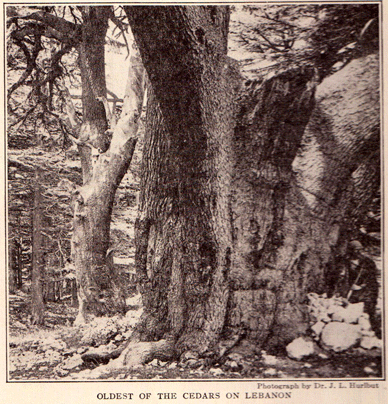
Hurlbutt’s Atlas, p. 118

The Christian fascination with the Holy Land as a window into interpretation of the Bible has a long and indeed fascinating history of its own. Here I continue the thread on Jesse Lyman Hurlbutt’s A Bible Atlas (New York: Rand McNally & Company, 1947, first published in 1882). Ah, those cedars of Lebanon, hewn for Solomon’s temple but a few being left for the intrepid explorer, in this case Rev. Hurlbutt himself. Here is his sketch of that temple. Continue reading Leaves from an old Bible Atlas #6

The Surprising Effect of Religious Devotion on Suicide Attacks


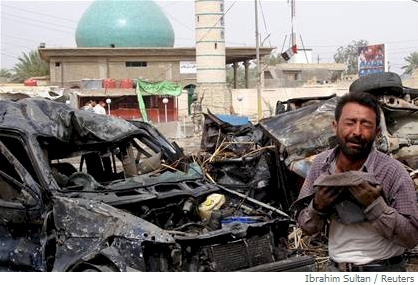
2007 suicide blast at Baghdad hotel

by Matt J. Rossano, The Huffington Post, September 27, 2010

We all have our personal “theories” about what motivates religious terrorists. To go from personal theories to real ones, we need to study the issue scientifically. One recent study draws the provocative conclusion that ritual participation more than religious belief may be behind suicide attacks.

From a scientific standpoint a suicide attack represents an extreme form of parochial altruism — a self-sacrificial act made on behalf of one’s in-group, involving aggression against an out-group. Religious belief, some have argued, is the prime motivator for such an attack. The attacker believes that his or her sacrifice will lead to a glorious reward in the afterlife (e.g., Islam’s famous 70-some-odd virgins-awaiting). This explanation can be called the “belief hypothesis,” and it would predict that those who demonstrate increased devotion to religious beliefs or deities would be more supportive of suicide attacks. In the context of a recent study (Ginges et al., Psychological Science, 20, p. 224), devotion was measured by prayer frequency. Thus, those who prayed more were assumed to be more devoted, and some preliminary analyses confirmed that this was indeed the case. Continue reading The Surprising Effect of Religious Devotion on Suicide Attacks

In Memoriam: Selma Al-Radi


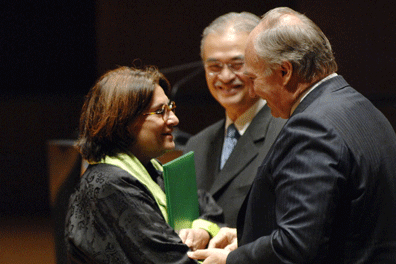
Dr. Selma Al-Radi, the Iraqi project director who restored the Amiriya complex in Rada, Yemen, over a 26 year period, receiving her 2007 Aga Khan Award for Architecture. The winners are being congratulated by Malaysian Prime Minister Badawi and His Highness the Aga Khan. Photo credit: AKDN/Gary Otte

Selma Al-Radi died peacefully at her home in New York City on October 7, 2010. She was 71 and was surrounded by family and friends. Often described as “a force of nature” by many, she was slowly robbed of that energy by her Alzheimer’s affliction, leaving a ruin that was rapidly demolished by ovarian cancer in a little over a year after symptoms were first detected.

Selma was born on 23 July 1939 in Baghdad and grew up in many countries but largely in Iran and India where her father served as the Iraqi Ambassador for a number of years. She graduated from Cambridge University in Archaeology and Ancient Semitic Languages, and earned her Master’s degree at Columbia where she came under the influence of her lifelong mentor, the late Dr. Edith Porada. She obtained her PhD at the University of Amsterdam but remained under the mentorship of Dr. Porada along with Dr. Maurits van Loon. Her thesis work focused on a Neolithic site in Cyprus (Phlamoudhi Vounari).

A consummate “dirt” archaeologist, working mainly on excavations in the field, Selma excavated on sites in most of the Middle East including Iraq, Syria, Turkey, Lebanon, Kuwait, Egypt, and Yemen. But Yemen was where she would spend much of her career. Continue reading In Memoriam: Selma Al-Radi