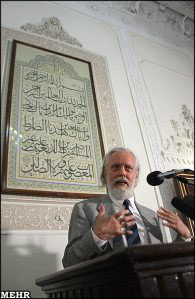
Islam and the Goal of Love


Islam and the Goal of Love

by William C. Chittick, The Huffington Post, November 6, 2010 08:20 PM

Muslim scholars who claimed that Islam specifically and religion generally are based on love were not simply talking through their hats, as many readers of my previous post seem to think. They offered plenty of evidence. In order to see its logic, however, we need to remember the two axioms upon which all Islamic thought is built: the reality of God and the messengerhood of Muhammad.

The first axiom does not depend on the Quran. It needs to be accepted before there is any reason to consider Muhammad and the message. If God is not real, then God’s “messages” will be even less real.

This first axiom states that there is only one true reality. Everything else — the universe and all it contains — derives from it. What we call “realities” are in fact non-realities dressed up in fancy clothes.

In the language of Islamic theology, this axiomatic notion is called tawhid (pronounced “toe-heed”), meaning “the assertion of unity,” that is, the unity of the ultimate reality, which is commonly called “God.” Any close reading of the Quran (and the works of practically any Muslim theologian, Sufi or philosopher) will show that tawhid is taken as self-evident to any healthy intelligence. If people miss it, the problem is “forgetfulness,” the outstanding characteristic of the human race. According to the Quran, Adam did not “sin”; rather, “He forgot” (20:115). Continue reading Islam and the Goal of Love →
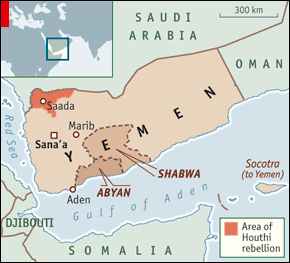
Yemen is Not a Terrorist Factory


Yemen is not a terrorist factory
By Daniel Martin Varisco, Special to CNN, November 8, 2010

Editor’s note: Daniel Martin Varisco is a professor of anthropology at Hofstra University and has visited Yemen over a dozen times for development consulting and research since 1978. He moderates Tabsir, an academic blog on Islam and the Middle East.

(CNN) — Domino theorists love the Middle East. Because of this, a number of media pundits have recently added the little-known country of Yemen as a front in the unsettled aftermath of George W. Bush’s War on Terror.

First came the overthrow of the Taliban in Afghanistan, then a protracted war there and in Iraq. Iran is still in the hawkish gun-sights of conservative pundits, but the focus has now shifted to Yemen, a country most Americans could not find on a map. Is Yemen really the terrorist haven we should fear the most?

For the rest of my post on the CNN blog, click here.

Ibn Tufayl’s Fable


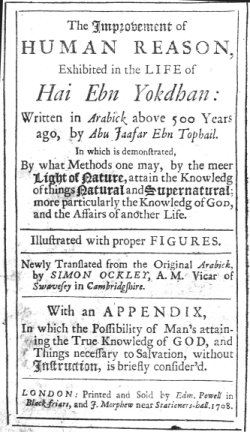
What would happen to a child growing up on an island outside any human society? In real life such a scenario would be absurd. No child could survive from birth on his or her own, despite exotic accounts of feral human babies being reared by animals. But as a thought experiment, it makes an intriguing story. Such is the philosophical fable spun by the Andalusian Muslim scholar Ibn Tufayl over eight centuries ago. I have just finished teaching this text and the lessons in it are fresh in my mind.

If you have never read this classic fable, it can be found online in the original 1708 translation into English by Simon Ockley. A more recent translation by Lenn Evan Goodman is available from Amazon. The author was a distinguished Muslim intellectual who borrowed from the earlier Greek icons Aristotle and Plato, as well as the commentaries by earlier Muslim philosophers like Ibn Sina (Avicenna) and al-Farabi. His fable combines logical arguments, inductive scientific observation and a form of intuition that leads to a union with the One. Continue reading Ibn Tufayl’s Fable →

Those Yemeni parcels


Armed Yemeni police stand guard next to the closed UPS office Thursday, Nov. 4, 2010, in Sanaa, Yemen

[Webshaykh’s Note: The latest from Greg Johnsen, one of the most informed commentators on AQAP and one who needs to be much more widely read.]

Initial Notes on AQAP’s statements
by Gregory Johnsen, Waq al-Waq, Friday, November 5, 2010

I have just finished a first reading of the three statements AQAP posted to jihadi forums earlier today. The one that is getting the most attention – not surprisingly – is the one that takes credit for two parcel bombs and the downing of a UPS plane in Dubai in September.

But for me, by far the most interesting statement is #27, which denies that AQAP had anything to do with two bombs outside a sports club in Aden on October 11. I will return to this below, and talk about why I think this statement is so significant. but first a couple of notes.

Note 1: Statement #28 talks about the fighting in Mudiya on October 14, 2010. I wrote about this fight here, in which the brother of the governor of Abyan was killed. Now we have AQAP’s version of the fighting, interesting details, but probably only to me. So I’ll save you the full discussion.

Note 2 : Another thing that I have noticed is the change in references to President Ali AbdullahSalih now and in the pages of Sada al-Malahim back when it was under the editorial guidance of al-Qahtani, who was killed in an airstrike. Continue reading Those Yemeni parcels →

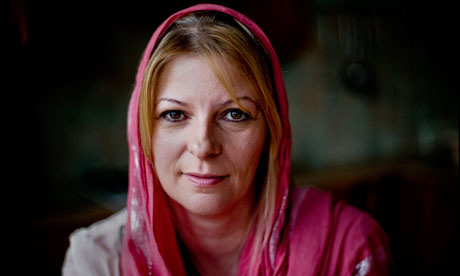
Lauren Booth on Lauren Booth


I’m now a Muslim. Why all the shock and horror?

by Lauren Booth. The Guardian, November 3, 2010

It is five years since my first visit to Palestine. And when I arrived in the region, to work alongside charities in Gaza and the West Bank, I took with me the swagger of condescension that all white middle-class women (secretly or outwardly) hold towards poor Muslim women, women I presumed would be little more than black-robed blobs, silent in my peripheral vision. As a western woman with all my freedoms, I expected to deal professionally with men alone. After all, that’s what the Muslim world is all about, right?

This week’s screams of faux horror from fellow columnists on hearing of my conversion to Islam prove that this remains the stereotypical view regarding half a billion women currently practising Islam.

On my first trip to Ramallah, and many subsequent visits to Palestine, Egypt, Jordan and Lebanon, I did indeed deal with men in power. And, dear reader, one or two of them even had those scary beards we see on news bulletins from far-flung places we’ve bombed to smithereens. Surprisingly (for me) I also began to deal with a lot of women of all ages, in all manner of head coverings, who also held positions of power. Believe it or not, Muslim women can be educated, work the same deadly hours we do, and even boss their husbands about in front of his friends until he leaves the room in a huff to go and finish making the dinner. Continue reading Lauren Booth on Lauren Booth →

Guardians of the Sacred

by F. E. Peters, NYPL Website, October 18, 20120

For very long time, Jews, Christians and Muslims have behaved toward one another like members of a dysfunctional family, like the competitors for an immense inheritance, the favor of Almighty God. But the current exhibition at the New York Public Library uncovers quite another strain of familiarity among the three, their devotion to the book.

Many cultures value the written word, the art of writing and a reverence for books, but Jews Christians and Muslims are unique in their devotion not merely to books – the scribe was always among their elite members before the age of printing – but to the Book. Continue reading Guardians of the Sacred →