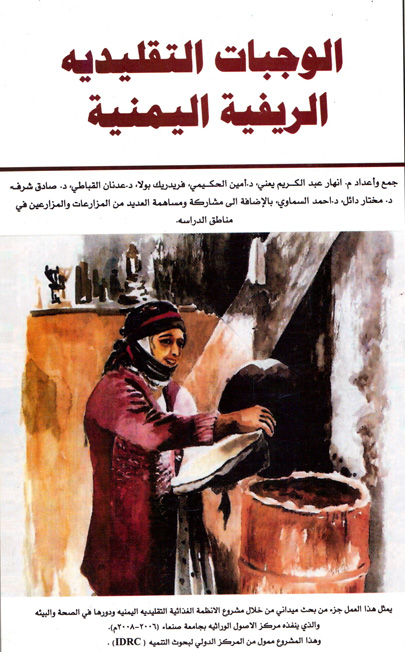
Readers who know Arabic will realize that this blog entry is not about terrorism. Even if you do not know Arabic, what do you think the book cover in the picture above is about? Details coming tomorrow.
to be continued
Readers who know Arabic will realize that this blog entry is not about terrorism. Even if you do not know Arabic, what do you think the book cover in the picture above is about? Details coming tomorrow.
to be continued
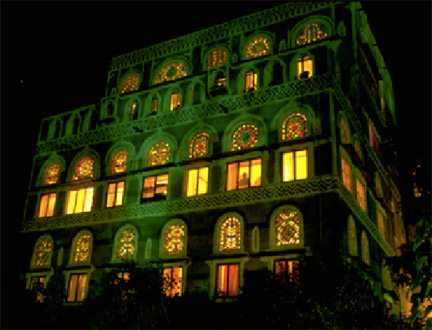
Bayt al-Hilali. Lighted middle floor was Wyatt’s home in Sanaa,Yemen (1970-72); Photo by Peggy Crawford (1988)
Is Yemen Really a Hotbed of Terrorism? “No,†says Author.
Arabian Nights and Daze Evokes a Friendlier Yemen than the Media Presents
Americans today have a negative image of Yemen and its people in the aftermath of media focus on radical Islam and terrorist activities in that country. Susan Clough Wyatt’s Arabian Nights and Daze: Living in Yemen with the Foreign Service provides timely insights into this vulnerable country, its history and culture, and the enormous challenges Yemen faces today. Arabian Nights and Daze has been selected as part of the Memoirs and Occasional Papers Series of the Association for Diplomatic Studies and Training (ADST) in Arlington, Virginia.
Journey back to 1970 when Wyatt and her Foreign Service officer husband reopened the U.S. diplomatic mission to the Yemen Arab Republic (YAR) after its closure at the time of the 1967 Arab-Israeli War. Arriving only eight years after progressive revolutionaries ousted a thousand-year-old dynasty of conservative Shiite Muslim imams, they found the mission in a shambles. Under the protection of the Italian embassy, they built it back in stages prior to full resumption of diplomatic relations with the YAR in 1972. Continue reading Arabian Nights and Daze
by Reidar Visser, Iraq and Gulf Analysis, 11 November 2010 22:00
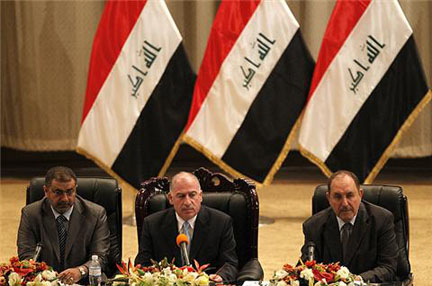
In a repeat of the procedure used in April 2006, the Iraqi parliament today met and elected not only its speaker (Usama al-Nujayfi of Iraqiyya) but also the president (Jalal Tabalani of the Kurdish alliance). Talabani went on to nominate Nuri al-Maliki as premier candidate of “the biggest bloc in parliament†– the National Alliance, consisting of Maliki’s own State of Law alliance (89 deputies) plus its newfound partners from the disintegrated Iraqi National Alliance including the Sadrists (40 deputies), Ibrahim al-Jaafari and Ahmad Chalabi. It is noteworthy that constitutionally speaking, parliament could have delayed the president election until one month after the speaker had been elected and then the president in theory would have had 15 days to nominate the premier candidate. For some ten minutes of the session, this appeared to be a real possibility as Iraqiyya deputies objected to persevering with the election before parliament had discussed the political deal by bloc leaders that brought about today’s meeting, including the question of the de-Baathification status of some of its leaders. They also correctly pointed out that the original invitation to the session did not have the presidency question on the agenda, only the speakership, and there were outright lies about the constitution from some Shiite Islamist leaders, with both Humam Hammudi and Hassan al-Shammari erroneously claiming the election of the president in the same meeting was stipulated in the constitution. However, instead of using his newfound authority to throw the session into disarray, Nujayfi continued to chair the session for a while even as many of his fellow Iraqiyya deputies stormed out (some reports say in the range of 50 to 60). Eventually Nujayfi himself temporarily withdrew, allowing his newly elected deputies, Qusay al-Suhayl (a Sadrist from Basra) and Arif Tayfur (of the Kurdish alliance and a deputy speaker also in the previous parliament) to go along with orchestrating vote on the president. Nujayfi returned to chair the final part of the session, and embraced Talabani as he entered the stage to make his acceptance speech. Continue reading Nujayfi, Talabani and Maliki – Plus Lots of Hot Air
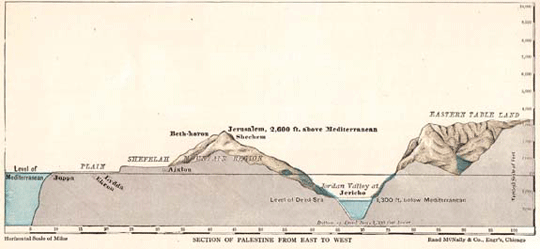
Hurlbutt’s Atlas, p. 16
The Christian fascination with the Holy Land as a window into interpretation of the Bible has a long and indeed fascinating history of its own. Here I continue the thread on Jesse Lyman Hurlbutt’s A Bible Atlas (New York: Rand McNally & Company, 1947, first published in 1882). Hurlbutt includes two diagrams showing cross-sections across Palestine. That shown above is an east-west transect, showing the Dead Sea level at 1,300 feet below sea level. These were indeed better times, more than a century ago. Today the Dead Sea has dropped at least another 85 feet and continues at an alarming rate. The north-south transect is shown below. In order to be able to read it here, I have split it, but originally it was a single horizontal diagram. Continue reading Leaves from an old Bible Atlas #8

Performing Islam is the first peer-reviewed interdisciplinary journal about Islam and performance and their related aesthetics. It focuses on socio-cultural as well as historical and political contexts of artistic practices in the Muslim world. The journal covers dance, ritual, theatre, performing arts, visual arts and cultures, and popular entertainment in Islam influenced societies and their diasporas. It promotes insightful research of performative expressions of Islam by performers and publics, and encompasses theoretical debates, empirical studies, postgraduate research, interviews with performers, research notes and queries, and reviews of books, events and performances.
Call for contributions for the second issue: Continue reading Performing Islam
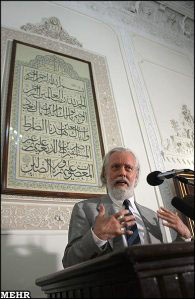
Islam and the Goal of Love
by William C. Chittick, The Huffington Post, November 6, 2010 08:20 PM
Muslim scholars who claimed that Islam specifically and religion generally are based on love were not simply talking through their hats, as many readers of my previous post seem to think. They offered plenty of evidence. In order to see its logic, however, we need to remember the two axioms upon which all Islamic thought is built: the reality of God and the messengerhood of Muhammad.
The first axiom does not depend on the Quran. It needs to be accepted before there is any reason to consider Muhammad and the message. If God is not real, then God’s “messages” will be even less real.
This first axiom states that there is only one true reality. Everything else — the universe and all it contains — derives from it. What we call “realities” are in fact non-realities dressed up in fancy clothes.
In the language of Islamic theology, this axiomatic notion is called tawhid (pronounced “toe-heed”), meaning “the assertion of unity,” that is, the unity of the ultimate reality, which is commonly called “God.” Any close reading of the Quran (and the works of practically any Muslim theologian, Sufi or philosopher) will show that tawhid is taken as self-evident to any healthy intelligence. If people miss it, the problem is “forgetfulness,” the outstanding characteristic of the human race. According to the Quran, Adam did not “sin”; rather, “He forgot” (20:115). Continue reading Islam and the Goal of Love
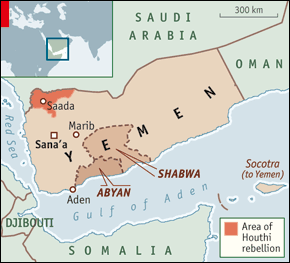
Yemen is not a terrorist factory
By Daniel Martin Varisco, Special to CNN, November 8, 2010
Editor’s note: Daniel Martin Varisco is a professor of anthropology at Hofstra University and has visited Yemen over a dozen times for development consulting and research since 1978. He moderates Tabsir, an academic blog on Islam and the Middle East.
(CNN) — Domino theorists love the Middle East. Because of this, a number of media pundits have recently added the little-known country of Yemen as a front in the unsettled aftermath of George W. Bush’s War on Terror.
First came the overthrow of the Taliban in Afghanistan, then a protracted war there and in Iraq. Iran is still in the hawkish gun-sights of conservative pundits, but the focus has now shifted to Yemen, a country most Americans could not find on a map. Is Yemen really the terrorist haven we should fear the most?
For the rest of my post on the CNN blog, click here.
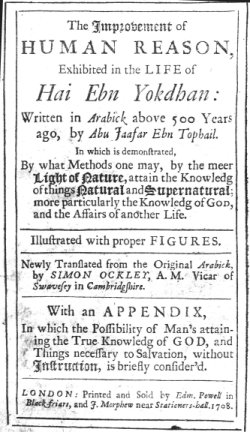
What would happen to a child growing up on an island outside any human society? In real life such a scenario would be absurd. No child could survive from birth on his or her own, despite exotic accounts of feral human babies being reared by animals. But as a thought experiment, it makes an intriguing story. Such is the philosophical fable spun by the Andalusian Muslim scholar Ibn Tufayl over eight centuries ago. I have just finished teaching this text and the lessons in it are fresh in my mind.
If you have never read this classic fable, it can be found online in the original 1708 translation into English by Simon Ockley. A more recent translation by Lenn Evan Goodman is available from Amazon. The author was a distinguished Muslim intellectual who borrowed from the earlier Greek icons Aristotle and Plato, as well as the commentaries by earlier Muslim philosophers like Ibn Sina (Avicenna) and al-Farabi. His fable combines logical arguments, inductive scientific observation and a form of intuition that leads to a union with the One. Continue reading Ibn Tufayl’s Fable