When in Lebanon …


Miss World 2010 top model Luna Ramos and Adriana Pena (Miss Venezuela in 2007)

As much as I have been glued to coverage of the protests in Egypt and elsewhere, there are times when a little levity is needed. So why not turn to Lebanon, despite its lack of a functioning government (or maybe because of it)? I suppose the phrase “When in Lebanon…” might be concluded with “do as the Lebanese would want to do, even if it gets harder and harder to do.” While postwar Beirut has lost much of its playful lustre, Lebanon is still (barely as this picture shows) an oasis of Western style in a political arena that has seen a rise in hijab fashion rather than skirt length. The main news may not fully cover stories about uncovering, but at least the Huffington Post (all the news that’s fit to entice, ‘specially if it’s lefty, naughty and oh so nice – at least before it merged with AOL) offers an alternative to Hamas, Hizbullah and Ahmadinijad. I realize it is a slippery slope, but now that the World Cup finals are over, what better way to promote South American beauty queens than wearing bikinis on skis in mountains that used to boast the cedars of Lebanon. If you prefer a video collage with a beat, see the shots on Youtube.

2011 RIFT VALLEY INSTITUTE FIELD COURSES


Dhow near Lamu at sunset

2011 RIFT VALLEY INSTITUTE FIELD COURSES:
SUDAN, HORN OF AFRICA AND GREAT LAKES

SUMMARY

This year’s Rift Valley Institute field courses stress the historical background to political developments in the region: the two-state future in Sudan, the effect of recent and upcoming elections in the Great Lakes, and the continuing challenges to political evolution in the countries of the Horn of Africa. The courses are seminar-based, one-week, high-intensity events to be held between May and July. Faculty includes internationally-known regional specialists, researchers and civil society activists from Sudan, Ethiopia, Somalia, Rwanda, Burundi, and the DRC.

The application deadline for all courses is Monday 28 February. You can apply online here.

Summaries of each course are included below. Prospectuses containing further details are attached to this message and can be downloaded from www.riftvalley.net/courses. (Or write to courses@riftvalley.net.)

DATES AND GENERAL INFORMATION

Dates for this year’s courses are as follows:

The Sudan Course, Wednesday 25 May to Tuesday 31 May, in Rumbek, Southern Sudan.

The Horn of Africa Course, Saturday 4 to Friday 10 June in Lamu, Kenya.

The Great Lakes Course, Saturday 9 July to Friday 15 July in Bujumbura, Burundi.

The courses are intensive, graduate-level, residential programmes. They are designed for local and expatriate peacekeepers, aid workers, diplomats, researchers, campaigners, business people and journalists.Taught by leading regional and international specialists, the courses provide a fast-track introduction to the history, political economy and culture of a country or region, challenging assumptions and offering new perspectives on politics, development and other current issues. Continue reading 2011 RIFT VALLEY INSTITUTE FIELD COURSES

Why Egyptians Should Insist that Citizen Mubarak Stay


by Mohammed Fadel, Palestine Note, February 2, 2011

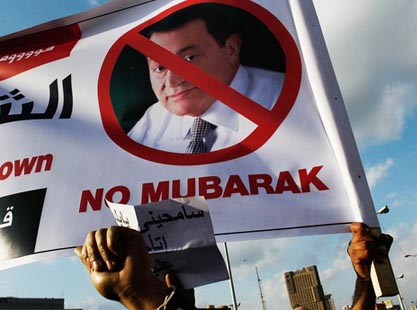
Following a week of unprecedented anti-regime demonstrations that culminated in the “million-person” march, Hosni Mubarak, Egypt’s president for the last thirty years, finally announced that he would not seek re-election in September. He reiterated his determination, however, to remain in office until the expiry of his term, in part, to assure a smooth transition in power and help effect the reforms demanded by the people. Pointing to his record of military service defending Egypt, as well as the achievements of his regime, he reiterated his determination to live out the rest of his days in Egypt and to die on Egyptian soil with the dignity of an Egyptian citizen.

Predictably, reaction to his speech has been almost uniformly negative, with many Egyptians dumbfounded, and others just enraged, that he still believes he is in a position to negotiate with the Egyptian people over the terms on which he will give up office. I may be the only Egyptian who is willing to take him up on this offer, but only if he is serious about the “citizen” part. Continue reading Why Egyptians Should Insist that Citizen Mubarak Stay

Streaming Revolution, Screaming Revolution


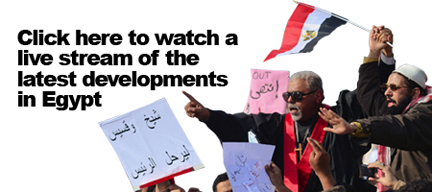
Al Jazeera offers live coverage of events in Egypt on the internet

Not even Rupert Murdoch, the media mogul who I suspect lies awake at night (just as many of his news outlets lie throughout the day) thinking of new ways to manufacture news, could have imagined the current crisis streaming live on the cable channels and over the Internet for well over a week. America has had its tea party and birthers with Fox gobbling up Sarah Palin to supplement the loonies already on the payroll. I suppose the Israel/Palestine issue was getting too stale, so why not a domino fury across North Africa and the Middle East? No, Murdoch did not cause the overthrow of Ben Ali, the massive anti-Mubarak protests in Egypt, the ripple effect of less virulent protests in Yemen, Jordan, Syria, and Sudan. There are very good local reasons why the streets are filled with angry people from all walks of life (well not the corrupt elites who benefit from dictatorial spoils).

It is not about hating the United States, not when the signs spell out freedom and democracy instead of “Death to America.” It is not even about Islam, certainly not the silly rantings of Glenn Beck that a new chalkboard caliphate is in the making. It is about frustration that reached the boiling point, the astronomical rises in food costs, the lack of jobs, the growing income gap between the average person and friends of the regime. When you have a president alleged to be worth 40 billion dollars, you get the picture of why there has not been an end to the takeover of Tahrir Square in Cairo. Continue reading Streaming Revolution, Screaming Revolution

Alwan for Egypt and Tunisia


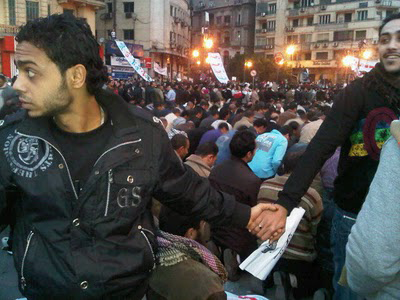
Egyptian Christians holding hands to protect, if in name, if in symbolism only, their Muslim countrymen during prayer as the protests continue; photo by Nevine Zaki in Cairo

Alwan for the Arts is sponsoring a fundraiser: In Solidarity -The Morning After on
Saturday, February 5, 2011 12:00 pm at Alwan for the Arts (16 Beaver Street
4th Floor, New York, NY 10004 (646) 732 3261

12:00-2:00 Reception
2:00-4:00 Al-Jazeera Live Feed
4:00-5:00 Skype and phone Conversations with Egypt and Tunisia
5:00-5:30 Break
5:30: Live Concert by Arab Performers

Suggested Donations: $25

Over a pier, the first beacon inflamed —
The vanguard of other sea-rangers;
The mariner cried and bared his head;
He sailed with death beside and ahead
In seas, packed with furious dangers.

By our doors Great Victory stays …
But how we’ll glory her advent?
Let women lift higher the children! They blessed
With life mid a thousand thousands deaths —
Thus will be the dearest answered.- Anna Akhmatova Continue reading Alwan for Egypt and Tunisia

What the Arab papers say

The Economist has a roundup of views from the Arab press on the unfolding events in Egypt (in English translation):

THE Arab press has been following the unrest in Egypt closely since the country’s first “day of rage”, over a week ago.

In Al Shorouk, an independent Egyptian daily newspaper, Emad El Din Hussein describes the sudden disappearance of religious and political barriers that have divided Egyptians in the past decades:

I swear by Almighty God that I cried with joy to see Egypt reborn in Tahrir Square on Tuesday night…Members of Muslim Brotherhood, Nasserists and Marxists were all present; you could recognize them from their physical appearance and the way they spoke or dressed. But they were few and far between…The majority of those present were ordinary citizens…thousands of people mingled together shouting different slogans and singing together…other demonstrators sat talking about poverty, unemployment and violation of human dignity.

Continue reading What the Arab papers say

Dawn

by Sherifa Zuhur, Sociology of Islam and Muslim Societies, February 1, 2011

I find it very difficult to assemble emotions, memories and impressions to respond to the events in Tunisia and Egypt. I have been responding sharply to others who seized the moment to offer their analysis. Certain characterizations of Egyptians did not sit well with me. I also fear that specific arguments are easily manipulated — that the centers of power who have so deftly dominated the media, huge sums of money and many segments of national elites will thwart the resurgence of popular resistance and demonstration of public will. But since those consulted by Barry and Joe and their “teams” are hard at work, spreading fear of a future Egypt non-compliant with the terms of Camp David, conjuring up the Islamist bogeyman, and (one fears) holding Hosni’s hand, we too should speak.

A group of Tunisian friends joined my Facebook page and share their jubilation and updates with me. Their example has inspired Egypt, however, to attribute events in Egypt to Tunisia, or social media and the impact of al-Jazeera would be wrong. Underlying events are Egyptians’ own lengthy struggles and perceptions that transformation is possible. To some degree, fear of counter-revolution is what froze civil expression in Egypt when the communists, the workers and the Muslim Brotherhood were each treated as intolerable threats to the Nasser government. Student activism became possible again in Sadat’s era, but firm rules were established about the “forbidden topics” (the infitah, peace with Israel, corruption, Saudi Arabia etc.) People complied, or they suffered professional defeat, exile, or worse. Then, for many years, violent attacks – against government officials, against judges, policemen, continued up to the crescendo of the firebombing of buses in Tahrir square and the massacre of tourists at Luxor. When the truce with the Gama’at Islamiyya and then Gihad Islami (Islamic Jihad) were achieved, the detentions, torture, and suspension of civilian liberties could have been lifted, but they were not. This year, I spent some time studying instances of extrajudicial actions versus what is acknowledged as state terror. Perhaps they differ in volume, but not in effect. We are speaking of drowning in cold water, the use of dogs, hanging, beatings, electrocution, and threats to family members. These were the weapons of government and are responsible, at least to some degree for the emergence of figures like Ayman al-Zawahiri. In the 2000’s as new “terror” threats emerged, the Minister of the Interior and his employees arrested thousands in the Sinai and elsewhere, and these tactics continued as well as public beatings and confrontations with demonstrators. The emergency laws were extended again, and again. Continue reading Dawn

Yemen is Not Tunisia, not Egypt

Yesterday I published a commentary on CNN Opinion about the recent protests in Yemen. I attach the start of this here, but the full account can be read at CNN.com.

(CNN) — “Yemen is not Tunisia.” These were the words that President Ali Abdullah Saleh spoke to his people on television last Sunday.

As street protests erupt in Yemen’s capital, it is not surprising that an Arab leader who has held power since a bloodless coup in 1978 would dismiss calls for his ouster.

But he was correct.

Although his regime has been accused of corruption, Saleh is no Zine El Abidine Ben Ali of Tunisia, nor even Hosni Mubarak of Egypt. Instead of using an iron fist, he has maintained power by cleverly playing off rivalries among tribal, religious and political divisions.

When he became president of North Yemen, he allied himself with Sheikh Abdullah al-Ahmar, who headed the most powerful tribal alliance in the North. After negotiating the unification of Yemen’s North with the socialist South in 1990, Saleh fostered a climate of grass-roots democratization before outmaneuvering the socialists for total control of the country.

Power is shared in Yemen largely because of the continuing local importance of tribal affiliation. This is not always understood. A major conflict near Yemen’s border with Saudi Arabia, for example, has been wrongly characterized as an Islamist rebellion. Like most political conflict in the region, the battle has religious overtones, but it is mainly over tribal autonomy…

I was interviewed this morning for the program Worldview of WBEZ in
Chicago and this interview aired today but is archived on the website.

Daniel Martin Varisco