Quoth the Raven (in Arabic)


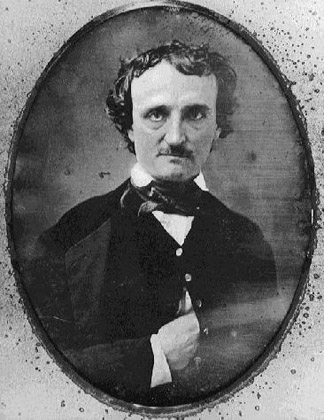
Edgar Allen Poe

New Release: Translation of the complete works of Edgar Allen Poe into Arabic

The complete works of the macabre and quintessentially American poet Edgar Allan Poe are now available in Arabic, giving more readers the chance to be chilled

Ahram Online, Thursday, June 2, 2011

Egypt’s National Center for Translation has published the complete works of the American poet, Edgar Allan Poe. It is translated into Arabic by Ghada Al-Halawani and reviewed by the novelist Edward El-Kharrat. This comes as a part of a poetry series supervised by Dr Rania Fathi. The first volume is entitled The Valley of Anxiety.

Edgar Allan Poe, born in 1809 in Boston, Massachusetts, the American poet, critic and one of the greatest short story writers is one of the leaders of American Romanticism. His fame came from his macabre stories and poems that sometimes reach into science fiction. He invented the Gothic horror novels or detective literature.

As life imitates art, his death is surrounded by mystery: at the young age of forty he was oddly found wearing clothes that were not his. The cause of his death remains a mystery – as well as the location of his grave. Continue reading Quoth the Raven (in Arabic)

Love in a Time of Torture


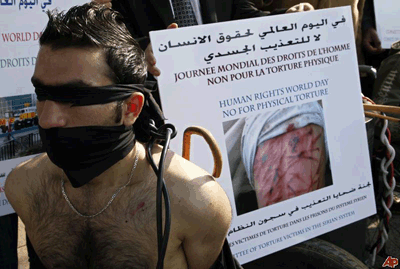
A young man’s account of sadistic torture in a Syrian secret prison, and how a girl’s note helped him through his pain.

Hugh Macleod and Annasofie Flamand, Al Jazeera, June 6, 2011

Arrested during a protest in the first days of the Syrian uprising, a young man endured acts of sadism and torture at the hands of Bashar al-Assad’s secret police.

As his body was beaten, whipped, electrocuted and worse; the prisoner could think only of the girl he loves, clenching a note from her in his hand as the torturers did their worst.

Told largely in his own words, this is his remarkable personal story of endurance and hope in a place filled with darkness and despair.

A small piece of paper held tight in a clenched fist. A lifeline to a better place.

Days become nights become days. The kicks, the punches, the questions, the insults, the humiliation and the pain.

“She was always on my mind in the toughest moments during the torture. The only thing that relieved the pain was my belief that, at that moment, she was comfortable in her bed.”

The beatings begun on the police bus driving arrested protesters to one of Syria’s most notorious secret police branches.

“Your mother is a whore!” screamed one of the policemen, as he slammed the butt of his rifle into the prisoner’s face. “We will f*** her and your sister!”

But the young man wasn’t listening.

“In the first five minutes I was only thinking of her. I was so afraid for her. But when the bus drove off I saw her trying to phone somebody, so I was so happy that she’s wasn’t under arrest. I didn’t know then that they arrested her a few minutes later. Continue reading Love in a Time of Torture

Is it civil war yet in Yemen?


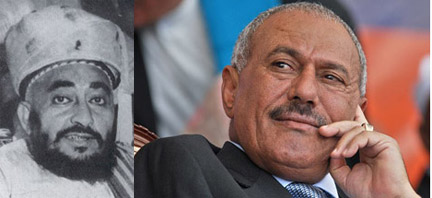
Imam Ahmad, left; Ali Abdullah Salih, right

[Webshaykh’s Note: This is a nice summary of the situation in Yemen just before Salih was wounded and left for Saudi Arabia.]

An avoidable civil war in Yemen that has already begun

by Brian O’Neill, The National, June 5, 2011

The scenes coming to us out of Yemen appear as raw and bloody chaos: running gun-battles through the streets, protesters screaming fiercely and the president, Ali Abdullah Saleh, apparently wounded in a mortar attack at the weekend (and rumoured to be headed to Saudi Arabia for treatment).

But while it looks like madness, the falling apart of Yemen is deeply rooted in the inexorable logic of its own history, the personalities of the major players and a looming generational shift. While civil war is not inevitable, circumstances have made it likely, and it may be too late to prevent the country from violently tearing apart its own seams.

Probably the biggest question swirling around the fighting is why? Not why is President Saleh clinging to power, but why has he established a series of feints and dodges that would appear to propel unrest rather than restore stability?

For instance, why did the president offer to sign a GCC-sponsored transfer of power, only to back away multiple times? If he had no intention of signing, why even bother with the pretence?

The answer to these questions is one of the keys to understanding why Yemen is where it is.

Mr Saleh has ruled parts or all of Yemen for over 30 years. But even the “all” in that sentence is misleading. Mr Saleh has never ruled all of Yemen, even if he has arguably the longest reach in his country’s ancient history. Yemen is governed by negotiation and appeasement, by the carrot and the stick, by squeezing one party while massaging the other.

Rule in Yemen is very personal; the president, like the Imam before him, is intimately involved in tribal politics – a game of swirling alliances. Continue reading Is it civil war yet in Yemen?

How appalling, Mr. Naipaul


Diana Abu-Jaber is the author of five award-winning books, including the forthcoming novel Birds of Paradise

From One Writer To Another: Shut Up, V.S. Naipaul

by Diana Abu-Jaber, NPR, June 3, 2011

Dear V.S. Naipaul:

You recently remarked, “I read a piece of writing and within a paragraph or two I know whether it is by a woman or not. I think [it is] unequal to me.”

I was sad to read this, to realize that you’re apparently unable to think beyond schoolyard rankings and peevish comparisons, that you’re incapable of recognizing grace and power from unexpected and unfamiliar places, such as a woman’s experience.

But what worries me more is your comment that that women write with “sentimentality, the narrow view of the world,” because, “inevitably for a woman, she is not a complete master of a house, so that comes over in her writing too.”

Your use of the word “master,” is chilling. Continue reading How appalling, Mr. Naipaul

Ali Abdullah Salih and Yogi Berra


The picture chosen by The Washington Post for its lead article today

The speculation about the health and future of President Ali Abdullah Salih of Yemen is wild today. On Friday he was wounded by a rocket attack on his compound that killed several others. I first heard about this when someone called me and mentioned that in Pakistan they were saying he had been killed in the attack. When he only gave an audio message afterwords, and that with a clearly heavy breathing voice, it was still not clear what his injuries were. Since government sources are certainly not believable and no reporters were on the scene, all kinds of rumors spread easily. Now it is known that Salih with a number of family members and some of the other wounded are in Saudi Arabia for treatment.

So what next? The BBC takes a cautious approach with the headline “Yemenis rejoice as Saleh leaves but fighting continues” while The Washington Post is more optimistic, leading the headlines with “Yemeni crowds cheer as Saleh transfers power,” and stating “The departure of Yemen’s president for Saudi Arabia raises the prospect that a key U.S. ally in the fight against al-Qaeda has lost his grip on a nation tumbling into chaos.” Over at Waq al-Waq Gregory Johnsen reflects the hopes and fears of the situation:

“My guess is that his wounds are much more severe than Yemeni officials have let on, as Salih was well aware that leaving Yemen would make it incredibly difficult for him to return. Continue reading Ali Abdullah Salih and Yogi Berra

The al-Ahmar Family: Who’s who


Sadiq al-Ahmar and Ali Abdullah Salih before the shelling started

by Gregory Johnsen, Waq al-Waq, June 3

The news is coming fast and furious out of Sanaa. Not much is known for certain and it will likely be a while before we have all the details, but here is the broad outline:

Today, following Friday Prayers, forces loyal to President Salih opened shelling directed in the general direction of Hamid al-Ahmar’s house in the wealthy Sanaa suburb of Hadda.

Making things more complicated is the fact that Ali Muhsin, the defected general and head of the 1st Armored Division, is Hamid’s next door neighbor. And given how inaccurate Yemeni troops can be at lobbying shells towards a target it is unclear which one of the two enemies of Salih they were aiming at. Maybe both.

Shortly after that two shells hit the mosque inside the presidential palace, reportedly wounding a number of top officials – although the information at this point is mostly contradictory rumors, so I’ll hold off speculating on the identities of the injured.

What I would like to do, instead, is to give a quick run down of the al-Ahmar family, particularly the four eldest. Continue reading The al-Ahmar Family: Who’s who