New blog on Yemen


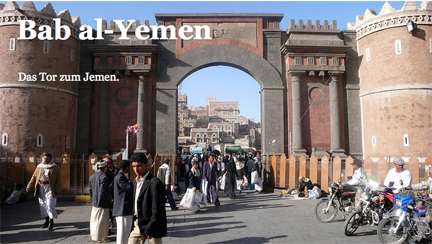
There is a new blog on Yemen: Bab al-Yemen: Das Tor zum Yemen; this is created by Marie-Christine Heinze, who is a graduate student at the Bielefeld Graduate School in History and Sociology. Marie-Christine is working on her Ph. D. about the “Social Life of Weapons in Yemen,” including the famous Yemeni jambiyya. In her new blog she has posted a review of a recent book privately published by Stephen Gracie entitled Jambiya: Daggers from the Ancient Souqs of Yemen.

French Center for Yemeni Studies threatened


Le CEFAS : un instrument indispensable de compréhension de la péninsule Arabique

by Laurent Bonnefoy (chercheur, Institut français du Proche-Orient)

En 2011, jamais la France et l’Union européenne n’ont autant eu besoin de comprendre les sociétés arabes. Jamais les chercheurs spécialistes du monde arabe contemporain n’ont autant répondu à une demande sociale venant tant des médias et des diplomates que même parfois des entreprises. A l’heure où le Yémen connaît un profond mouvement de révolte et où s’expriment des aspirations au changement, à la liberté et à la démocratie, le ministère des Affaires étrangères songe à mettre fin à l’expérience du Centre français d’archéologie et de sciences sociales de Sanaa (CEFAS).

Ce centre, créé sous le nom de Centre français d’études yéménites en 1982 sous la double tutelle du ministères des Affaires étrangères et du CNRS, a en près de trente ans permis à des centaines d’étudiants et de chercheurs de se familiariser avec les sociétés de la péninsule Arabique, d’apprendre l’arabe et de mener à bien de nombreux projets de recherche avec les partenaires locaux qu’ils soient yéménites, saoudiens, omanais ou autres. Son travail d’interface avec les institutions yéménites et du Golfe, sa bibliothèque exhaustive ont fait du CEFAS un instrument unique au monde, valorisé à l’échelle internationale. Les archéologues liés à cet institut ont été à la pointe des découvertes sur les cités antiques de l’Arabie Heureuse. Ses historiens ont pu analyser et réévaluer tant les spécificités que l’intégration ancienne de la péninsule Arabique dans le système monde. Ensemble ils ont directement contribué à valoriser, mais également à préserver, un patrimoine d’une richesse inestimable qui reste encore pour une grande part inconnu. Les chercheurs en sciences sociales ont pour leur part travaillé à rendre intelligible les sociétés et systèmes politiques de cette région du monde arabe. Le rôle de chacun, dans un Yémen et dans un Golfe arabo-persique en transformation, est dès maintenant d’appréhender et d’analyser les transformations et, à l’usage de chacun en France, en Europe et dans le monde, de fournir de nouvelles grilles de lectures indispensables. Continue reading French Center for Yemeni Studies threatened

New Orientalism at a German University?

By Andreas Neumann, Erlangen Center for Islam & Law in Europe (EZIRE)

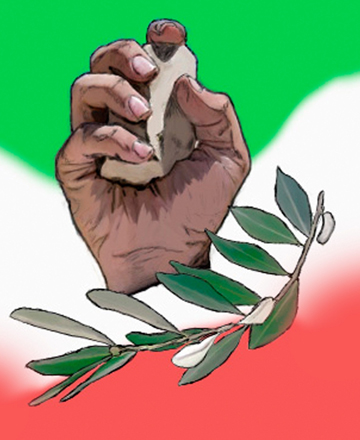
Recently, at one of the many German universities of excellence (names do not matter), students and other citizens were invited to a lecture with the title: “Stoning: a Non-Islamic tradition.” The hosts were the Seminar for Arab and Islamic Studies and the Institute of Criminal Sciences. The picture represented here is taken from the poster hanging all over the campus and also in the city. At its center, you see a huge hand on the point of casting a crude edged stone in the direction of the observer. In the foreground, there is an olive branch. The colors in the background evoke the national flag of Iran flying in wind. A short analysis might be fruitful. The picture is an example of contemporaneous stereotyped thinking and also transports a message contrary to the requirements of reason.

The hand, disambiguated by the context, symbolizes the gruesome act. It is combined with the enlarged olive branch. The olive branch was a symbol of peace in Greek and Roman antiquity, when it also was worn as an adornment by brides. Retrospectively, it was associated with Noah who sent out a dove which returned with an olive leaf in its beak (which became a branch in the Vulgate). This sign indicated that the water was receding. There might exist an older model of this image, since the association of the dove, the olive branch or even the rainbow with peace does not follow conclusively from the text. The Quran has not taken it over in its frequent references to the Genesis version of the story of the Flood (also see the account by Heinrich Speyer, Die biblischen Erzählungen im Qoran, Gräfenhainichen 1931, pp. 89-115). Nevertheless, the olive tree (by the way, in German more often called “Ölbaum”, oil tree) is cited several times in the Quran, especially in the beautiful verse of the light, Q 24:35, where the blessed olive tree in question is characterized as neither Eastern nor Western (cf. Zechariah 4:3-11). The olive branch has become an international symbol of peace and is represented on the emblem of the United Nations, where two of them symmetrically embrace a map of the world. Continue reading New Orientalism at a German University?

Northrop Frye and the Qur’an


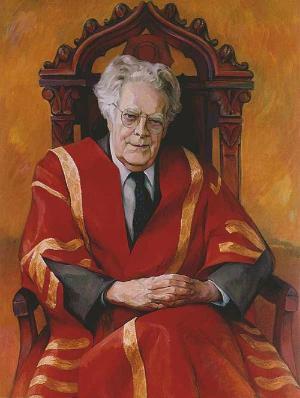
Northrop Frye

by Todd Lawson, University of Toronto, Dept. of Near and Middle Eastern Civilizations

In the course of my ongoing research project, studying the Qur’an as a special instance of apocalyptic discourse, I have found that the writings of Northrop Frye hold important clues and suggestions for both the apocalyptic élan of the Qur’an and the related problem of the Qur’an’s status as a specific form of epic. The two seem to go together and I am exploring these cross-pollinating and mutually energizing literary dynamics in the book that will result. In the meantime, I have found that Frye deserves to be mined more deeply for what is obviously his irresistible interest in the Qur’an.

Over the last two years, I have conducted a grad seminar at the University of Toronto entitled “The Quran and the Apocalyptic Imagination.” A large part of the discussion in this course has focussed on Frye and what he might have to say about the Quran. I have also conducted an undergraduate seminar “How Does the Qur’an Mean” in which two texts have been assigned: the Qur’an and Frye’s Double Vision. It has been a revelation. In part, this has been an attempt to have a conversation that I never had the nerve to initiate while the great man was alive and working away happily, virtually across the street. In any case, the results have been extremely encouraging. I am now delving deep into the Frye archive and studying his marginalia and other related documents.

Frye’s explicit references to Islam and the Qur’an, though few, have long been in print. I am calling for a workshop to see if we can manage a coherent discussion around this general theme. Continue reading Northrop Frye and the Qur’an

Aesop’s Fabulous Camels (and an Ass) #2


Aesop’s Fables, 1888, p. 132

One of the joys of returning home to where I was born is going through the books that my grandmother once owned. In a previous post I mentioned an 1888 edition of Aesop’s Fables, translated by George Fyler Townsend. In leafing through the fables I found several that talk about camels and one that refers to an “Arab.”

In this post I provide three of the fables, Continue reading Aesop’s Fabulous Camels (and an Ass) #2

Yemen’s Unfinished Revolution


Photo by Karim Ben Khelifa

By TAWAKKOL KARMAN, The New York Times, June 18, 2011

Sana, Yemen

AFTER more than five months of continuous protests, I stand today in Change Square with thousands of young people united by a lofty dream. I have spent days and nights camped out in tents with fellow protesters; I have led demonstrations in the streets facing the threat of mortars, missiles and gunfire; I have struggled to build a movement for democratic change — all while caring for my three young children.

We have reached this historic moment because we chose to march in the streets demanding the resignation of President Ali Abdullah Saleh, an end to his corrupt and failed regime and the establishment of a modern democratic state. On June 4, our wish for Mr. Saleh’s departure was granted, but our demand for democracy remains unfulfilled.

Following months of peaceful protests that reached every village, neighborhood and street, Yemen is now facing a complete vacuum of authority; we are without a president or parliament. Mr. Saleh may be gone, but authority has not yet been transferred to a transitional presidential council endorsed by the people.

This is because the United States and Saudi Arabia, which have the power to ensure a peaceful transition to democracy in Yemen, have instead used their influence to ensure that members of the old regime remain in power and the status quo is maintained. American counterterrorism agencies and the Saudi government have a firm grip on Yemen at the moment. It is they, not the Yemeni people and their constitutional institutions, that control the country. Continue reading Yemen’s Unfinished Revolution

Aesop’s Fabulous Camels #1


One of the joys of returning home to where I was born is going through the books that my grandmother once owned. One of these is an 1888 edition of Aesop’s Fables, translated by George Fyler Townsend, as shown in the frontispiece above. The cover, which is dark brown, notes it is a “Caxton Edition” and includes a marvelous quote from Thomas Carlyle: “May blessings be upon the head of Cadmus, the Phoenicians, or whoever it was that invented books.” I suppose today we must add: “And curses upon the creator of the Internet idea of an e-book.” As noted in the preface, not all of these tales date back to Aesop; some indeed were thought up by Christian monks in the Middle Ages. According to the same preface no book, apart from the Bible, had a wider circulation in the era just prior to the printing press.

After commenting that these fables have been translated into languages, East and West, the preface continues by saying that they “have been read, and will be read, for generations, alike by the Jew, Heathen, Mohammedan, and Christian” (p. xviii). In leafing through the fables I found several that talk about camels and one that refers to an “Arab.” Aesop might be surprised to find these, but since it is all Greek to me I am not sure how fluent he might have been with the unflappable ship of the desert.

In this post I provide two of the fables, with the rest to come in a future post. Continue reading Aesop’s Fabulous Camels #1