There is a dangerous dualism that has haunted Islamic societies since the very start of the faith. I am speaking about the haram that results from individuals and groups that seek to enforce a distinction between haram and halal through violence. The recent waves of sectarian killings are a chilling reminder of the harm that can be caused in the name of stamping out haram. In the north of Nigeria, as reported by al Jazeera, as many as 150 people may have been killed in a single day by Boko Haram, a militant group whose name means “Western education is sacrilege.” The irony of this name is tragic. When I think of the hadith “Seek Knowledge even unto China,” I do not think that the Prophet only meant to look eastward for knowledge. When I think of the extraordinary contributions Muslim scientists and philosophers made to the earlier classical heritage of knowledge, I do not think the Prophet would have disapproved. When I think of sacrilege, I remember that the Prophet forbade his followers to violate the truce of the sacred month and prohibited those who fought for him from mutilating the bodies of those who fought against him. There is much that is haram in this world, but it appears that the value of human life is not as sacred for some Muslims as it is for Allah as the Merciful One or for Muhammad as a Prophet for peace. Continue reading The haram that is not sacred
Tabsir Redux: Ibn Abī Bakr al-Azraq on Massage Oils: #1
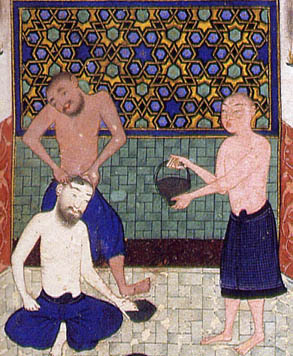
The Arab physician IbrÄhÄ«m ibn ‘Abd al-Rahman ibn AbÄ« al-Azraq, wrote an important medical text near the end of the 9th century A.H./fifteenth century C.E. This is his TashhÄ«l al-manÄfi‘ fÄ« al-á¹ibb wa-al-ḥikma, which was published in Cairo in the late 19th century and has been republished many times since then. One of his chapters deals with adhÄn, that is oils and lotions that were rubbed on the body either in the hot bath or just for general health. Here is my translation of his account on oils.
Section on the Benefit and Influence of Oils (adhÄn)
The Prophet, may Allah bless him and grant him salvation, said: “Eat olive oil (zayt) and rub it on the body.†It is a remedy for seventy illnesses, one of these being leprosy (judhÄm). He said: “For forty nights, Satan will not come near anyone who has olive oil applied.†Zayt is the extraction of the olive, according to al-DÄ«wÄn. Cold and wet, but said to be hot. It softens (yadbughu) the stomach, strengthens the body, energizes movement, and there is benefit for one in old age in applying it to the eyes against dimming of vision. According to Ibn ‘Amr the Prophet, may Allah bless him and grant him salvation, said: “Use it to season bread and rub it on the body, because it comes out of the blessed tree (al-shajara al-mubÄraka). Continue reading Tabsir Redux: Ibn AbÄ« Bakr al-Azraq on Massage Oils: #1
Tabsir Redux: Apocalypse Watch: The Man Who Knows Squat
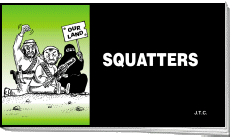
Most people find it hard to take cartoons seriously, apart from political satire and that can become a deadly issue, depending on the target. Given the recent Danish cartoon controversy it would seem that comics and religion do not mix well or at least settle well for the believers who see themselves as the target. But what about comic relief for the political struggle between Israel and the Palestinians? Fundamentalist tract artist Jack Chick, whose comic empire is dedicated to winning souls for Christ by drawing on God’s hate, has been using his pen to spread a rather sinister version of the fundamentally reduced Gospel for over 40 years. One of his more recent offerings is called “The Squatters†and it provides a virtual roadmap to apocalypse. Continue reading Tabsir Redux: Apocalypse Watch: The Man Who Knows Squat
Thugs join the protests
Yemen Post is reporting that the thugs hired by the government to attack and molest the protesters in Yemen are now themselves protesting because the government is not paying them what it promised. As one Yemeni doctor noted, “I don’t know whether to cry or laugh! Have Yemeni stoop so low that criminals dare now protest? Is there anything sacred anymore, any shame at all left in this country.”
Over and almost out (of Iraq)
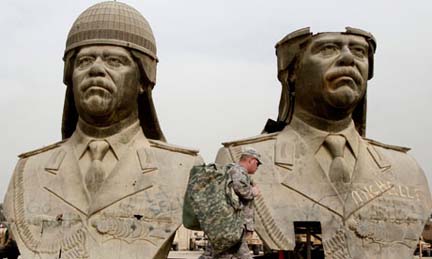
The Iraq war is finally over. And it marks a complete neocon defeat
by Jonathan Steele The Guardian, October 23, 2011
The Iraq war is over. Buried by the news from Libya, Barack Obama announced late on Friday that all US troops will leave Iraq by 31 December.
The president put a brave face on it, claiming he was fulfilling an election promise to end the war, though he had actually been supporting the Pentagon’s effort to make a deal with Iraq’s prime minister Nouri al-Maliki to keep US bases and several thousand troops there indefinitely.
The talks broke down because Moqtada al-Sadr’s members of parliament and other Iraqi nationalists insisted that US troops be subject to Iraqi law. In every country where they are based the US insists on legal immunity and refuses to let troops be tried by foreigners. In Iraq the issue is especially sensitive after numerous US murders of civilians and the Abu Ghraib scandal in which Iraqi prisoners were sexually humiliated. In almost every case where US courts tried US troops, soldiers were acquitted or received relatively brief prison sentences.
The final troop withdrawal marks a complete defeat for Bush’s Iraq project. The neocons’ grand plan to use the 2003 invasion to turn the country into a secure pro-western democracy and a garrison for US bases that could put pressure on Syria and Iran lies in tatters.
Their hopes of making Iraq a democratic model for the Middle East have been tipped on their head. Continue reading Over and almost out (of Iraq)
Tabsir Redux: Opening the Qur’an
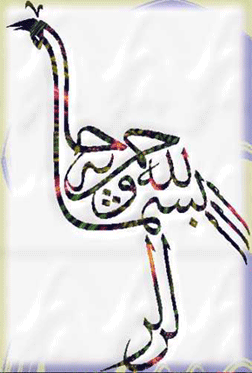
Note: The Qur’an can be divided into thirty equal parts. One part takes only twenty-four reading minutes, and the whole Book requires 12 reading hours. There are 114 chapters, and 6,236 Arabic verses (Abu ‘Amr Al-Dani in his book Al-Bayan), containing 77,439 Arabic words (reported by Al-Fadl bin Shadhan) made up of 371,180 Arabic letters (Abdullah b. Kathir reporting Mujahid, although there are different accounts). By contrast the King James Version of the Christian Bible (OT and NT) has 783,137 words and 3,566,480 letters. Muslims believe the Quran in Arabic is the actual Word of God given to Muhammad through a series of revelations from 610-632 C.E. and not written down as a “book†until after Muhammad died.
Given the general ignorance in American society of Islam, especially the theology based on the teachings in the Quran, it is important to go back to the beginning, the essence, the opening, the words that are by definition significant to all Muslims. This eloquent key is the opening (fatiha) of the text, a set of verses as repeated by Muslims daily as the Lord’s Prayer is by Christians. Continue reading Tabsir Redux: Opening the Qur’an
Night and Day at the Movies

There are quite a few classic Arabic movies available in full on Youtube, if you search by the Arabic name. An example is the early Youssef Chahine film Bâb al-Hadîd (Cairo Station in English) in the original Arabic without subtitles.
Camping Out for the Rapture
You may remember that May 21, 2011 was supposed to be the day the music stopped, well at least Gospel songs, since all the “real” Christians were supposed to be raptured into the air so that all hell could finally break loose here on earth. This was one of several predictions of the apocalypse by Rev. Harold Camping, who runs a “Family Radio” Bible-debasing empire. When May 21 passed, Rev. Camping when back to the numbers and lo and behold there was a new date of October 21, 2011. As he put it on his website, which has not been changed in the past several days:
Thus we can be sure that the whole world, with the exception of those who are presently saved (the elect), are under the judgment of God, and will be annihilated together with the whole physical world on October 21, 2011, on the last day of the present five months period. On that day the true believers (the elect) will be raptured. We must remember that only God knows who His elect are that He saved prior to May 21.
Mr. Camping and his followers are still here, so either the date is wrong again or perhaps the truth is that all the “real” Christians were indeed raptured out of this world but in fact there were none left, even Billy Graham, for the big event. There are a number of Christian groups who insist other Christian groups are not really Christian, such as the attack on Mitt Romney as a heretic Mormon or the man who on the day after the world was supposed to end disrupted a canonization ceremony in the Vatican and burned a Bible. Given that there are also Muslim groups which insist certain other Muslim groups are not really Muslim, perhaps there are no “real” believers at all, at least not in the narrow sense of the Campings and Ibn Taymiyas of this world.
This time around, without the “Family Radio” media campaign on billboards, there were other important news items; there were actually plenty of important news items back on May 21 as well, but this time there were no annoying reminders on Facebook that the secular jig was up. There will be more dates proposed and no doubt more gullible individuals will stand ready to be beamed up to Beulah Land. Camping might take some note of hope in the fact that Turkey has just experienced an earthquake, although it came a couple of days after the “for sure” Biblical date. And, after all, Turkey is mainly a Muslim country. But then we had a quake here on the east coast a month or so ago (perhaps Camping believes our President is secretly a Muslim, like some 20% of Americans and 30% of Republicans apparently think).
You might be wondering why yet another failed end-of-the-world prediction by a Bible-belabored Christian who thinks he is one of the few “real” Christians is worth a commentary on a blog devoted to thoughts on Islam and the Middle East. For most Americans, even the bulk of self-styled “evangelicals,” Camping represents a lunatic fringe. As the votes are being tallied in Tunisia, Egypt prepares for a vote, Libya begins the process of picking up the pieces after Qaddafi’s exit and Yemen is still waiting for Godot (I mean Ali Abdullah Salih) to go, there is a fear among many Americans that after the dictators another form of lunacy will take hold: Muslims who argue that only “their” way of being Muslim is valid. Actually, this problem is quite widespread and it is not as simple as Sunni vs. Shi’a, although that is an old and convenient fault line. Continue reading Camping Out for the Rapture