A Swede and a camel in Yemen


by Iona Craig, The National, January 9, 2012

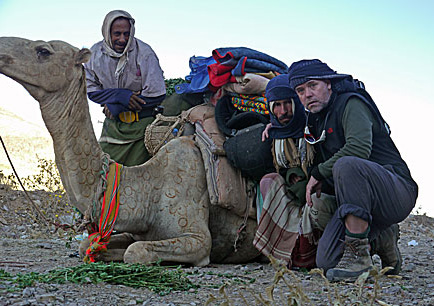
A Swedish adventurer crossing Yemen by camel hopes his journey will encourage tourists to see beyond the political turmoil and violence that has engulfed the country for nearly a year.

Mikael Strandberg set out on December 7 on a 380-kilometre trek across the treacherous highlands, the first leg of his Yemen venture, to disprove the purveyors of pessimism.

“I don’t know what they [the tourists] are waiting for … it is such a wonderful country with great potential,” he said, after arriving in Sanaa after a two-week march through the toughest terrain in the Arabian Peninsula.
Along with two Yemeni companions, Mr Strandberg is in the initial phase of a journey that will cross the country from the western coastal plains of Hodeida to the edge of the world’s largest sand desert, the Rub’ Al Khali, or Empty Quarter, and beyond to Oman.

The explorer, 48, who fell in love with both the country and his wife Pamela, an American, during a visit to
Yemen three years ago, holds fond memories of Sanaa and the Yemeni people.

“We decided to go and try to make a difference and give a different perspective from the one portrayed by the media,” said Mr Strandberg. Continue reading A Swede and a camel in Yemen →

For the love of Jesus


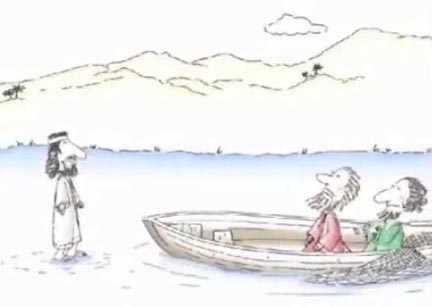
There are a number of issues on which Christians and Muslims agree, despite the historical antagonism that Islamophobia and Sectarianophobia perpetuate. For example, boycotting the power drink “Red Bull” in South Africa. A recent ad showed Jesus walking on the water after he drank “Red Bull”, stepping gingerly on the rocks that he could see beneath his feet in the water. The only miracle was in the drink, if you follow the ad. While the advertisers did not expect people to take the ad literally, gulp down their “Red Bull” and promenade without their water skis, the premise of the ad indeed denies the miracle, a denial that many Christians accept post-Hume with little problem. As reported in The Washington Post and picked up by a number of Muslim media outlets, such as Cii, South Africa’s Roman Catholic hierarchy told the faithful to give up “Red Bull” for Lent. And then, South Africa’s Muslim Judicial Council, in solidarity, joined the boycott by saying that an affront to the Prophet Issa (Jesus) is an affront to Muslims.

From the Catholic perspective, at least one that focuses less on “turn the other cheek” and more on “Get thee behind me, Satan,” the moral outrage is understandable. Think of a possible amendment to the catechism as follows:

Question: “What would Jesus do if a television commercial made fun of his miracles?
Answer: “If you believe that Jesus walked on “Red Bull”, then render unto “Red Bull”, but if you believe Jesus walked on water, then don’t drink this whited sepulcher of a beverage during Lent. Remember that at the wedding in Cana Jesus turned the water into wine, not “Red Bull.”

Although I have not found any specific news accounts, I suspect that the Bible-believer missionaries will forego “Red Bull” as well, even if they don’t hold fast to the Lenten fast.

But the fact that a major Muslim organization in South Africa has joined in condemnation of the ad is a cautious welcome sign, no matter what you think of the ad itself. Continue reading For the love of Jesus →

Numismatics at Hofstra


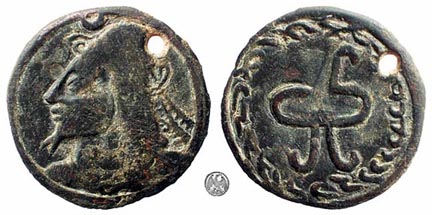
Sogdiana, Chach 3rd century

The Middle Eastern and Central Asian Studies program at Hofstra announces
the Fourth Seminar on Central Asian and Middle Eastern Numismatics in Memoriam Boris Kochnev

Hofstra University, Breslin Hall 217, March 17, 2012
(Directions to Hofstra)

Attendance is free and all are welcome.

11:00 am
Daniel Varisco (Hofstra University)
Opening Remarks

11:15 am
Vladimir Belyaev (Zeno.ru, Sankt-Petersburg) and Aleksandr Naymark (Hofstra University)
Ancient Sogdian Coins from the Center of Kashka-darya Valley

12:00 noon
Stefan Heidemann (Hamburg University)
A Hoard from the Time of the Collapse of the Sasanian Empire

12:45 pm Lunch Break

1:30 pm
Michael Bates (American Numismatic Society, New York )
How Ziyad Made a Name for Himself:
Coins and the Chronology of Ziyad ‘son of his father’/’son of Abi Sufyan’ Continue reading Numismatics at Hofstra →

Berserk, Breivik and Barzakh


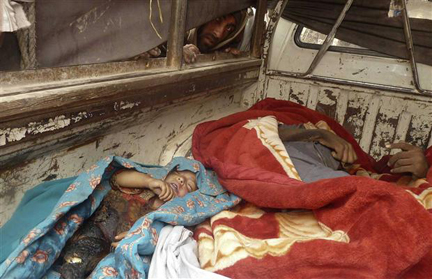
An Afghan man looks over the dead bodies of people killed by coalition forces in Kandahar province, March 11, 2012. Afghanistan’s defence ministry said coalition forces killed 15 civilians in a shooting spree in Kandahar province on Sunday.
Photograph by: AHMAD NADEEM, REUTERS

The senseless killing of more than a dozen Afghan villagers, while they slept, by a U.S. soldier has captured the headlines worldwide. Many of these headlines are variants of “In Afghan Civilian Killing Rampage, U.S. Soldier May Have Gone ‘Berserk'” The choice of “berserk” to describe this act is telling, since the word itself derives from old Norsk in reference to, as the OED puts it, “A wild Norse warrior, who fought with frenzied fury.” In the Norse legend, however, the warrior had a cause, while the Rambo-rampage here was a solo act, a random act as far as war strategy is concerned. The explanation that immediately comes to mind is that he “lost his marbles,” perhaps because those marbles had been jostled too many times during his three tours in Iraq.

A few days ago a court in Norway ruled that Anders Behring Breivik, “the 33-year-old right-wing extremist psychotic,” as USA Today terms him, might go to a psychiatric ward rather than prison for his “bomb and shooting rampage” that left 77 people, many who were young people, dead. News reports also labeled Breivik as someone “gone berserk.” But neither in Norway nor Kandahar do the men who aimed their guns at innocent victims demonstrate any kind of courage in the “just war” alibi. The old Norse warrior Berserk exuded raw courage, battling without armor and with the intensity of a bear or wolf. Of course, he was not a good man, having killed his wife after she delivered 12 sons (or so we are told in legend), but his battle-axe was aimed at fellow warriors, not sleeping children. One can understand, even if it is hard to appreciate, the fury of a battle, when blood runs hot as it is slashed out of bodies in hand-to-hand combat. But is “berserk” really the right word for deliberate singling out of men, women and children that in all normality are innocent? Continue reading Berserk, Breivik and Barzakh →

AIPAC, buy me!

The leading right-wingers in America view Israel as a kind of political football made out of seven million residents, a football that can be kicked at the wall over and over.

By Boaz Gaon, Haaretz, March 7, 2011

I, Boaz Gaon, being of sound mind and body, hereby offer myself for sale to AIPAC. Should the committee decline, I offer the opportunity to Sheldon Adelson. In any event, I offer my internal organs for free, as a confidence-building gesture, to leading right-wingers in America – to all those who view Israel as a kind of political football made out of seven million residents, a football that can be kicked at the wall over and over. After all, we Israelis don’t feel any pain, and we know that our destiny is to be tossed around like a ball in some exclusive gym by Republican lobbyists, before they head off to the sauna and then cocktails.

I’m offering myself for sale even though I was warned by my lawyer that this is an irreversible step, and that in all likelihood I’ll find myself at Israel Hayom newspaper’s next conference, and/or at the next reunion of White House veterans who worked for George W. Bush – persons who are partners of the Israeli right (Daniel Pipes, Elliot Abrams ) – naked and trussed up, with an apple stuffed in my mouth and served on a silver platter that has a likeness of Irving Moskowitz inscribed on it.

I’m doing this because I can read the writing on the wall. Continue reading AIPAC, buy me! →

Saving Face


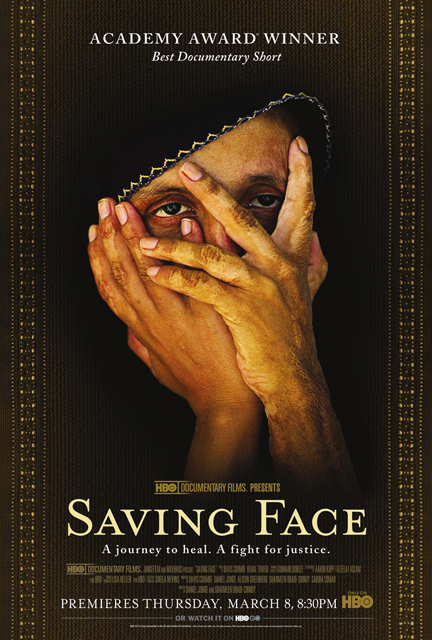
HBO is rebroadcasting the documentary “Saving Face” today (8:45 am) about the attacks in Pakistan on women. It will also be available in their on-demand service.

Every year in Pakistan, many people – the majority of them women – are known to be victimized by brutal acid attacks, while numerous other cases go unreported. With little or no access to reconstructive surgery, survivors are physically and emotionally scarred, and many reported assailants, typically a husband or someone else close to the victim, are let go with minimal punishment from the state.

This year’s Oscar winner for Best Documentary Short, SAVING FACE chronicles the arduous attempts of acid-attack survivors Zakia and Rukhsana to bring their assailants to justice, and follows the charitable work of Dr. Mohammad Jawad, a plastic surgeon who strives to help them go beyond this horrific act and move on with their lives. Directed by Oscar and Emmy nominee Daniel Junge and Emmy-winning Pakistani director Sharmeen Obaid-Chinoy, SAVING FACE debuts THURSDAY, MARCH 8 (8:30-9:15 p.m. ET/PT), exclusively on HBO.

South Arabia and the Berber Imaginary


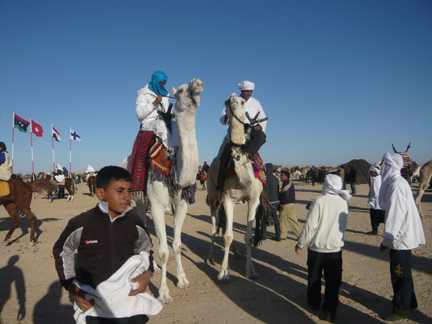
Mahri camels at the International Festival of the Sahara in Douz, Tunisia,
December 24, 2012. Photo by Sam Liebhaber.

by Sam Liebhaber

One of the long-standing myths of Berber ancestry places their origins in Yemen from whence they were dispatched to North Africa in the service of ancient Ḥimyarite kings. Although this chapter in the mythological prehistory of the Arab world can be refuted on the grounds that the Berber are indisputably indigenous to North Africa, the offhand dismissal of the South Arabian-Berber imaginary overlooks an important sociolinguistic kinship between the Berber of North Africa and one of the last indigenous linguistic communities of the Arabian Peninsula: the Mahra of Yemen and Oman.

A number of socio-cultural parallels distinguish the Berber and Mahra from the other minority language communities of the Middle East. For one, the Mahra and Berber are members of the Islamic ʾummah, unlike many of the other minority language communities of the Arab world where linguistic boundaries are frequently coterminous with religious divisions. Further, the Berber and the Mahra did not inherit a written tradition that includes religious and literary texts. As a consequence, the Mahri and Berber languages are frequently consigned to the category of “lahja,” an Arabic term that signifies any non-prestigious, vernacular idiom that lacks of historical or social value.

Without their own written history or affiliation to a prestigious, non-Arab civilization, the Mahra and Berber are more easily “willed” into historical narratives of “Arabness” (ʿurūba) than the other language minority communities of the Arab world. This motif is the mainstay of modern Arabic scholarship on Berber and Mahri genealogical and language origins. A sample of a few recent titles demonstrates this point: The Berber: Ancient Arabs (al-Barbar: ʿArab qudāmā, al-ʿArbāwī, Tunis: 2000), The Arabness of the Berber: The Hidden Truth (ʿUrūbat al-Barbar: al-Ḥaqīqa al-Maghmūra, Mādūn, Damascus: 1992), Comprehension of Arabic and the Secret of the Mahri Language (Fiqh al-ʿArabiyya wa-sirr al-lugha al-mahriyya, al-Ways, Sana’a: 2004) and Ancient Arabic and its Dialects (ie, Mahri, al-ʿArabiyya al-qadīma wa-lahajātuhā, Mārīkh, Abu Dhabi: 2000).

Even if contemporary scholarship on Mahri and Berber origins is problematic, it is conceivable that historical intersections between the Berber and the Mahra gave medieval Arab historians a justifiable basis to propose their common ancestry. Continue reading South Arabia and the Berber Imaginary →