Meanwhile in Socotra


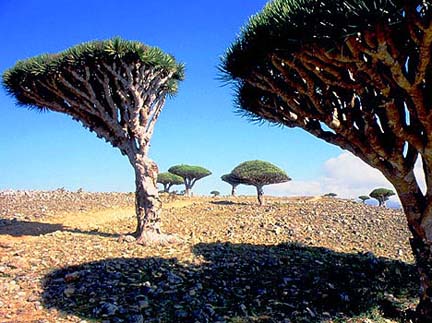
The famous dragons blood tree; Photo by Valerio Pandolfo

Revolution in Socotra: A Perspective from Yemen’s Periphery
by Nathalie Peutz, Middle East Report #263, Summer 2012.

At the beginning of 2012, as Egyptians and Syrians marked the second year of their revolts, protesters also took to the streets of Hadiboh, the tumbledown capital of Yemen’s Socotra archipelago (pop. approx. 50,000). Like demonstrators elsewhere, the Socotrans were calling for both local administrative change and national political reform. While the Socotran protests, occurring since March 2011, were small, they were no less significant than the more spectacular rallies in the epicenters of Arab revolution. Indeed, the spread of revolution to Socotra, the largest and most populated of the archipelago’s four islands, shows the extent to which the events of 2011 have resonated even at the very margins of the Arab world. Moreover, it demonstrates how socially and culturally empowering these events have been for a people who have long been politically subjugated, economically marginalized and, unlike many in mainland Yemen, unarmed.

For if revolution has reached Socotra, as many young enthusiasts in Hadiboh would claim, it is manifest not merely in the biweekly gatherings of male protesters marching through the dusty market to the familiar slogan, “The people want the fall of the regime.” It is evident also in the way that Socotrans have begun to speak openly and forcefully about their preferences for Socotra’s political future. And it was measurable in the islands’ largest cultural event, a five-day festival during which nine Socotran wordsmiths vied for the title of “poet of the year.” Now in its fourth year, the festival, which began on the eve of 2012, featured poem after poem, in the islanders’ native Suqutri tongue, reflecting on the Arab revolts, the turmoil on the mainland and the fate of the archipelago. Where political discontent long found expression in ruminations on a pastoral past, today it is articulated in contending verses on the prospects for Socotran sovereignty.

For the full article, click here to read it on the MERIP website.

Horses of Early Arabia


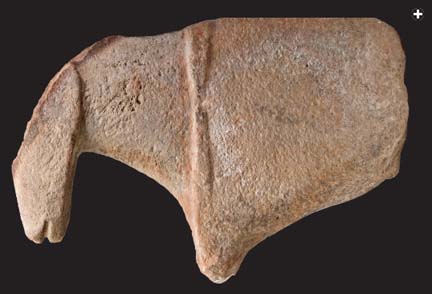
The largest, and to date the most significant, of more than 300 artifacts found so far at al-Magar is a sculpture fragment whose head, muzzle, nostrils, arched neck, shoulder, withers and overall proportions resemble those of a horse, though it may represent an ass, an onager or a hybrid. Eighty-six centimeters (34″) long, 18 centimeters (7″) thick and weighing more than 135 kilograms (300 lbs), it is provisionally dated to about 7000 bce.

The latest issue of Saudi ARAMCO World (May/June 2012) has a fascinating article about archaeological finds at the site of Magar in southwestern Saudi Arabia. It features an early sculpture of a horse, among other artifacts.

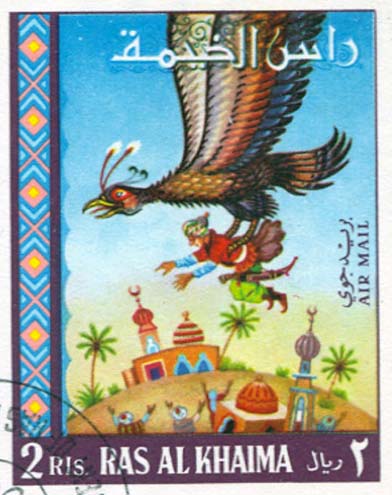
The 8th Voyage of Sinbad: #3


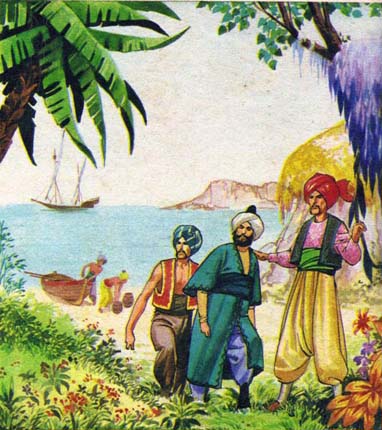
Sinbad the Sailor by Nadir Quinto (1918-1994), an Italian artist, born in Milan

[Webshaykh’s Note: This last semester I taught an Honors Seminar on the Arabian Nights. The last assignment asked students to write the 8th voyage of Sindbad, drawing on what happened in earlier voyages. I will post several of these here for your enjoyment. This is the third one I am publishing by Peter Otis. The second is by Marissa Priest. For the first by Taryn Teurfs, click here.]


The Eighth Voyage of Sinbad: The Isle of the Lost Civilization

by Peter Otis

And Scheherazade said, it is recounted, your grace, of how Sinbad the Sailor invited the Porter back the following evening, and told the tale of his magnificent eighth voyage:

My friends, I tell you that in turbulent times, the fortunes of all men and creatures in God’s creation are scattered like sand in a torrent, and that fate holds unpredictable odds in store. Truly, as I recounted to you yesterday evening, my seventh voyage was the final of my audacious journeys on the vast and distant seas on the outer rim of the world. Of course, you know from my voyages of my immeasurable wealth. However, you know not that the vast fortunes that surround you this evening would not be, were it not for my eighth and final voyage! On my journey back to Baghdad from my seventh adventure, I was wracked with a deep sense of despair to learn in Basra that civil war had erupted between the Caliph’s two sons, whose greedy rage had resulted in the devastation of my beloved Baghdad! Surely, my friends, the destruction is all too fresh in your minds as well. I returned in horror to find Baghdad in ruin, and to little surprise my own wealth stored at my palace had been plundered amid the turmoil. What precious wealth I had brought back with me from my seventh voyage I gave to the city’s keepers to finance reconstruction and the care of invalids. Give alms according to God’s will, for truly, only God in his goodness is eternal, while the aspirations of man and his pride are reduced to dust! Heartbroken to see the object of my desire—my beloved city—ruptured in such a way, I returned to my true home the sea, and left Baghdad almost as quickly as I had returned to her. Continue reading The 8th Voyage of Sinbad: #3

Dance at Alwan


Magda Saleh, “Giselle”, Studio Portrait, Cairo, Egypt, 1968, left; Magda Saleh in “Don Quixote”, Guest Artist, Bolshoi Ballet, right

Panel Discussion: Dancing Culture and Controversy: Professional Women Dancers of the Arab World
Monday, June 4, 2012 6:30 pm at Alwan for the Arts

Join renowned professional dancers Magda Saleh of Egypt, Leila Molaei of Arab-Iranian descent, and dance anthropologist Najwa Adra, for a panel presentation and discussion on women professional dancers of the Arab world and diaspora.

Dance by women is the most controversial of all performance arts, because it is the body, the basis for construction of gender difference, which creates it. Traditional or culturally specific dances especially embody cultural ideals and taboos related to the female body.

Panel Discussion 6:30-8:30

$5 at door (Free for members.)

Magda Saleh will share vignettes of her trailblazing career path of classical dance, becoming Egypt’s beloved Prima Ballerina with the Cairo Ballet Company. She will also present footage of her 1979 documentary film, “Egypt Dances”, highlighting women performers of Egyptian traditions such as zar, haggalah and others.

Leila Molaei, expert performer and teacher of raqs sharqi, Iraqi kawleya, and one of a handful of Arab professional dancers of these forms in diaspora, will speak to how she negotiates cultural challenges of performing female solo dances. Leila will also discuss gender issues in performance of dances such as kawleya and khaleegy, including demonstrations of relevant technique and issues such as costuming and context.

Leila will also be teaching a workshop on Iraqi dance and performing in NYC, presented by Mark Balahadia. For more information on the May 31 show, or June 2 & 3 workshop, visit www.markbalahadia.com.

Najwa Adra, cultural anthropologist specializing on dance in the Middle East region will serve as the panel respondent.

About the Artists: Continue reading Dance at Alwan

Shaykh Abu Luhum (1938-2012)

*يمن برس – متابعات
وصل جثمان الفقيد المناضل الشيخ محمد عبدالله صالح أبو لحوم إلى العاصمة صنعاء أمس الخميس والذي وافته المنية في فرنسا يوم الأحد الماضي.

وتم الصلاة على جثمانه صباح أمس الخميس بعد نقل جثمانه من مطار صنعاء في جامع مستشفى جامعة العلوم والتكنولوجيا، واوري الثرى في مقبرة خزيمة.

الشيخ محمد عبدالله صاللح أبو لحوم من مواليد منطقة نهم، شمال العامصة صنعاء عام 1938، درس في الكلية العسكرية ببغداد وحصل على دورات عسكرية متعددة.

وتولى عدة مناصب عسكرية ومدنية، حيث بدأ حياته العملية كبيراً للمعلمين في مدرسة المدرعات، ثم قائداً لكتيبة المدرعات والمدرعات الاحتياطة، قبل أن يكون عضواً في مجلس القيادة وقائداً للواء السادس.

وعين الفقيد رحمه الله لاحقاً محافظاً لمحافظة حجة ثم سفيراً مقيماً لليمن في باريس وعضواً في مجلس الشورى.

نسأل الله أن يتغمد الفقيد بواسع رحمته وأن يسكنه فسيح جناته ويلهم أهله وذويه الصبر والسلوان, وإنا لله وإنا إليه راجعون.