Category Archives: Bible and Holy Land

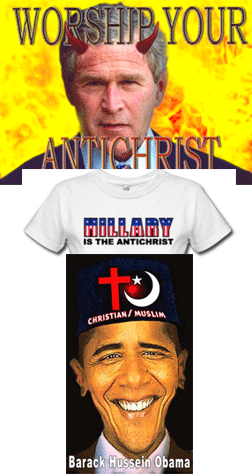
Obama, Running for Antichrist?

Political candidates attract mud and the current presidential marathon on the Democratic side is no exception. Several conservative hit men have emphasized Obama’s Muslim middle name, Hussein, and used their rather pathetic poetic license to rhyme (without reason) Obama and Osama. Already relegated to the status of an urban legend, the smear tactic that Senator Obama is a mixed Muslim/Atheist still resonates in parts of rural America, no doubt among those white out-of-work blue collar men who think Hillary used to be a short-order cook.

But the image of a stealth Muhammadan running for President is outdone on the lunatic apocalyptic fringe of the Christian far-right by Dana Smith’s recent speculation about Barack Obama as the Antichrist. Here is the lead-in on the Raiders News Network:

People are swooning, falling headlong on the floor, while he speaks. Does Hillary get this reaction? An emphatic no is the answer! It seems today that from every corridor the people are talking about this. Is Obama the man? Is he the Anti Christ? Is he this or that? The truth is society is ready for the man of sin mentioned in 2 Thessalonians chapter 2. But is Obama the man? The real verdict on that will be out until the end of his term. One thing for sure, his reign, if he is elected will be during a tremendously prophetic time on the calendar. All things are set for the uprising of the ‘man of perdition’. Continue reading Obama, Running for Antichrist?

So if it’s not about religion …

The War on Terror, upon which the GOP presidential candidates (minus libertarian Ron Paul) have been feasting, is promoted as a clash of civilizations masquerading as religions. In this pop culture scenario there is the secular West, which promises freedom of religion and only tolerates freedom from religion, vs. the fanatically religious non-West currently reduced to mad mullahs and Islamic Jihadists. We are told it is not about religion. That is true. It is, however, about religions. The West assumes it has tamed its religious impulse to crusade and colonize the Gospel to the ends of the commercially driven earth. Our religious wars are in the history books. Or are they?

Inquistors with holy orders have been replaced by mega-church preachers with rock-music intros. Witch trials have been overturned by a mentality that still thinks the 10 Commandments trump the U.S. Constitution. The United States is in legal theory not allowed by law to prohibit religious worship (although it did so against Native Americans). But America has only a veneer of secularism. Religious organizations no doubt take in more money than the IRS and not all that goes to charity. Much of this freedom of religion is an invitation to convert others or to promote outmoded notions such as biblical creation and Noah’s flood. The fact that half of the population in the U.S. still holds on to the myth of Adam and Eve as an explanation for human origins, despite the evidence from scientific research, says we are not yet free of irrational thinking.

Then there is “their” religions. Continue reading So if it’s not about religion …

The Problem with “Fundamentalism”

[This is an excerpt from my article, “The tragedy of a comic: fundamentalists crusading against fundamentalists,” published in Contemporary Islam (2007, Vol. 3, #1).]

The issue of religious fundamentalism has been raised both in the popular media and by academicians as one of the most critical global challenges to a smooth transition into the third millennium. The Y2K alarm over cyberspace as the clock turned over 2000 was only the Book of Revelation in digital imagination. Debating the death of God, especially in the halls of Academe, has had little impact on the perpetual panopticon of apocalyptic scenarios literally decoded out of the Bible. The Catholic church and mainline Protestant denominations have largely left behind the baggage of prophecy as contemporary politics, though in the past Christian clerics of all persuasions had no trouble conjuring enemies, including the Ottoman Turks, as anti-christened candidates. In Christianity biblical literalists today are often, and erroneously, dismissed in blanket condemnation as “Fundamentalists” because of what they reject rather than what they believe. The problem with being a “Bible believer” is that this implies rejecting rationalism, modern science and theological reform. The problem with being labeled a “Fundamentalist” is that most people fit into the category do not use or accept the term.

“Fundamentalism” as a term should be of interest to scholars who study the phenomenon not only because of what it is said to represent, but also because it is “our” term – a word coined almost a century ago within American Protestantism to define a self-proclaimed conservative religious movement contra a liberal shift in mainline denominations.(1) Continue reading The Problem with “Fundamentalism”

Lost in the Lost Archive

The following is a reaction to the article “The Lost Archive” in The Wall Street Journal Jan 12, 2008, page 1 (US edition) by Michael Marx (marx@bbaw.de), Director of Research, Centre Corpus Coranicum (Berlin-Brandenburgische Akademie der Wissenschaften)

The lost archive, the myth of philology, and the study of the Qur’an
by Michael Marx

The belief in the myth that old manuscripts should be mysterious and powerful is part and parcel of the age of Modernity. That such expectations were operative in the discussion on the Qumran fragments is still remembered, and more recently the Da Vinci Code, in itself a quite shallow story, sold extremely well. The fact that the Wall Street Journal placed an article on the “lost Bergstrasser-film archive” of Qur’anic manuscripts on its front page on 12th of January seems to be due to the myth of “textual wars” taking place in the world. Labelled as a clash of civilizations or war of religions, conflicts today in the Middle East and Europe involving Christians, Muslims and Jews are likely to be perceived in isolation from their economical, social, or political preconditions. On September 12th 2001 a friend of mine bought a copy of the Qur’an in order to “understand what is going on”. Indeed, as if in the spirit of the protestant slogan of “sola scriptura” (= “through scripture only”), the idea of deciphering the software of “Muslim patterns of action” through the Sacred Book of Islam is tempting. As superficial as it may look, this very perception of the direct causal link between “what Muslims do” and passages of the Qur’an seems to be widespread. No article on the missing enlightenment in “Islam” without pointing to a still missing “but urgently needed” critical edition of the Qur’an. Almost no coverage on warfare in the Middle East and suicide bombings without the attempt to dig out passages from the Qur’an and pictures of praying and reciting Muslims. The cultural, social, and religious diversity of a whole region, the Middle East, that European and American history labels as the cradle of civilisation and the birthplace of Judaism and Islam appears transmuted into a “disturbing” monolithic religious monster. Continue reading Lost in the Lost Archive

Exodus Redux

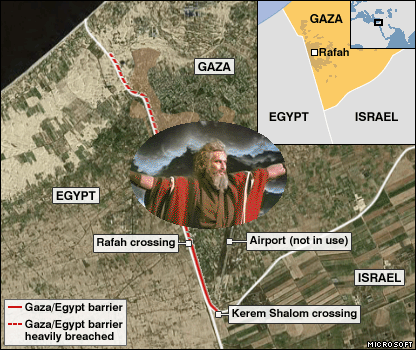
Remember the Exodus? Even if you never saw Charlton Heston part the waters Hollywood style, the story of the mistreatment of the descendants of the patriarch Jacob of Israel and their harrowing escape from the clutches of a hard-hearted Pharaoh has been retold millions of times over the past two millennia or more. In that story the more that Moses and brother Aaron demand “Let my people go,” the more the burden on the people, including the last straw, literally the last straw, in a work force up against a mud brick wall. Things got so bad that even the supervisors tried to reason with Pharaoh, but to no avail. So Moses in frustration turned to his Lord and complained in plain King James English:

And Moses returned unto the LORD, and said, Lord, wherefore hast thou so evil entreated this people? why is it that thou hast sent me? For since I came to Pharaoh to speak in thy name, he hath done evil to this people; neither hast thou delivered thy people at all. (Exodus 5:22-23)

Then came the plagues worthy of a passionate Mel Gibson remake: Nile water turned into blood, frogs everywhere, pesky gnats and flies (hardly anything new, I should suspect), the heavy vegan-friendly killing off of horses, donkeys, camels and flocks, then festering boils, heaven-sent hail and fire (an interesting notion for resolving global warming), lots and lots of locusts (some of which may have been kosher), total darkness and then the ultimate weapon of killing every non-Israelite firstborn. One would think this would be enough for several movies, but the journey has not even begun. That exodus, hardly a march of triumph, would condemn the brickmakers of Egypt to forty years wandering in the desert. Where is Mel Brooks when you need him?

Yesterday the irony of contemporary politics put the exodus in reverse. Continue reading Exodus Redux

Pin the Biblical Tale on …

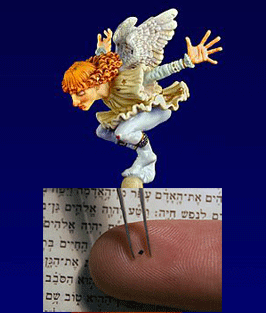
Riddle of the day (stretching back a bit): How many angels can dance on the head of a pin? Before you answer, here is what the theologian St. Aquinas had to say:

Q. 52, a. 3 – “Whether Several Angels Can Be At The Same Time In the Same Place? There are not two angels in the same place. The reason for this is because it is impossible for two complete causes to be immediately the causes of one and the same thing. This is evident in every class of causes. For there is one proximate form of one thing, and there is one proximate mover, although there may be several remote movers. Nor can it be objected that several individuals may row a boat, since no one of them is a perfect mover, because no one man’s strength is sufficient for moving the boat; the fact is rather that all together are as one mover, in so far as their united powers all combine in producing the one movement. Hence, since the angel is said to be in one place by the fact that his power touches the place immediately by way of a perfect container, as was said (Q. 52, a. 1) there can be but one angel in one place.”

So the devout answer would be “one,” assuming it was an angel who knew how to dance.

Next riddle: How many Bible tales can you inscribe on the head of a pin? Here is what the BBC has to say: Continue reading Pin the Biblical Tale on …

Who Owns the Holy Land?

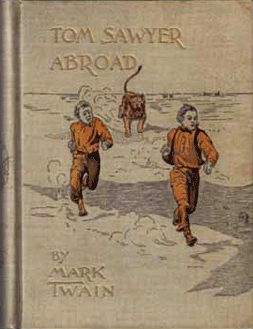
As another year draws to a close, it is hard not to think in larger terms of the course of the last century. The world has seen two world wars and far too many atrocities since 1908 to think of our technological and commercially driven age as golden. But in it all there has been humor. Believe it or not, the American writer Mark Twain was still alive one hundred years ago. His greatest books belong to the century before, from the mother of all Holy Land travelogues, Innocents Abroad, to Huckleberry Finn and his adventurous friend Tom Sawyer. Surely one of the greatest humorists ever, Mark Twain did more than tell funny stories. His work survives in part because it uses humor to remind us of the unfairness and unwavering mundaneness of life.

In Tom Sawyer Abroad Twain offers a vivid critique of the kind of Orientalism that Edward Said rightly views as a style for dominating the Orient. Continue reading Who Owns the Holy Land?

While in the Other Manger …


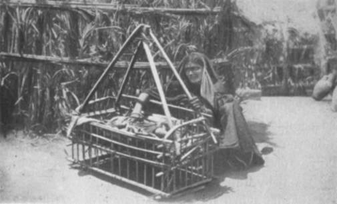
Date Stick Cradle, from Zwemer’s book.

Christmas Eve is the time for reflecting on a baby in a manger in Bethlehem, three kings bringing spices and shepherds blinded by angel light. Christians around the world celebrate this scene, but what do they think of all those other babies who were not destined to become religious icons? Back in 1902 the Christian missionary Samuel Zwemer and his wife Amy teamed up to write a children’s book about Topsy-Turvy Land. For more information on this apologetic diatribe against Islam and Arabs, click here. As the authors claim, “In Topsy-turvy Land all the habits and customs are exactly opposite to those in America or England.” And where is this mythical garden of play for good Christian children? Arabia, specifically an Arabia in which the Ottoman Empire still had steam. For a good-old-boy, old-fashioned religion view of the “Arab” child as a topsy-turvy other, this is as prime a piece of apologetic and Orientalist dismissal as you can find. So take a look in the other manger, as the evangelistic Zwemers did a mere century ago…

ARAB BABIES AND THEIR MOTHERS

An Arab baby is such a funny little creature! In Christian lands babies, as soon as possible, are given a warm bath and dressed with comfortable clothing. But in Arabia the babies are not washed for many days, only rubbed over with a brown powder and their tiny eyelids painted round with collyrium. They are wound up in a piece of calico and tied up with a string, just like a package of sugar. Continue reading While in the Other Manger …