Category Archives: Bible and Holy Land

Leaves from an old Bible Atlas #4


Hurlbutt’s Atlas, p. 17


Hurlbutt’s Atlas, p. 17

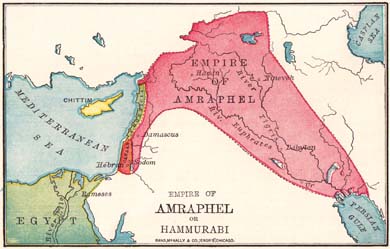
The Christian fascination with the Holy Land as a window into interpretation of the Bible has a long and indeed fascinating history of its own. Here I continue the thread on Jesse Lyman Hurlbutt’s A Bible Atlas (New York: Rand McNally & Company, 1947, first published in 1882). After describing the physical geography, Hurlbutt proceeds directly the “The Journeys of the Patriarchs.” He writes (p. 17):

The journeys of Abraham extend over nearly all the lands of the Old Testament from Chaldea to Egypt. They represent the separation of a Semitic clan from the great body of the race, which was then ruled by an Elamite dynasty; and they bring to our notice the political relations of the world about two thousand years before Christ, in the early Chaldean period of the East.

Continue reading Leaves from an old Bible Atlas #4

The Empire’s New Clothes


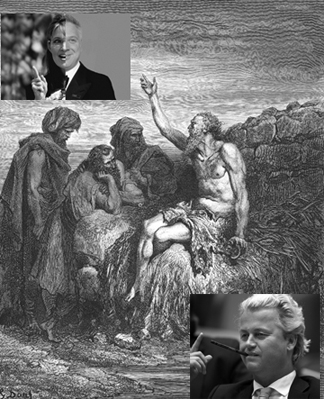
Biblical Job by Gustave Gore, surrounded by his so-called “friends”

In biblical times when an individual mourned, it involved tearing up everyday clothes and putting on coarse sackcloth and ashes. This is what the patriarch Jacob did when told his young son Joseph had been killed. When Job lost his family he sat on a dung pile. Both acts were motivated by humility rather than thoughts of revenge. As fitting as Job’s location might be for some of the memorial scenes yesterday, several of those making the news headlines represented the Empire (it is hard not to think of the United States superpower as anything else but an empire) in what they thought were patriotic “red, white, and blue” cloth, but which even a little child could see were politically naked to the core. The New York Times reports a woman at the 9/11 site holding up a sign that read ““Today is ONLY about my sister and the other innocents killed nine years ago.” Would that were true.

The loss of life nine years ago in a terrorist act deserves reflection for many reasons. For those of us who live in the New York area, there but for the grace of timing go we. Those who died had pulled no triggers, pushed no buttons to drop bombs, made no political decisions to invade another country, burned no Qur’ans. They died because politically motivated extremists so hated the policies of the United States in the Middle East that they were willing to commit an atrocious suicidal act to make a symbolic statement. It did not matter that among those killed were Americans who strongly disagreed with America’s foreign policy or were in fact Muslims. Such is the ethical nothingness that hate sets as a trap, no matter which God is being called upon to condone an evil act. Continue reading The Empire’s New Clothes

Bücher und Menschen


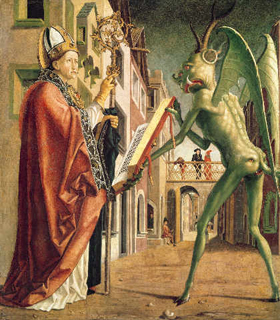
“Is this the book you wish to burn, Rev. Jones?”
Painting of the Devil tempting St. Augustine, by Michael Pacher (1435-1498).

I doubt that Rev. Terry Jones reads German, but he should. The German poet Heinrich Heine (1797-1856), reflecting well over a century ago on the atrocities of the Spanish Inquisition, wrote:

Dort, wo man Bücher verbrennt, verbrennt man auch am Ende Menschen
“Where they burn books, so too will they in the end burn human beings.”

Heine was born Jewish. His books were eventually burned in Nazi Germany; so were a number of his coreligionists.

If there is a hell down there or out there (apart from the one some people create for others here on earth every day), the Rev. would seem to be warming up for his grand entrance and welcome from Der Teufel himself.

Luke R. E. Publican

Burning books, burning bodies, burning bridges

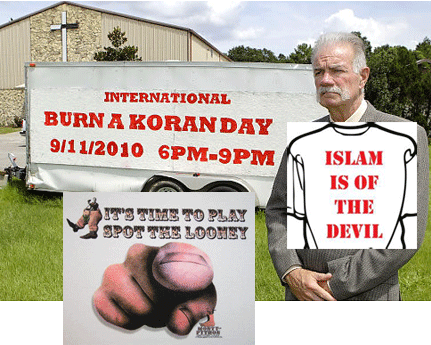
“Burn, baby, burn.” One might expect these words to come from a comedian as much as an arsonist. If you put the name “Terry Jones” into Google you will find a comedian. That is Terence Graham Parry Jones of Monty Python fame. These days there is another Terry Jones, a “Rev.ed” up one to boot. Rev. Terry Jones is the previously and foreseeably future little-known pastor of the Dove World Outreach Center on the outskirts of Gainesville, Florida. For a congregation estimated at about 50, their outreach may take a millennium or more, but they do have an inflammatory website, which promotes the “Right” (in all the irony this words entails) Rev. Jones’ book with the rather unoriginal title of “Islam is of the Devil,” which is for sale, as is a $20 t-shirt to advertise hatred of Islam. For an individual who has no clue about Islam, apart from his own rabid intolerance, the devil is certainly not in the details. His moment of fame is about to eclipse, but his motive is so shameful it deserves all the condemnation it can get, the kind in which the pen is mightier than the bonfire.

Let’s start with the desire to burn. One name should suffice to call out the hypocrisy of Mr. Jones. That name is John Wycliffe, the 14th century Christian cleric whose name inspired the Wycliffe Bible Translators, one of the most active Protestant organizations translating the Bible into other languages. Wycliffe dared to translate the Latin Vulgate into English, so earning the ire of the Catholic Pope that he was excommunicated. Some 44 years after Wycliffe died of a stroke, the “Church” had his bones dug up and burned, along with all his writings. I suspect that Jones prefers the King James Version of the Bible, although I do not know if he is aware that this “authorized” version was greatly influenced by Wycliffe. Continue reading Burning books, burning bodies, burning bridges

Leaves from an old Bible Atlas #3


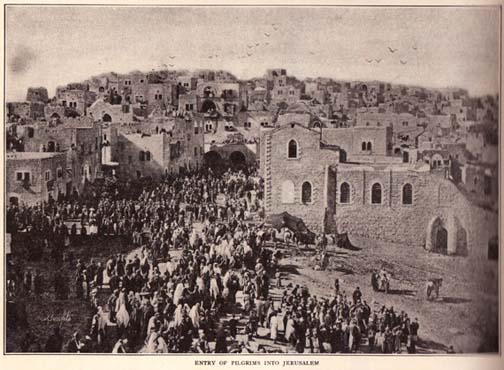
Entry of pilgrims into Jerusalem, Hurlbutt’s Atlas, p. 150

The Christian fascination with the Holy Land as a window into interpretation of the Bible has a long and indeed fascinating history of its own. Here I continue the thread on Jesse Lyman Hurlbutt’s A Bible Atlas (New York: Rand McNally & company, 1947, first published in 1882). The photograph above is actually the last in the atlas, just before a colorful foldout chart of Bible History.

The edition I am using includes an Introduction by Bishop John H. Vincent, whose memories of a visit to Palestine are quite typical of this Holy-Landaphilia. The following is a good example of the preacher’s rhetoric:

At one time I was permitted to spend forty days and forty nights in Palestine. I saw Abraham at his tent door; Rebekah veiling herself at the approach of the stranger; the long caravan of camels and Midianites on their way toward the south. I saw the wailing mourners at the house of death; the roof that might easily have been broken up; the wedding procession; the grass on the housetops; the sparrow making a nest for her young in the synagogues of Jerusalem. I saw the elders in the gates; David the shepherd, with his sheep, on the hillside; the Jewish mother, teacher Timothy, the words of the old Book in the old city on the hill. Verily, it is the old land; it is the old life; it is the memorial presentation in concrete form of what the Book says was true there thousands of years ago.

To be continued …

Leaves from an old Bible Atlas #2


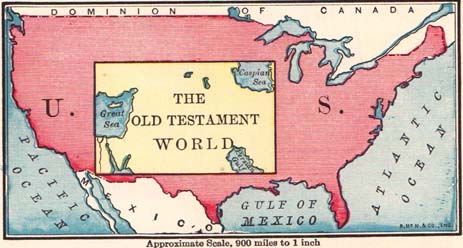
Comparative view of the United States and Old Testament world, approximate scale, 900 miles to 1 inch (in the original map which is only 3 3/4 inches across)

The Christian fascination with the Holy Land as a window into interpretation of the Bible has a long and indeed fascinating history of its own. Here I continue the thread on Jesse Lyman Hurlbutt’s A Bible Atlas (New York: Rand McNally & company, 1947, first published in 1882). I love the irony of the map above. Long before the political map devolved into Blue States vs. Red States, here is the Old Testament squarely in an expanded Bible Belt.

Here is Hurlbutt’s summary of the physical space defined as the Old Testament world:

The Old Testament world embraces the seas and lands between 30° and 54° east longitude, or from the mouth of the Nile to the head of the Persian Gulf; and between 27° and 40° north latitude, from the parallel south of Mt. Sinai to the north of Mount Ararat. The total extent of territory is about 1,400 miles from east to west and 900 miles from north to south, aggregating 1,260,000 square miles. If the space occupied by the Mediterranean Sea and other large bodies of water is deducted from this, the land will include about 1,110,000 square miles, or one-third of the extent of the United States, excluding Alaska. Unlike the United States, however, nearly two-thirds of this area is a vast and uninhabitable desert, so that the portion actually occupied by man is less than an eighth of that included int he American Union.

I wonder what Sarah Palin would think about Hurlbutt excluding Alaska, but at least it was not a state yet and some still referred to it as Seward’s folly.

To be continued …
WWGBD


Yesterday there was a rally at the Lincoln Memorial, a political act paraded as a national revival meeting. And guess who showed up? None other than Elmer Gantry. If you are too young to remember who Elmer Gantry is, Youtube comes to your rescue. Based on a novel published by Sinclair Lewis in 1927, the fictional character Gantry is a consummate hypocrite preaching against vice from the pulpit and practicing vice whenever he has a chance. Lewis wrote it as a satire on the bigoted Protestant fundamentalism of his day, and earned the mantra of “Satan’s cohort” from famed evangelist Billy Sunday. Perhaps it is time to bring the novel back to the required reading list or at least re-release the film version starring Burt Lancaster.

Glenn Gantry, I mean Elmer Beck, well you know who I mean, left the set of his Fox News extravaganza and cozy radio perch to lead a rally of Tea Party and other discontents, but claimed that God had dropped a sandbag on his head (I suspect it was rather heavy sand to cause such a reaction) and made him realize the rally should be a religious revival, getting America back to her Christian roots. The fact that it was planned on the anniversary of Martin Luther King’s memorable speech in the same place (only three years after the release of the Elmer Gantry film) is said to be accidental or divine. I suspect for showman Beck, there is little difference between the two. Continue reading WWGBD

Leaves from an old Bible Atlas #1

Perhaps there is a geographical inclination gene in my ancestry, since I have always loved Bible atlases. Many years ago my father was given a copy of Jesse Lyman Hurlbut’s A Bible Atlas, first published in 1910; his volume was a 1947 revision. But for the most part I assume the photographs were taken around the turn of the 20th century, give or take a decade. The author lived from 1843–1930 and as early as 1882 had published a Manual of Biblical Geography, the perecursor to this atlas. The 1910 version is archived online. There is also a website devoted to maps from his 1904 Story of the Bible.

So here I begin a thread of photographs of the Holy Land from at least a century ago. Let’s begin in Tiberias … Continue reading Leaves from an old Bible Atlas #1