Category Archives: Bible and Holy Land

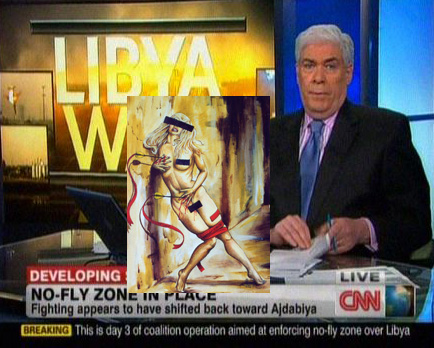
Pornographic War Gazing: Why We Don’t Look Away


[This commentary was origially published in Religion Dispatches, April 12, 2011.]

When it comes to grabbing attention bad news is the best news. Whether selling war or natural disaster or a fugitive serial killer, the competitive edge goes to the media outlet that can scoop the most violence, brutality or sheer inhumanity in an event.

The most recent news cycle of political protests started out on a hopeful note. As the spirit of frustrated youthful protest spread at tweet speed to dictatorial regimes and elitist monarchies, journalists flocked to North Africa and the modern day Holy Land. Live coverage has shifted from country to country, depending in large part on where the most violence is erupting. Yet, as much as the story may be promoted as one of hope and liberation, the hook is all about devastation. Continue reading Pornographic War Gazing: Why We Don’t Look Away

Oh Brother(hood)!


First, something positive: there is an excellent op-ed in today’s New York Times by Greg Johnson on the situation in Yemen.

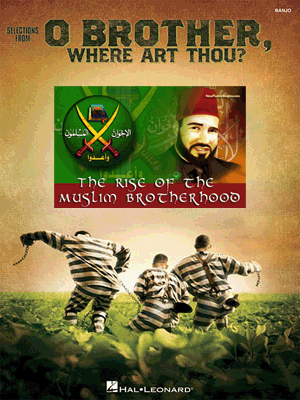
And now for something completely different… Now the “duh” moment. Here is a headline that deserves all the possible bad things one can say about an ignorant and stupid headline:
“Yemen’s Government Poised to Fall to the Muslim Brotherhood and Al-Qaeda ?” The source I consulted is the Right Side News, where “right” certainly does not make “right”. It would be quite a major event if Yemen was taken over by the Muslim Brotherhood, since it does not have any kind of presence there. Of course if most Muslims are radical and all radical Muslims are the same, it hardly matters to someone like the ludicrous ranting of someone like Robert Spencer (whose Islamophobic magazine rag is the ultimate source of this story). The article was posted Wednesday at 5:38, but over a full day later the prediction that Ali Abdullah Salih would be ousted in 24 hours was unfulfilled. Back to the drawing board or the Book of Daniel, perhaps? Is this regime change supposed to be before or after all the bible believing Christians are raptured away? Continue reading Oh Brother(hood)!

Review of “The Jew Is Not My Enemy”


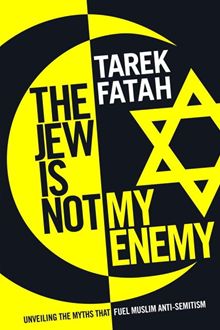
The following is a review of The Jew Is Not My Enemy: Unveiling the Myths that Fuel Anti-Semitism by Tarek Fatah, published by McClelland & Stewart
ISBN: 978-0-7710-4783-1 (0-7710-4783-5). The review is written by Ivan Davidson Kalmar and published in the Literary Review of Canada, March, 2011.

As Tarek Fatah, the author of this provocative book, puts it, “By all rational standard, Muslims and Jews should have been, and could be, partners. Their faiths are very similar (…). There were even times when Muslims and Jews prayed together around the tone covered today by the Dome of the Rock [in Jerusalem].” Certainly in the imagination of western Christians at least, Muslims and Jews were for centuries regarded as two of a kind.

From the medieaval theologians through to Hegel, Islam was considered to be a revival of Judaism (which Christians thought should have died with Christ). Though the attitude to both Jews and Muslims has generally been hostile, it was not always so. For example, Jews and Muslims were both admired by nineteenth century romantics as possessors of an eastern spirituality that inspired and could continue to inspire the Occident.

When Jews and Arabs were both classed as members of the same “Semitic” race, “Semite” was at first often meant as a compliment. It was partly in reaction to romantic accounts of the Semites that the term “anti-Semitism” was invented by a new breed of Jew-haters. And it was, in turn, largely a reaction to modern anti-Semitism that the old idea of “returning” the Jews to the Orient took hold in the form of modern Zionism. Zionism led to a long and still ongoing, bloody conflict between Jews and Muslims over the holy land of Israel/Palestine. Continue reading Review of “The Jew Is Not My Enemy”

Looting the Pharaohs before Mubarak


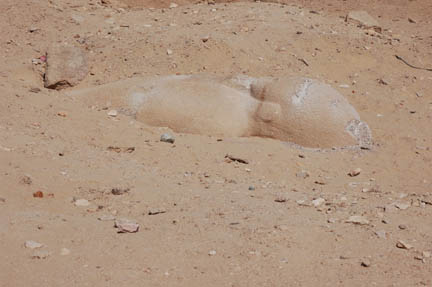
Statue of Ramses II in Aswan

The status of Egyptian antiquities today, 3 March, 2011

by Zahi Hawass, March 3, 2011

When the revolution began on January 25, 2011, and through its first week, there were only a few reports of looting: at Qantara East in the Sinai, and at the Egyptian Museum, Cairo. However, since Mubarak’s resignation, looting has increased all over the country, and our antiquities are in grave danger from criminals trying to take advantage of the current situation.

The Egyptian Museum, Cairo

On Saturday, 29 January, I entered the museum the morning after the break-in and I could see through the museum’s monitor, objects were broken and thrown all over the galleries. However, all of the masterpieces seemed to be present. At first glance, it did not seem that objects were missing and I announced that the museum was safe.

After our preliminary inventory, we discovered that eighteen items were missing. Thankfully four of these items have already been recovered. The Heart Scarab of Yuya and the body of the goddess from the statue of Menkaret carrying Tutankhamun were both found on the west side of the museum near the new gift shop, and one of the missing shabtis of Yuya was discovered under a showcase inside of the museum. The statue of Akhenaten as an offering bearer was discovered by a young protester near the southern wall of the museum in Tahrir Square. His family immediately contacted the Ministry of State for Antiquities to arrange the statue’s return to the museum. I am now waiting for the Registration, Collections Management and Documentation Department to complete its final report on what else, if anything, is missing from the Egyptian Museum, Cairo. The General Director of the museum has told me that this report will be completed by Sunday. Continue reading Looting the Pharaohs before Mubarak

All Eyes on Egypt


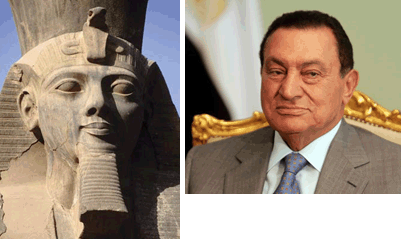
Ramses II, left; Mubarak I, right

About a month ago I visited the King Tut exhibit in New York. Here was the splendor of one of the minor pharaohs of Egypt, one that died at a very young age. Other pharaohs reigned for a lifetime, such as Ramses II who was in power over three millennia ago and ruled the mighty Egyptian empire for more than half a century. Hosni Mubarak on the Nile is no pharaoh any more than Saddam Hussein was Nebuchadnezzar on the Euphrates. Still, he has been in power almost three decades with a son said to be waiting in the wings for succession. But it is unlikely that he will match Ramses, and not simply because he would be over a century old if he did. The words of the Prophet Daniel, for a different time and place, are apt: mene mene tekel upharsin.

A Greek historian noted about the same time as Daniel that Egypt was a gift of the Nile. Not much has changed, since the vast majority of Egypt’s population lives along this river, including its delta at the Mediterranean. One of the major changes is the population density. With over 80 million Egyptians on the narrow strip along the Nile and southern Mediterranean coast, there is hardly an Egyptian more than a stone’s throw from water. When I worked on a sanitation project in 1981 for USAID, I visited a number of “villages” in the governorates of Asyut and Minufiyya. I say “villages” because of the lack of services, since some had more than 10,000 residents. At the time, as USAID was scrambling to spend development money promised to Egypt in the aftermath of Sadat signing a peace agreement with Israel, many people thought the problems in the country insurmountable. Continue reading All Eyes on Egypt

Buried Texts Recovered: An American Consul goes to Bethlehem, 2

I continue a thread on one of the numerous 19th century Bible customs travel accounts by Christian enthusiasts able to travel to their “Holy Land.” The author, Frank S. DeHass, served as the United States Consul in Palestine in the mid 19th century. His text is aptly entitled Buried Cities Recovered, or, Explorations in Bible Lands, giving the results of recent researches in the Orient, and recovery of many places in sacred and profane history long considered lost. My copy, handed down from my grandmother, was published in 1886 in Philadelphia by Bradley & Company; the tenth edition no less! This is a wonderful read and it is worth reading the entire book online, thanks to Google Books.

An eastern inn, or khan, never was a house of entertainment in the sense that Americans understand a hotel to be. Such accommodations as provision, bed, and other comforts at an inn are unknown int he Orient, and belong exclusively to western civilization. In the East all travelers carry their own bedding and provision with them, and must dress their own food, kindle their own fire, and spread their own table. An Oriental inn is merely a place of shelter from the storm, or protection from robbers, where a man and his beast can safely lodge for the night free of charge. A portion of the khan was assigned to the beasts, generally one side, and travelers who came in late, if they found the khan full, would have to make their beds in the manger with the horses and camels, as Joseph and Mary were forced to do. These caravansaries, or inns, were sometimes very rude, simply a rough wall built around a house, or natural caves int he rocks, as appears to have been the case at Bethlehem. Many of these grottoes are used as stables in the neighborhood, and some of them as dwellings by the Arabs. Continue reading Buried Texts Recovered: An American Consul goes to Bethlehem, 2

Buried Texts Recovered: An American Consul goes to Bethlehem, 1

Yesterday, I began a thread on one of the numerous 19th century Bible customs travel accounts by Christian enthusiasts able to travel to their “Holy Land.” The author, Frank S. DeHass, served as the United States Consul in Palestine in the mid 19th century. His text is aptly entitled Buried Cities Recovered, or, Explorations in Bible Lands, giving the results of recent researches in the Orient, and recovery of many places in sacred and profane history long considered lost. My copy, handed down from my grandmother, was published in 1886 in Philadelphia by Bradley & Company; the tenth edition no less! This is a wonderful read and it is worth reading the entire book online, thanks to Google Books.

Bethlehem, and Hill Country of Judea

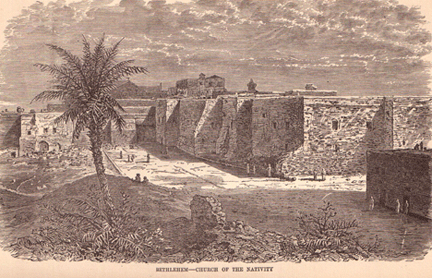
Situated on a fruitful ridge about six miles south of Jerusalem, overlooking the Valley of the Kedron on the north, and the deep chasm of the Dead Sea on the east, is Bethlehem of Judea, to the Christian the holiest place on earth.

It is one of the oldest villages in Palestine, and associated with some of the most stirring events in the religious history of the world. Here Ruth gleaned after the reapers of Boaz; here the youthful David kept his father’s flocks, and was annointed King of Israel; here, also, Jeremiah, after denouncing God’s terrible judgments upon the people, foretold the coming of “The Lord of Righteousness;” and here the shepherd’s who watched their flocks by night were startled by the angelic song announcing the Messiah’s birth, and proclaiming the evangel of “peace on earth, and good-will toward men.”

The name signifies the Hosue of Bread, and truly it may be said, Bethlehem has given to our perishing race the bread of eternal life. What countless millions have feasted on this heavenly loaf!

As we rode along the well-beaten path leading from Jerusalem, crowded with pilgrims from all lands going up to visit the place that gave birth to the Saviour of mankind, what old memories were awakened! Continue reading Buried Texts Recovered: An American Consul goes to Bethlehem, 1

Buried Texts Recovered: An American Consul in the Holy Land

“The author’s object in accepting an appointment under the United States Government was not the honor or emoluments of office, but a desire to visit the lands of the Bible, that he might see for himself how far the manners, customs, and traditions of the people and topography of those countries agreed with the inspired word.”

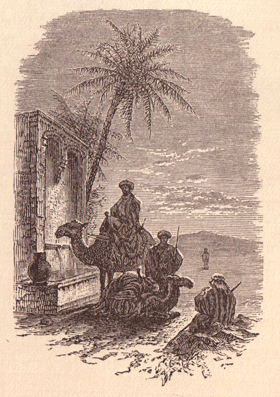
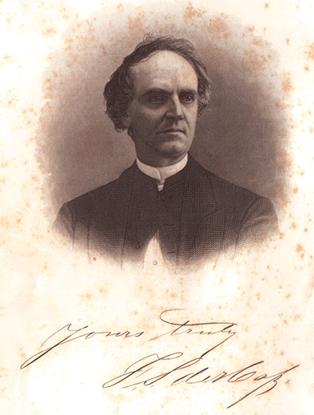
So begins one of the numerous 19th century Bible customs travel accounts by Christian enthusiasts able to travel to their “Holy Land.” The author is Frank S. DeHass, who served as the United States Consul in Palestine in the mid 19th century. His text is aptly entitled Buried Cities Recovered, or, Explorations in Bible Lands, giving the results of recent researches in the Orient, and recovery of many places in sacred and profane history long considered lost. My copy, handed down from my grandmother, was published in 1886 in Philadelphia by Bradley & Company; the tenth edition no less! This is a wonderful read and you can read the entire book online, thanks to Google Books.

Like so many other Bibliophiles of his generation, DeHass extols the virtue of actually visiting the land where Jesus was born and died. In his own words:

Recent explorations in the East have resulted in the recovery of many places in sacred and profane history long regarded as lost; and as the facts brought out by these researches are not accessible to the general reader, the author has compiled them in this concise form, and at the request of numerous friends gives them to the public, not as a scientific work for the antiquarian, but as a humble contribution to Biblical archaeology for the home circle, believing that such a volume will add greatly to the elucidation of the Scriptures, and serve to correct some of the errors which many travellers have fallen into by a too hasty or superficial view of the places visited. Continue reading Buried Texts Recovered: An American Consul in the Holy Land