Category Archives: Ethics

Dro[w]ning life, liberty and the pursuit of not being targeted


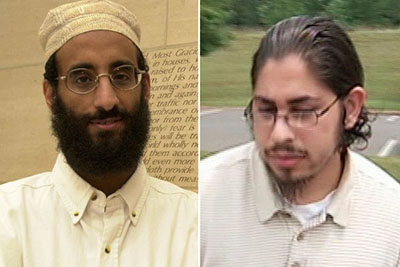
Anwar al-Awlaki, left, an operative in Al Qaeda’s Yemeni branch, was targeted in a strike that also killed Samir Khan, the creative force at a militant Web magazine. Both were Americans; Left, Linda Spillers for The New York Times; right, WBTV, via Associated Press

Today’s New York Times features a major article by MARK MAZZETTI, CHARLIE SAVAGE and SCOTT SHANE entitled “How a U.S. Citizen Came to Be in America’s Cross Hairs.” Actually the article discusses how three American citizens were the victims of drone attacks in Yemen in late 2011. The primary target was Anwar al-Awlaqi, who is described in the article as “the firebrand preacher, born in New Mexico, who had evolved from a peddler of Internet hatred to a senior operative in Al Qaeda’s branch in Yemen.” He was a socially mediated firebrand, far better known for his English than having an impact on recruiting terrorists in Yemen. Killed in the same after-breakfast attack was Samir Khan, “the creative force behind Inspire, the militant group’s English-language Internet magazine” and someone (basically a propaganda journalist) who was not considered important enough to specifically target. The article continues: “The next month, another drone strike mistakenly killed Mr. Awlaki’s 16-year-old son, Abdulrahman, who had set off into the Yemeni desert in search of his father. Within just two weeks, the American government had killed three of its own citizens in Yemen. Only one had been killed on purpose.” The 16-year old fell victim to a botched targeting:

Then, on Oct. 14, a missile apparently intended for an Egyptian Qaeda operative, Ibrahim al-Banna, hit a modest outdoor eating place in Shabwa. The intelligence was bad: Mr. Banna was not there, and among about a dozen men killed was the young Abdulrahman al-Awlaki, who had no connection to terrorism and would never have been deliberately targeted.

The drone issue has recently resurfaced, most notably in Mr-Rand-Paul-goes-to-Washington’s 13 hour filibuster. Continue reading Dro[w]ning life, liberty and the pursuit of not being targeted
Letters to My Son, #3


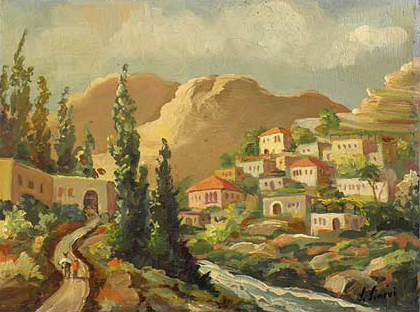
Lebanese village by Saadi Sinevi

by George Nicolas El-Hage, Ph.D.This is part three of a series from my book: The Return of the Hero and the Resurrection of the City, originally written in Arabic and translated by George N. El-Hage and edited by MaryAnn Del Vecchio, Ph.D. For part one, click here. For part two click here.September 1988Monterey, CAThird LetterI plant you in my eyes, a song of virgin longing, and I draw your smile over my sails bound towards the future.I am longing for return, and you are my hope and the eternal truth.Your two hands, my little one, are the cradle of love, and I am but a Sufi drowning in the deluge of meditation.I wear the gown of pain, and my feet are rooted in the glowing clay of creativity.May peace be upon you the day you were born and the day you embraced me and I felt that I held a bouquet of innocence and embraced a flaming sword.Glory be to your miraculous childhood.You are the lamb of peace, the joy of life, the tear of yearning and the hope of resurrection.My letters to you are but the embers of my burning thoughts, for you are the flame of prophecy and the wings of inspiration.You carry me to the world of the unknown and plant me in the fields of lilies and poems.You throw me on the sidewalks of the past and desert me on the shores of faraway islands.There, I metamorphose and transform into tropical plants, exploding with pleasure and burdened with forbidden fruits.I take off the tied gown of civilization and become naught but the flame of truth.I become one with the elements and melt like dew in the eyes of bereaving mothers. Continue reading Letters to My Son, #3

Letters to My Son, #2


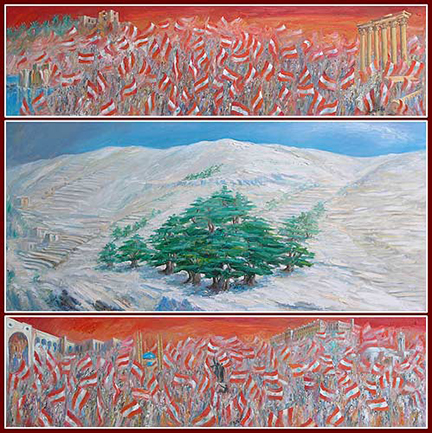
Lebanese triptych by Joseph Matta

by George Nicolas El-Hage, Ph.D.
This is part two of a series from my book: The Return of the Hero and the Resurrection of the City, originally written in Arabic and translated by George N. El-Hage and edited by MaryAnn Del Vecchio, Ph.D. For part one, click here.

July 1988
Monterey, CA
First Letter

In the name of God, I preface my first letter to you, my son. You are the stream of tenderness that flows in my heart and fills my cup. You are my provisions for the coming years and the lantern of my future. You are the most precious possession that I have in this world. You were gifted to me at my most blessed moment of contentment and peace. That day, you were formed in my conscience, a graceful thought, and in your mother’s womb, a clot of blood. That day, I was very conscious of what I was doing. To your mother, I said: “Come, my love, let us create a son, and his name shall be Nicolas.” I knew that the newcomer will be you. An inner feeling and a sense of the mystical awakened inside of me an unmistakable realization of your arrival, my joy, my boy, whose playground is the wide world while you remain ever present with me and within me.

Your wide open eyes are two lakes of emeralds. You are not of flesh and blood. You are the essence of love, the expanse of light, a river of warmth and the glimmer of hope. Let time stand behind us because we existed before time. As for me, you are my whole existence. Your smile permeates the world with joy. Your little hands are the perfumed lilies of the fields and your face the shining sun of light and truth. As you embrace me, time stops, and within me, the glory of the Lord shines bright. I declare to you our eternal relationship: You, me and your mother. Let all others who have populated my books come out. They are naught but a mob of “unnecessary duplicates.” You are not alone. I am with you forever. I give you more soul from mine, more love from my love and more heart from my heart. Your presence overfills my existence and leaves no space for any other. You, alone, are my preoccupation, and at your feet, time stops. You are ever-present in my memory. You are my fruit, my roots and my future. You are my glorious history. Continue reading Letters to My Son, #2

Letters to My Son, #1


Art by Khalil Gibran

by George Nicolas El-Hage, Ph.D.
From my book: The Return of the Hero and the Resurrection of the City, originally written in Arabic and translated by George N. El-Hage and edited by MaryAnn Del Vecchio, Ph.D.

Forward

These four letters, selected out of ten, are in fact a personal account of my feelings as a father, an immigrant, and a poet, towards my son. They are an emotional register of the dilemma of alienation, exile and loneliness that faces every immigrant, Lebanese or not, who, for various circumstances, leaves his or her country and emigrates abroad. I happen to be a Lebanese man who traveled to America during the Lebanese war to continue my education and make a future for me, my parents and my siblings. Like many cultures, being the eldest son in a Lebanese family carries a huge responsibility that falls on your shoulders and becomes your cause.

America, as it was known, was “the land of endless opportunities, the generous and welcoming land, where money grows on trees,” and “attaining the American Dream was only a measure of your determination, perseverance and hard work.” Indeed, this is the land where endless possibilities abound and the reality of forging a better life has, and still does, lure people from around the world. In fact, may God bless America.

It was not an easy task to write these letters to my son and to put my innermost feelings out there in the open. But as a poet, it is my mission to share because poetry is the art of the unusual encounter with the inevitable and the holy, and the poet’s mission is to always take the road rarely traveled and to return and inform fellow beings. Continue reading Letters to My Son, #1

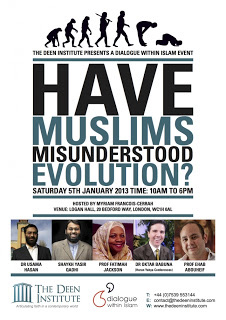
Have Muslims Misunderstood Evolution


The importance of Evolution and Islam debate in London

by Salman Hameed, Irtiqa’, January 7, 2013

I’m now back in US and I’m glad that I had a chance to attend the London debate, Have Muslims Misunderstood Evolution? It was organized by The Deen Institute and I posted some quick thoughts on Saturday.

You can find a good summary of each speaker’s presentation at Farrukh’s blog.

Here are a few reasons why I think the London debate on evolution and Islam may turn out be a game-changer in the way Muslims look at evolutionary biology, and science, in general.

This was an intra-faith debate. There is no question that the topic was controversial. However, the conversation on evolution often gets derailed by common misconceptions and juvenile creationist ideas. The debate would have been a failure, had it been simply between biologists and those who follow Harun Yahya. There is no common ground – as Yahya’s group has no understanding of science.

The reason for the success of the debate was that almost all of the speakers (with the exception of Harun Yahya acolyte, Oktar Babuna) accepted the scientific consensus on evolution. Then the question became: Can Muslims reconcile human evolution with their faith? Now this is an important question.

Here are a few take-aways from the London debate: Continue reading Have Muslims Misunderstood Evolution

Arab Constitutions and American Freedoms


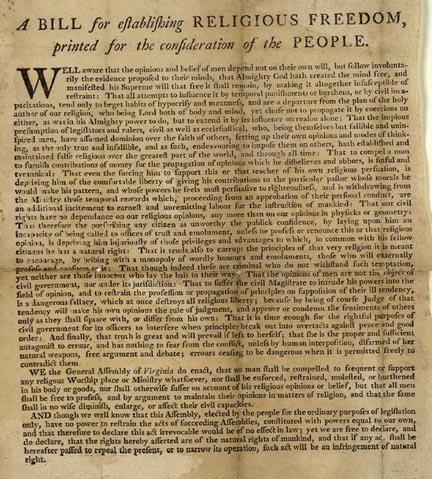
Virginia Bill for Establishing Religious Freedom; source, Library of Congress

By Anouar Majid, Tingis Redux, January 8th, 2013

The deeply contentious referendum on Egypt’s new constitution last December 2012 gave me some hope that not all is lost to Arabs and Muslims in the aftermath of the revolutions that toppled dictators in the last two years. Given the rapid Islamization of the public sphere in much of the Arab world in the last few decades, I was expecting something close to a landslide, not a small voter turnout and a modest 63.8 percent in favor of the charter. As it turns out, there are still pockets of resistance that oppose the Muslim Brothers and their agenda, even though, as the New York Times columnist Thomas Friedman noted at that time, the divisions are not necessarily between Islamists and secular liberals. The fault lines in Egypt seem to be more varied than what is broadcast in the United States.

Be that as it may, the thing that concerns me the most is what the Western media is talking about, i.e., the clash between those who want a nation governed by divine law and those who don’t want religion to be the absolute reference in legislation. In November 2012, I had the opportunity to make the case for the separation of state and religion to people who participated or are actually participating in the drafting of constitutions in Morocco and Tunisia, a person who ran in the last presidential race in Egypt, members of the Tunisian parliament, a leader of a major Egyptian political party, and many others who are playing some role in the future of North Africa and the Middle East. I also explained why, at this crucial juncture in the region, Arabs and Muslims can’t do better than learn from the American constitutional process and especially the reasons for separating state and religion.

Fewer documents explain more powerfully the reasons for doing so than the Virginia Statute for Religious Freedom, first written by Thomas Jefferson in 1777–only a year after he drafted the Declaration of Independence–and enacted into law in January 1786, with the crucial help of James Madison. Jefferson was so proud of Virginia’s Religious Act that he wanted it noted on his epitaph. Continue reading Arab Constitutions and American Freedoms

The Morale of the Moral Animal


A Christmas message from Charles Darwin

In a New York Times commentary two days ago, Rabbi Jonathan Sacks tackles the consumerist “war on Christmas/Hanukkah” but with a neuro-evolutionary twist traced back to none other than Charles Darwin. He argues that despite the rightwing clamor about the impending destruction of Christmas and all things deemed proper religion, religion is doing quite well “in an age of science” and after “a series of withering attacks, most recently by the new atheists, including Sam Harris, Richard Dawkins and the late Christopher Hitchens.” The proof? Well, “still in Britain three in four people, and in America four in five, declare allegiance to a religious faith.” He might have added that an even higher percentage would work for Islam, and probably Hinduism and Buddhism as well.

For Sacks this adherence to a religious faith “is truly surprising.” Really? It seems that the best explanation for him comes from Darwin, once considered the Great Satan of Scientific Doubt. Here is the dubious (and I believe ultimately “missing”) link between what people say in opinion polls about religion and the scientist whose 200th birthday was celebrated only three years ago:

Our biological and cultural makeup constitutes our “adaptive fitness.” Yet religion is the greatest survivor of them all. Superpowers tend to last a century; the great faiths last millenniums.

So “survival of the fittest” must mean that since something as vague as “religious faith” survives in opinion polls, it must be very, very fit. In this case the evidence does not fit very well. Sacks notes that Darwin was “puzzled” by the fact that the ruthless do not always win in the battle for survival. How could altruism possibly result from natural selection? Darwin was puzzled because he had no idea of genetics or DNA, despite his correct notion that inheritance is always unique; thus, his model provided a mechanism that explained why so-called “fixed” species could actually transform and did not in itself explain why. But Sacks misses the point on what allows humans (and no doubt several of our ancestral cousins) to be moral at all: the ability to think morally rather than simply act according to a programmatic code. The seeming altruism of an insect or bird is not the same as altruism among humans, because it is not thought out as humans do. Nor is it the case that altruism demands self-sacrifice; caring for one’s offspring can be as altruistic an act as sacrificing one’s life for a comrade. If a mother or father sacrifices herself or himself to save a child, this is indeed reproductive success as Darwin would define it.

But Darwin is not really the issue here, unless Sacks wishes to analyze Darwin’s own views on religion. In his Autobiography (a great read at any time of year), Darwin clearly rejected the formal Anglican Christianity of his day, but he did not consider himself an atheist. The term “agnostic,” created by his friend and public relations bulldog Thomas Huxley, is a closer fit to what Darwin is suggesting about the transformation of his own faith. He did not reject the idea of some intellectual force setting the whole universe in motion or keeping it together, but he did not see any viable explanation in the religions he knew. Continue reading The Morale of the Moral Animal

Suffer the little children


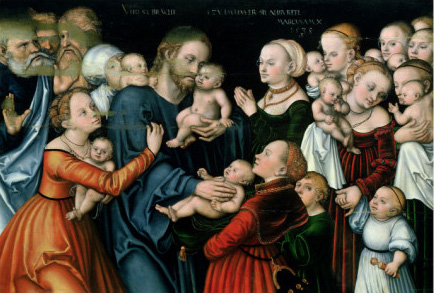
Suffer the Little Children to Come Unto Me, by Lucas Cranach the Elder, 1538

Growing up on the King James Version of the Gospels, I well remember the force of a verse from Mark 10:14 in which Jesus, in anger, said: “Suffer the little children to come unto me, and forbid them not: for of such is the kingdom of God.” The occasion was when several parents brought children to Jesus to be blessed, but were discouraged by his disciples. This past week has seen the suffering of little children around the world. Last Friday America was gripped by the tragedy of twenty elementary children and six adults gunned down by a disturbed young man, who first killed his mother in bed and then at the school took his own life. In a nation that wears its constitutional “right to bear arms” on its political sleeves, this was a shot to the gut. For all of us whose children have gone through the public school system, the shock lingers. It could have been any local school in any state. It could have been any of our children. A killer with a gun has denied them life. This suffering is not what Jesus meant when he said “suffer the little children to come unto me.” One need not be an expert in 17th century English to understand the meaning of the verse.

But children continue to suffer at the hands of adults all over the world. In Pakistan on Monday six health workers engaged in a project to immunize children were shot to death by extremists who have been told that such a program to save children’s lives is actually a Western plot to undermine Islam. Along with five brave women and one man, the Pakistani children who will not have immunity from polio will also suffer. The irony that six adults were killed both in Pakistan and in New Town, Connecticut is worth reflecting on. In both cases those trying to save children became victims; in both cases children suffer. Continue reading Suffer the little children