Category Archives: Ethics

Of Missile Strikes and Moros

In today’s New York Times columnist Nick Kristoff responds to critics of his support for targeted missile strikes on Assad’s regime to send a lesson about the use of poison gas. I agree with his opening comment that columny (whether by a columnist or not) is not a very useful way to think about a complex issue. There is indeed a lot of bluster, so much so that one might metaphorically call the debate over the use of a retaliatory strike on Syria poisoned from the start. For President Obama, drawing a red line in a public speech was bound to be seen as a red flag by the bullshit artists of the Tea Party anti-Obama-anything club. For Republicans who wore their hawkishness on their sleeves under Bush to criticize Obama for daring to apply American military power to a foreign conflict, the irony is very much the epitome of politically expedient hypocrisy. Then we have the normally peace-promoting liberals who want to make a principled statement about the horrific results of using chemical weapons. How could there be anything but contentious calumny?

American public and political outrage at Assad’s callous use of poison gas has a red line as well: virtually unanimous agreement on all sides that there shall be no American boots-on-the-ground. Given that the U.S. has an arsenal that makes that possible, as was evident in Kosovo and Libya, we can forge ahead with smug assurance that as long as our sophisticated missiles do not carry any Sarin gas we are on higher moral ground. There is an ethical dilemma here that transcends who you support in the civil war that is raging in Syria. In sheer numbers Assad’s forces have killed 1,000 times more with so-called “conventional” weapons than the lobbing of several canisters of gas at a Damascus neighborhood. Even if you believe that poison gas is so horrific that its use must be punished, then there is the obvious retort that the U.S. knew Assad had used poison gas earlier, as it knew Saddam used it against the Kurds and against Iranian troops. At best this is a case of situation ethics, where the ethical point only matters if the situation is politically expedient.

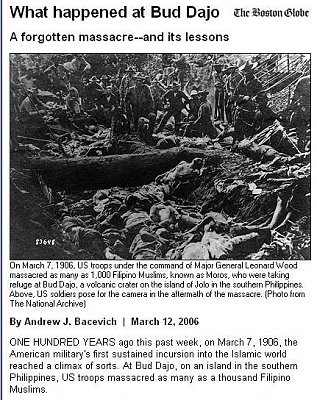
Also in today’s news on Al Jazeera is a report that Philippine troops are securing the southern port city of Zamboanga, where an estimated one hundred Moro National Liberation Front (MNLF) guerrillas have taken a number of hostages in a failed attempt to take over city hall. Although the “Moros” are a nationalist movement, they are also a brand of Muslim extremists who kill fellow Muslims, like the current morass in Syria. I suspect that most Americans are unaware that the Philippines were once under the direct control of the United States, as part of the spoils of the Spanish American War. Continue reading Of Missile Strikes and Moros
Playing Dice with God in the Middle East: The Putin Way

By Samson A. Bezabeh,

The World War II war time correspondent Emie Pyle once said that “there is no atheist in the fox hole”. What he meant does not only indicate the brutality of war but the honesty that can come out in war. In pronouncing these words, Pyle was pronouncing the truth about mankind, a deceptive being with layers of ideas. The whole thinking behind Pyle’s statement is that man need to be cornered to shade the various facades that he has adopted. As a Christian, the core for Pyle was the presences of God.

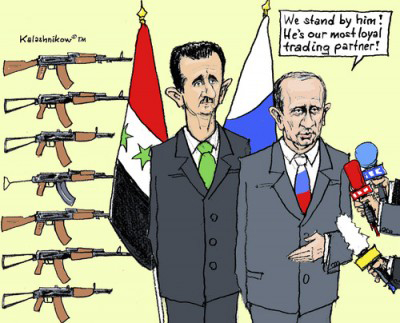
I am not here interested in Pyle or for that matter his view of God but on Putin and his recent comment on the ongoing Syrian affair in New York Times. Russia has been deeply enmeshed in the Syrian affair as a result of a number of strategic interests that the Assad government has been able to give to Russia. Yet Putin goes on to lecture about issues of morality to the American government without mentioning these issues. His focus in that essay was about the animosity as well as cooperation that his country had and is still having with the USA. His other focus was on the American exceptionalism that was pronounced by President Barack Obama. This point he apparently obtained after deeply studying Barack Obama’s recent speech.
Putin’s moralizing article was even more moralizing in its conclusion. Putin invoked the power of the people as he claimed that his article is addressed to the people of America. In his conclusion he even invoked a much higher power: God. He tells us:

There are big countries and small countries, rich and poor, those with long democratic traditions and those still finding their way to democracy. Their policies differ, too. We are all different, but when we ask for the Lord’s blessings, we must not forget that God created us equal (emphasis added).

Although hearing this from an x communist and a former KGB spy is stunning, it is even much more shocking when one realize the dishonesty that is embedded in Putin’s statement. Continue reading Playing Dice with God in the Middle East: The Putin Way

How to Kill a Terrorist


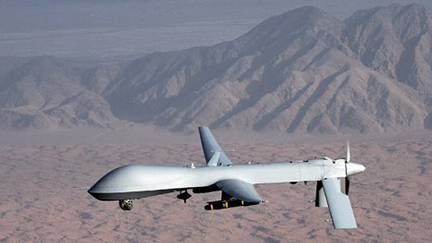
Predator drone

by Abdullah Hamidaddin, al-‘Arabiyya, September 11, 2013

On May 23, 2013 in a wonderful speech, that is yet to be translated into action, President Obama declared an end to the Global War on Terror (GWOT) which the U.S. has been waging since the early days after 9/11. Yet, killing terrorists is still on his agenda and that of other leaders around the world, albeit in a more “moderate” fashion. So here are some preliminary thoughts which I believe should guide this policy of killing.

The golden rule for killing a terrorist, actually the two golden rules, are simple and direct. The first golden rule is: do not become a terrorist in the process. The second rule is: do not create two or more terrorists for every terrorist you kill.

Very simple!

Yet the record of the past twelve years tells us that those two rules have been broken again and again and again. Some of those fighting terrorism have become as bad, and sometimes worse, than the terrorists they are fighting. Consequently, a new generation of terrorism has been born out of the very war that was supposed to fight and end terrorism. Moreover radicalization in our region has reached new and unprecedented limits; which is in itself a threat to civil peace. So what I will do here is register some of the ways in which those two rules have been broken, as things to be avoided in future killings.

Before I start with the first rule, I need to define what I mean by a “terrorist.” Continue reading How to Kill a Terrorist

Unbrotherly Brotherhood, Undemocratic Military

The debate over whether or not to send a cruise missile or two into Syria and spank Bashar al-Assad for adding chemical weapons to his bloody arsenal of putting down the revolt in Syria has overshadowed the continuing battle in Egypt for control of the political future. In both situations there is an alarming paradox for most Western observers: there seem to be no good guys wearing white hats, like in an early John Wayne movie. The al-Assad clan has run a security-based dictatorship that, like Saddam Hussein, tortured and killed opponents. But the major opposition, at least at this point in the ongoing civil war, includes a number of extremists who would be as bad a choice to take over. As the American experience in both Iraq and Afghanistan well demonstrates, the friendly (to us) leaders we would like to install (and did with impunity in the old days) do not work out so well these days.

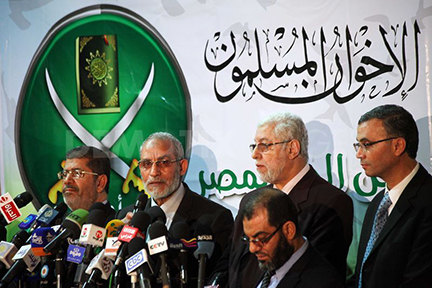
Egypt may not be today’s top story coming out of the Middle East, but it is hardly a stable situation. An article just out in the New Yorker by Joshua Hersh illustrates the clear objective of the Muslim Brotherhood to de-secularize Egypt. Those who came to power around Morsy were not very brotherly brothers and created a backlash by attempting to muscle out those who were not of their ideology. Continue reading Unbrotherly Brotherhood, Undemocratic Military

Père Etienne Renaud: In Memoriam, 2


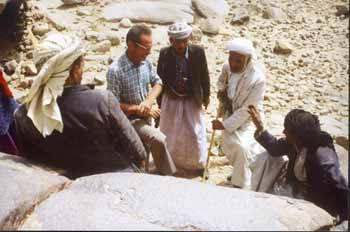
Père Etienne in Yemen

[In a previous post I commented on the life of Père Etienne Renaud, who rose to the position of leader of the Catholic White Fathers (Pères blanc), now known as the Missionaries of Africa. In 1987 he wrote a pastoral letter in the order’s in-house magazine, Petit Echo. This eloquent statement by a man who devoted his life to being a witness for humanity among Muslims and encouraging dialogue between Christians and Muslims deserves reading. It was originally written in French and translated into English in the same issue.]

Letter of Father General, Pére Etienne Renaud

Rome, 12 February 1987

Dear Fathers and Brothers,

Before taking up my pilgrim’s staff for West Africa, I should like to share some reflections with you.

After my election, several people asked me: “Is this going to change something in the Society’s commitment with regard to Islam?” One or another insisted more explicitly: “Is this going to increase our manpower in North Africa?” By way of riposte, I answered that a right wing government was well placed to make some left wing policy and vice-versa.

The fact remains that no one can make abstraction of his past, of all the missionary experience he has lived, and I must admit that my life in the Land of Islam, in North Africa as in Yemen, just as these last years teaching at the PISAI have deeply marked my general conception of mission.

My intention today, in this letter, is not to comment on the Chapter directives with regard to Islam, but to share with you some aspects of this conception of mission, which Islam has as it were forced me to deepen. I think that here it is a question of values important for every missionary, wherever he may be, even if they are values among others.

Respect for the other’s faith

In contact with Muslims, one is struck by the depth of their convictions, and more generally by the solidarity of the religious edifice of Islam. It is there, omnipresent. Study only reinforces this impression of massiveness, by helping us discover its centuries-old roots. Continue reading Père Etienne Renaud: In Memoriam, 2

Père Etienne Renaud: In Memoriam, 1

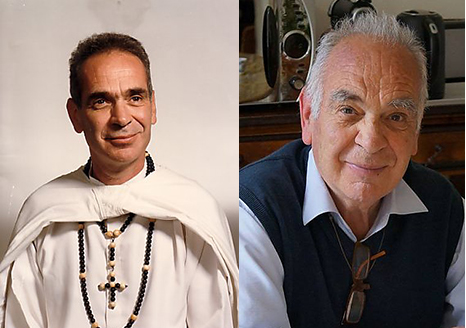
Just a few days ago I learned that a man I respected more than just about anyone else I have ever met had passed away on June 20, 2013 at the age of 76. This was Père Etienne Renaud, a man of the cloth I met in Yemen in 1978 and was able to visit in Rome in 1983. Etienne was a remarkable man, a missionary of the White Fathers (Pères blancs) teaching electrical engineering in Sanaa and ministering to the expatriate Christians in the community at the time. He was loved by all, including the many Yemeni Muslims he met, because he loved all.

His interest in Islam had evolved while serving in the French army in Algeria, after which he decided to enter the priesthood. With Arabic training in Damascus in 1968, he went to Tunisia the next year and on to Yemen in 1972. In 1980 he returned to Rome and taught Arabic at the recently formed Pontifico Instituto di Studi Arabi e d’Islamista. In 1986 he became Superior General of the order and served for six years. He visited many African countries where the White Fathers worked and spent the last several years in Marseille encouraging dialogue between Christians and Muslims.

Père Etienne was no ordinary missionary. He saw his mission as one of living his faith rather than trying to convert for conversion’s sake. In a poignant article, which I will post here in a follow-up, he noted that he was a Christian because he was born into Christianity. Although he accepted the Christian message as truth for him, he would not put himself in a position to judge another’s faith. His goal, as laudable as they come, was to be true to himself and allow others to be true to themselves, to see dialogue as an encounter that did not have to result in a zero-sum monologue. Continue reading Père Etienne Renaud: In Memoriam, 1

Death at the mosque


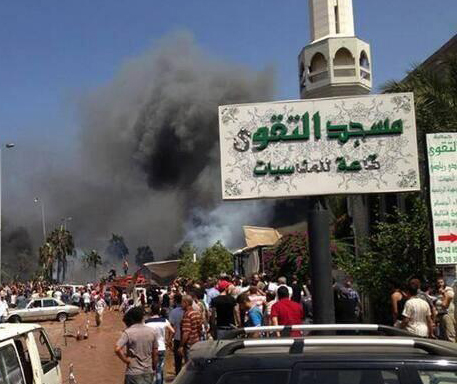
Blast at al-Taqwa Mosque in Tripoli, Lebanon

The mosque in Islam is known as a place of prayer. Since the very inception of Islam it has also been a place of death, indeed murder. It is reported that Ali, the cousin and son-in-law of Muhammad, was killed as he was praying in the Great Mosque of Kufa in Iraq by a fellow Muslim. Today in Tripoli, Lebanon, explosions at two mosques killed at least 27 people and injured hundreds. One of the blasts occurred near the al-Taqwa Mosque, where a Salafi preacher was praying, in the Abu Ali Square as those attending were leaving following Friday afternoon prayers. Another blast hit the al-Salam Mosque in the center of Tripoli. The reason? Yet another repeat of the intra-Islamophobia of one group of Muslims politically opposed to another group of Muslims.

When Ali was hit with a poisonous sword blade, he urged his sons and followers not to seek revenge on the Kharijites, the group to which the man who attacked him belonged, but to the man himself. But Ali was a better man than his followers. It seems that the attack on the Sunni mosque was tit-for-tat for the blast earlier this month in southern Beirut in the stronghold of Hezbullah. And the cycle continues, not only here, but in Iraq where it is almost a daily occurrence this summer.

There is a twisted logic here, the notion that someone who is clearly of the same religion is also someone that can be mercilessly slaughtered at prayer. Is there no one who will pray for peace and who will set aside political partisanship to work for peace? Continue reading Death at the mosque

Humans without Gods


Theobald von Oer, The Weimar Court of the Muses (1860)

by Anouar Majid. Tingis Redux, August 7, 2013

For many years now, I have shared my utter amazement at how human beings living in the 20th and 21st centuries could still believe that the gods of the Bible and the Koran are as real as the computer or mobile device in their hand, the cars they drive, or the many people, animals, or trees they see and touch. When I ask people if God exists, many say yes. But when I ask them how they got to know Him (God in the Judeo-Christian-Islamic tradition is unmistakably male), they quote their holy books as evidence. I have yet to meet someone who had a direct encounter with God; our knowledge of the Almighty relies heavily on our faith that Moses, Jesus, and Mohammed had exclusive access to Him, and that the books that tell us about these privileged encounters are the uncorrupted truth.

Most of us have been indoctrinated into such beliefs since childhood, so that by the time we start defending God against unbelievers, the best we can do is rationalize the faiths we inherited from our parents, families, and social environments. Take away the holy books and the theologians that have spent millennia preaching their dogmas and we are left with only our mere existences, alone with the elements, without any guide to show us how to make sense of our lives. This is, in fact, how the world was in ancient Greece before Christianity took over and condemned philosophy to perdition. And this is the world that the British philosopher A. C. Grayling wants us to rediscover in his newly published book, The God Argument: The Case Against Religion and for Humanism (2013).

Grayling doesn’t talk about the role of writing and scripture in the making of religions; he is more interested in making a humanist case against the basic assumptions of the three monotheistic religions. (Buddhism, Jainism and Confucianism, for example, are better understood as philosophies, not religions in the sense Westerners understand the term.) Such religions, a “hangover from the infancy of modern humanity,” a collection of “superstitions of illiterate herdsmen living several thousands of years ago,” expressions of the “pre-scientific, rudimentary metaphysics of our ancestors,” and a relic of the distant unlettered past are “essentially a stone-age outlook in the modern world.” It would be as if today’s governments still depended on the power of astrology and magic to govern people and run their affairs. This survival, needless to say, is astonishing in an age when science has made great strides—but, then again, science has yet to make a significant impact on many parts of the world, including the Islamic one. Continue reading Humans without Gods