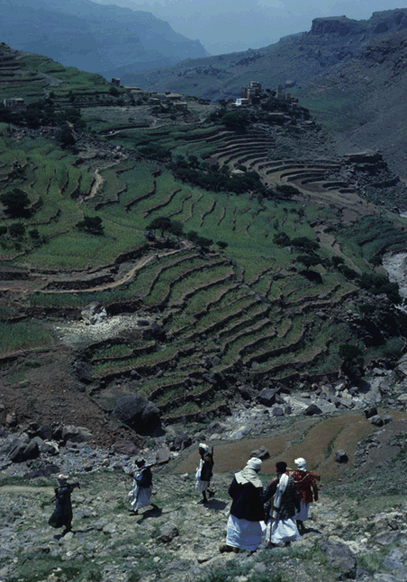
near al-Tawila, September, 1978; Photo by Daniel Martin Varisco
Category Archives: Photography
Lady Burton in Jeddah
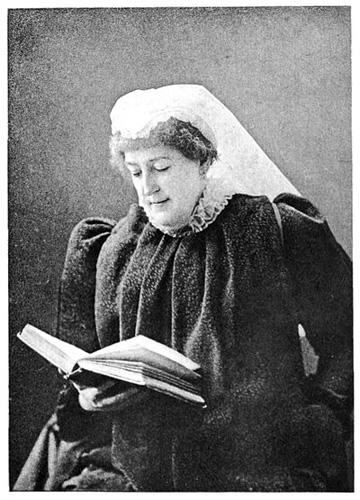
Lady Isabel Burton, wife of Sir Richard Francis Burton
[The following is an excerpt from The Romance of Lady Isabel with her reflections on visiting Jedda on the way to India in 1876. The entire book is available online.]
I was delighted with my first view of Jeddah. It is the most bizarre and fascinating town. It looks as if it were an ancient model carved in old ivory, so white and fanciful are the houses, with here and there a minaret. It was doubly interesting to me, because Richard came here by land from his famous pilgrimage to Mecca. Mecca lies in a valley between two distant ranges of mountains. My impression of Jeddah will always be that of an ivory town embedded in golden sand.
We anchored at Jeddah for eight days, which time we spent at the British Consulate on a visit. The Consulate was the best house in all Jeddah, close to the sea, with a staircase so steep that it was like ascending the Pyramids. I called it the Eagle’s Nest, because of the good air and view. It was a sort of bachelors’ establishment; for in addition to the Consul and Vice-Consul and others, there were five bachelors who resided in the building, whom I used to call the “Wreckers,†because they were always looking out for ships with a telescope. They kept a pack of bull-terriers, donkeys, ponies, gazelles, rabbits, pigeons; in fact a regular menagerie. They combined Eastern and European comfort, and had the usual establishment of dragomans, kawwasses, and servants of all sizes, shapes, and colour. I was the only lady in the house, but we were nevertheless a very jolly party. Continue reading Lady Burton in Jeddah
Happy Birthday Sir Richard Francis Burton
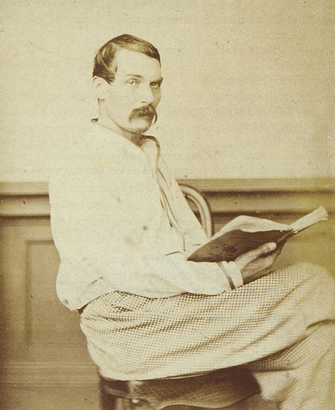
Burton in Aden
Today is March 19. Exactly 191 years ago, at 9:30 in the evening in the British town of Torquay in Devon the future Sir Richard Francis Burton was born. Like his 2oth century acting namesake, Burton was a character for the ages. He reveled in adventure and eroticism, for which he was much reviled in public and no doubt admired in private. If any one word can be used to described the persona that Burton pursued it would be “swashbuckling” in life as in spirit. My point today is neither to praise this flamboyant quasi-Victorian Caesar nor bury him (his grave is indeed a monumental site to behold). May his dry bones rest in the kind of peace he never seems to have found in life.

Burton’s biographers are numerous, as befits someone who is remembered as larger than life. His prolific corpus is now almost entirely online in various formats, but the place to start is burtoniana.org. There is much to question and quibble about in Burton’s exploits. Was his surreptitious entry into Mecca, disguised as a pilgrim, a travesty of Islamic values? Did his fascination with erotica in an age of gentlemananged taboos overstep ethical bounds? Was he the bad kind of “Orientalist,” a discourse cum intercourse voyeur that warrants calling him “Dirty Dick”, as Edward Said does in Orientalism (p. 190)? Was he, perhaps, a bit mad in that ubiquitous England manner?
Whatever you might think of the man, it is probably because of what you have read about him rather than what he actually wrote. Regardless of what he is saying, it must be noted that he had an extraordinary capacity for learning languages. Below is a list of the languages and dialects he is said to have mastered to some extent:
English, French, Italian, Latin, Greek, Jataki dialect (he wrote a grammar), Hindustani, Marathi, Urdu, Arabic, Persian, Pushtu, Sanskrit, Portuguese, Spanish, German, Icelandic, Swahili, Amharic, Fan, Egba, Ashanti, Hebrew, Aramaic, Many other West African & Indian dialects
I suspect he would get into Harvard, no matter what his SAT score.
A Swede and a camel in Yemen
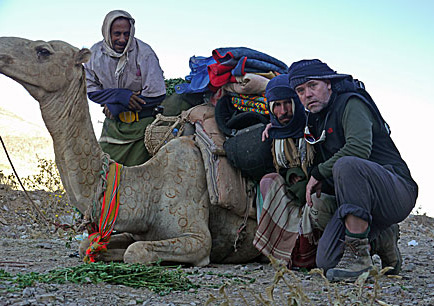
by Iona Craig, The National, January 9, 2012
A Swedish adventurer crossing Yemen by camel hopes his journey will encourage tourists to see beyond the political turmoil and violence that has engulfed the country for nearly a year.
Mikael Strandberg set out on December 7 on a 380-kilometre trek across the treacherous highlands, the first leg of his Yemen venture, to disprove the purveyors of pessimism.
“I don’t know what they [the tourists] are waiting for … it is such a wonderful country with great potential,” he said, after arriving in Sanaa after a two-week march through the toughest terrain in the Arabian Peninsula.
Along with two Yemeni companions, Mr Strandberg is in the initial phase of a journey that will cross the country from the western coastal plains of Hodeida to the edge of the world’s largest sand desert, the Rub’ Al Khali, or Empty Quarter, and beyond to Oman.
The explorer, 48, who fell in love with both the country and his wife Pamela, an American, during a visit to
Yemen three years ago, holds fond memories of Sanaa and the Yemeni people.
“We decided to go and try to make a difference and give a different perspective from the one portrayed by the media,” said Mr Strandberg. Continue reading A Swede and a camel in Yemen
An Orientalist Coverup: Imagine that…
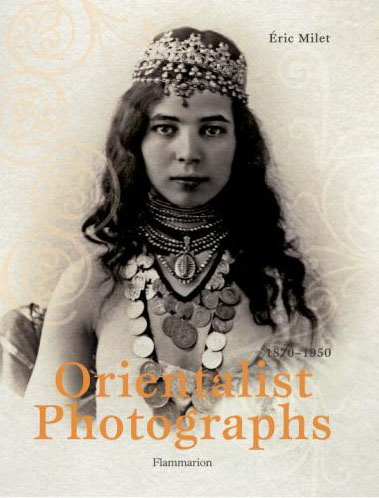
Cover of Milet’s book
In the Islamic Arts Museum in Qatar last December I bought a copy of a fascinating book of Orientalist Photographs by Éric Milet, who has worked as a tourist guide in Morocco for a number of years. The photographs, from both the 19th and 20th centuries, are accompanied by short vignettes. As Milet notes, “The ‘Oriental’ Maghreb was born in the darkrooms of Western photographers. A land of contrasts, revealed to the public at large by men and women who were delighted to have crossed to the ‘other side’ in their own lifetimes, constantly evoking the delights of this earthly paradise.” The book is well worth owning, not only to decorate your coffee table, but for easy, entertaining and informative reading.
As the author Malek Alloula has written, in his The Colonial Harem (1988), the ‘Oriental’ created by the photographer became “the oriental’ for the general public. The photographic lens is portrayed by Alloula as the structural enemy of the veil; capturing the image thus sought the removal of the veil and exposure of the female body as a voyeuristic object. Of course, the photographers who paid prostitutes to pose as “typical scenes” in the Maghreb were not the prudish Orientalist scholars, who would often render sexual argot in pseudo-scientific Latin (perhaps assuming that Victorian ladies did not know their Latin or at least that kind of vulgar Latin). But in the case of Milet’s book, the cover is a modern-day coverup that allows it to be sold in the likes of a bookstore of an Islamic Museum. The picture chosen for the cover has been altered so that the bare breast exposed by the photographer in this exquisite 1910 image (shown below) is lost in an arabesque and nipple-less swirl.
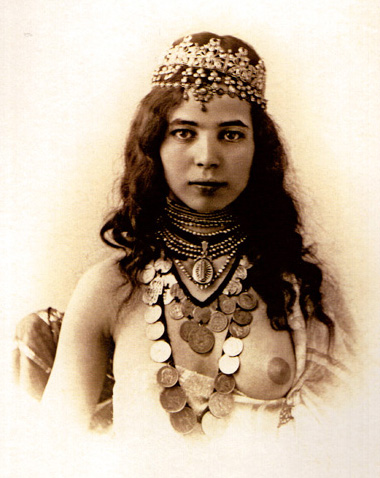
“Young Woman in Arab Costume, Algeria, 1910
The objectification of the female body, as shown by Alloula and many others, reinforced the image of the exotic and erotic harem girl open to the gaze of the European voyeur. True enough, although photographers of the time would expose the female body no matter what the nationality. Artistic nudes graced the major museums and were admired; the emerging visual realm of photographs quickly elided the erotic into the pornographic. But in the case of Milet’s book, undoubtedly due to the publisher rather than the author, there is a reversal, a kind of commercially smart prudery that removes the apparently offending body part, even though in so doing the very exposure for which such Orientalist photographs are critiqued is erased. It is not unlike sanitizing the Arabian Nights as children’s fairy tales.
In this case I am not suggesting we judge a book by its cover, but that we allow ourselves to be seduced into opening the book to see the range of images, some clearly bordering on the exploitative and others evincing a sensitivity usually reserved for poets.
Daniel Martin Varisco
The African Diaspora in the Indian Ocean World

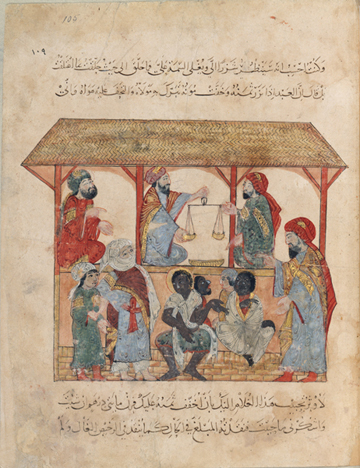
Slave Market in Yemen, 1237
Al-Maqamat, folio 105. Author: al-QÄsim ibn AlÄ« al HarÄ«rÄ« al-BasrÄ«. Illuminator: Yahya ben Mahmud al-Wasiti. Bibliothèque nationale de France. 021, an enslaved Ethiopian, Najah, seized power in the city of Zabid. This image represents the slave market at Zabid—at the time the capital of Yemen—in 1237. The illustration is part of “Al-Maqamat†(Assemblies), a genre of rhymed prose narrative. Both the author and the illuminator of this work were born in Iraq.
The Schomburg Center for Research in Black Culture has posted online a very nice exhibition on the African diaspora in the Indian Ocean World with illustrations and scholarly text. Continue reading The African Diaspora in the Indian Ocean World
Picturing Yemen #6
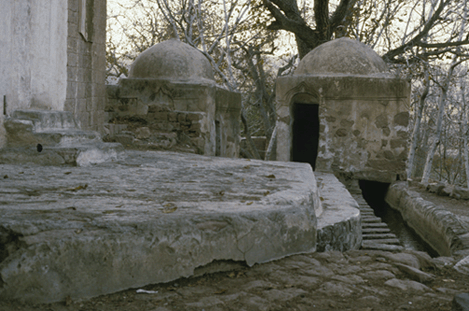
Outside the Hadda mosque, March, 1985; Photo by Daniel Martin Varisco
World Press Photo of the Year 2011
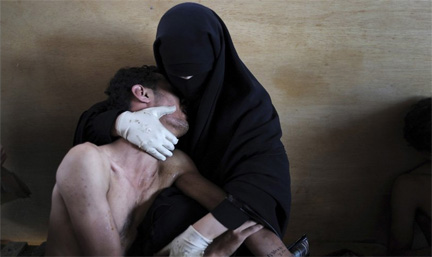
The international jury of the 55th annual World Press Photo Contest has selected a picture by Samuel Aranda from Spain as the World Press Photo of the Year 2011. The picture shows a woman holding a wounded relative in her arms, inside a mosque used as a field hospital by demonstrators against the rule of President Ali Abdullah Saleh, during clashes in Sanaa, Yemen on 15 October 2011. Samuel Aranda was working in Yemen on assignment for The New York Times. He is represented by Corbis Images.
Comments on the winning photo by the jury
Koyo Kouoh: “It is a photo that speaks for the entire region. It stands for Yemen, Egypt, Tunisia, Libya, Syria, for all that happened in the Arab Spring. But it shows a private, intimate side of what went on. And it shows the role that women played, not only as care-givers, but as active people in the movement.”
Nina Berman: “In the Western media, we seldom see veiled women in this way, at such an intimate moment. It is as if all of the events of the Arab Spring resulted in this single moment – in moments like this.”
Aidan Sullivan: “The winning photo shows a poignant, compassionate moment, the human consequence of an enormous event, an event that is still going on. We might never know who this woman is, cradling an injured relative, but together they become a living image of the courage of ordinary people that helped create an important chapter in the history of the Middle East.”
Manoocher Deghati: “The photo is the result of a very human moment, but it also reminds us of something important, that women played a crucial part in this revolution. It is easy to portray the aggressiveness of situations like these. This image shows the tenderness that can exist within all the aggression. The violence is still there, but it shows another side.” Continue reading World Press Photo of the Year 2011