Category Archives: Journalism and Media

Just Rain?


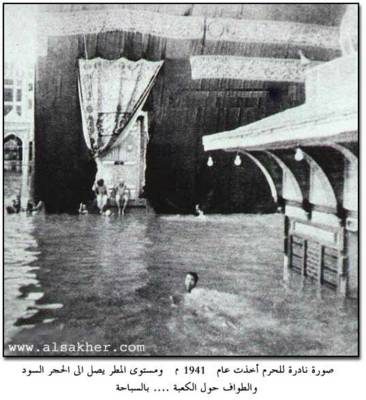
Flooding in Mecca in 1941, in which the circumambulation had to be swum

In many parts of the Middle East, where water is not an easily accessible resource, rain is baraka. The Arabic term baraka is only vaguely understood in the English sense of “blessing,” the lexical translation. Context makes this heaven-sent product a blessing some times and a curse other times. Pilgrims to Mecca this year have witnessed torrential rain, dampening the make-shift hotel tents and ihram garb, but perhaps not the enthusiasm of the hajjis and hajjiyyas. An article on today’s Al-Jazeera website notes that about three million Muslims are performing the pilgrimage; as for the number of umbrellas being used, Allahu a’lama. Normally, extra rain in the arid environs of Mecca and Medina would seem something to evoke al-hamdillah from the faithful, but in this case timing is a problem. Some 50 people have already been killed due to these rains, and the fear of spreading disease during an already concurrent high flu season is no doubt troubling to the health officials. The H1N1 flu has already claimed four pilgrims and some 67 have been diagnosed with the virus. Perhaps the Egyptian government missed a few of those dangerous swine of the Christian Zabbalin.

So if one assumes that this ordained ritual is important in the eyes of Allah, an old and nagging question arises: why does the rain fall on the just as well as the unjust. This ethical dilemma played out on the monotheistic stage has a long history. In the Gospels Jesus reminded his followers that God is an equal opportunity Creator: Continue reading Just Rain?

Going (after) Muslim


A picture making the news rounds of Major Hasan on the day of the shootings.

[Note: I have just published a commentary on a commentary in Forbes Magazine in which Major Nidal Hasan is said to have “gone postal” in his frenzy. This is published on Religion Dispatches. I excerpt the first couple of paragraphs here, but please go to the Religion Dispatches site, where you can post comments as well.]

If the media frenzy over the Fort Hood killings is any gauge, the ugly specter of 9/11 has again taken its psychological toll. This time, instead of the “bad Muslim” being a bearded terrorist called bin Laden, there is a US Army psychologist who was trained to be a healer of military personnel. He happens to have an Arabic ancestry and is Muslim.

Prominent American Muslim organizations issued statements right away condemning the murders. Debate in the media is now focused on his motivation. Was he a fifth-columnist wolf in military dress? Did his sympathies for innocent victims in our ongoing wars in Iraq and Afghanistan overwhelm his common sense of decency? Should the FBI and security arms of the US military have pounced on him when they uncovered his initial links to a radical imam?

One result that I have noticed among those who study Islam, especially my Muslim colleagues, is a growing fault line over the dubious “good Muslim/bad Muslim” binary. As Mahmood Mamdani has eloquently argued, the choice is not between good and bad individuals or citizens, but about being Muslim. Major Hasan is a man who looked very much like a “good Muslim”: a military officer providing therapy to returning veterans. But, now, it seems that at some tipping point he became the “bad Muslim,” the kind who places mosque above state.

For the rest of this commentary, click here.

Daniel Martin Varisco

Ignorance is no Excuse


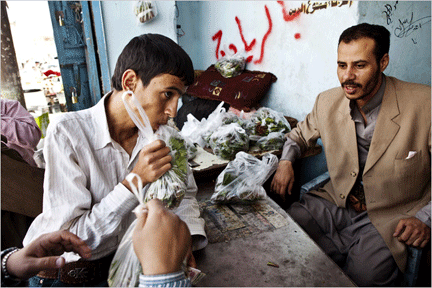
Selling qât in Sanaa, Yemen’s capital. Photo: Bryan Denton

These days if you run across an article on Yemen, it will no doubt feature a scenario of gun-toting tribesmen swearing allegiance to Al-Qaeda, the latest German tourist hijackings or feigned shock at the terrible, terrible addictive drug called qât. At least this was the case in Sunday’s New York Times in another piece of mixed journalistic pablum by roving reporter Robert Worth. Entitling the article “Thirsty Plant Dries Out Yemen,”, the author seems unaware that the site of his posting (Jahiliya) is in fact the Arabic term for the time of “Ignorance” before the rise of Islam. I doubt this reporter stepped out of a Queen-of-Sheba-era time machine and interviewed Abraha about his recent defeat at the “Battle of the Elephant” before Mecca. So where exactly is the fabled posting site of Jahiliya? Ironically, it is part of a World Bank irrigation project. I will leave the irony about IMF money being poured into Jahiliya in the strict sense to the imagination of the reader. And I strongly suspect the posting was made from a fancy hotel in the capital Sanaa and not from a rural internet cafe, while sipping qishr. But for a front page article on a major newspaper, ignorance is no excuse. Continue reading Ignorance is no Excuse

Reduced to a four-letter word


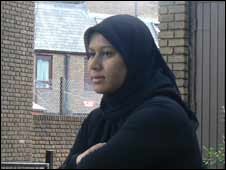
Tamanna Rahman: Even at home in Manchester, Tamanna is now wary of attacks

Tamanna Rahman spent two months living on a Bristol housing estate for the BBC’s Panorama programme Undercover: Hate on the Doorstep.

Here she explains her reasons for agreeing to take part in the programme and describes how it felt to be a daily target of racist abuse, both physical and verbal. Her report contains details of racial abuse.

by Tamanna Rahman, BBC Panorama, October 19, 2009

In 2000, as a 16-year-old at my culturally and racially diverse Manchester secondary school, I was asked by a local television news team examining the hopes and aspirations of the first class of the new millennium if I felt that racism in Britain was a thing of the past.

Fresh-faced, naïve and optimistic, I answered yes; racism is dead.

Fast-forward to the summer of 2009 and my answer is very different.

What changed? As part of a Panorama programme, I spent two months working undercover on a Bristol housing estate.

Over the course of our investigation I would have glass, a can, a bottle and stones thrown at me. Continue reading Reduced to a four-letter word

Ardi, We hardly knew yah

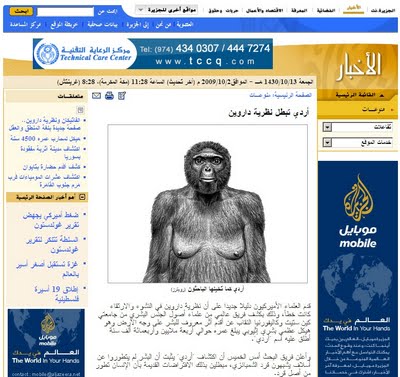
Making sense of Al Jazeera’s strange coverage of “Ardi”

by Salman Hameed, Irtiqa, A Science & Religion Blog, October 13, 2009

About two weeks ago, Science included a series of papers about our 4.4 million year old ancestor Ardipithicus or “Ardi”. It is a fascinating find that has justifiably garnered attention worldwide. You can read the details in Science (there is also a nice short video there) and an excellent description on The Loom.

However, Al Jazeera gave an interesting spin to the same story. Lina Malkawi translates the story on her blog and points out the bizarre coverage by the Arabic version of Al Jazeera, where the headline reads: Ardi refutes Darwin’s theory (the screen shots on the right are from Lina’s blog). And one goes, huh?! Did Al Jazeera any thing about Ardi? Hey – if not the original Science article, at least read the summary of the findings (they could have at least watched the short video that explains the findings). Continue reading Ardi, We hardly knew yah

Sex, flies and videotape: the secret lives of Harun Yahya

by Halil Arda, The New Humanist, Volume 124, Issue 5, September/October 2009

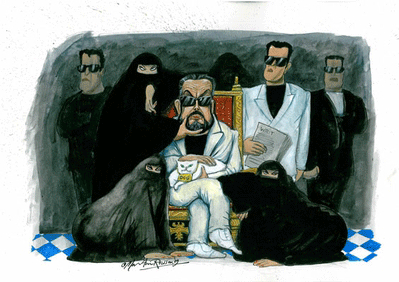
Inspired by the high profile of its Christian American counterpart, Muslim creationism is becoming increasingly visible and confident. On scores of websites and in dozens of books with titles like The Evolution Deceit and The Dark Face of Darwinism, a new and well-funded version of evolution-denialism, carefully calibrated to exploit the current fashion for religiously inspired attacks on scientific orthodoxy and “militant” atheism, seems to have found its voice. In a recent interview with The Times Richard Dawkins himself recognises the impact of this new phenomenon: “There has been a sharp upturn in hostility to teaching evolution in the classroom and it’s mostly coming from Islamic students.”

The patron saint of this new movement, the ubiquitous “expert” cited and referenced by those eager to demonstrate the superiority of “Koranic science” over “the evolution lie”, is the larger-than-life figure of Harun Yahya. Continue reading Sex, flies and videotape: the secret lives of Harun Yahya

Burns on Afghanistan


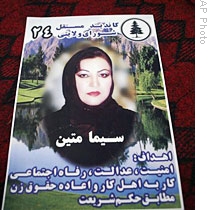
An election poster in Kapisa province for Sima Matin, a female candidate in a provincial council election, 28 Jul 2009

John Burns Answers Your Questions on Afghanistan

By John F. Burns, The New York Times, August 19, 2009

After more than 30 years as a Times foreign correspondent, I’ve grown used to looking out of the aircraft or jeep or train on arrival in unfamiliar and often inhibiting terrain, and wondering with a mixture of anticipation and anxiety how quickly, and capably, I’ll get my professional bearings — and justify the editors’ faith in assigning me. The boundary I’ll be crossing with this new venture for “At War,” our new and expanded blog on the conflicts of the post-9/11 era, is a different kind of challenge — but just as daunting, in its way, as those old forays into unknown lands.

In the first 48 hours after our Web editors invited readers to send in their questions, more than 220 of you responded, a degree of interest that is encouraging for what it suggests about the potential for us at the Times of this kind of interactive journalism. Just as much, the flow of questions, and the sophisticated commentaries woven into many of them, have been a reminder of how much many of our readers already know about the complex challenges America confronts abroad. Continue reading Burns on Afghanistan