Category Archives: Yemen

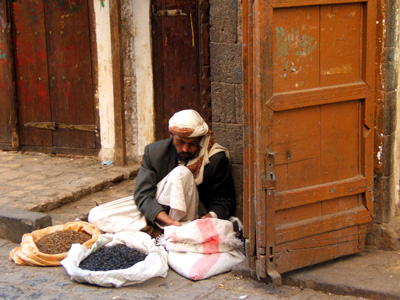
Yes, We Qat no Grapes

Yemeni farmers threaten to swap grapes for qat
Saddam Al-Ashmori, The Yemen Times, October 11, 2008

SANA’A, Oct 11 – Yemeni raisin producers have threatened to replace grapes with qat in their plantations after the loss they sustained this year as a result of not being able to sell all their produce.

Nasser Al-Khawlani, owner of a vineyard, said that the reason behind the low demand for local raisins this year was the presence of other cheap and attractive raisins in the markets, smuggled into Yemen from China.

He further said that, if the government didn’t take steps to prevent the smuggling of Chinese raisins into the country, farmers would replace grapes with qat in their lands. Continue reading Yes, We Qat no Grapes

Literacy through Poetry


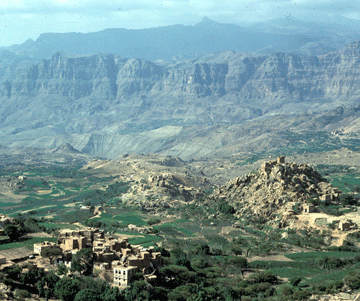
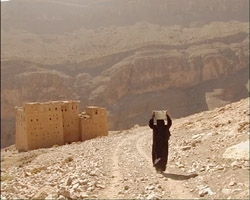
Highland valley of al-Ahjur in central Yemen

The following report was recently published online by dvv international at the Institut für Zusammenarbeit des Deutschen Volkshochschul-Verbandes. It can be read in English, French or Spanish. The report describes an innovative World Bank-funded literacy project coordinated in Yemen by anthropologist Najwa Adra in 2002/2003.

Learning through Heritage, Literacy through Poetry
by Najwa Adra

I have just read Henrik Zipsane’s fascinating article on heritage learning (Zipsane 2007) in the latest issue of this journal. Zipsane describes several highly effective programs for lifelong learning provided by Jamtli Open Air Museum in Sweden. He argues that each person’s heritage includes “many coexisting histories” and that there is a need to provide diverse learning experiences. He suggests that one can learn “through cultural heritage” and not only about this heritage. In a part of the world far from Sweden, geographically and culturally, I too have found that heritage can be an effective learning tool “in the present” and not just an interesting artifact of the past.
The Project

In 2002-2003, I piloted a literacy project for adults in Yemen, on the SW corner of the Arabian Peninsula, in which learners created their own texts through their stories, poems and rhyming proverbs (Adra 2004). 2 Classes began with a discussion of a photograph of a scene familiar to the students or a topic of their choice. Students were encouraged to insert poetry and proverbs into their discussion, as is their custom when discussing issues of importance to them. With the teacher’s help, the class developed a short story based on the discussion. This story, which was written on large paper taped to the wall, along with poems and proverbs generated by the discussion, became the text through which students learned to recognize and read phrases, words and letters of the alphabet. In order to reinforce letter and word recognition, texts often focused on particular letters, words or syllables. Continue reading Literacy through Poetry

Jangling Nerves in Yemen


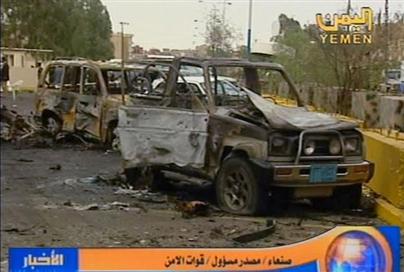
Damage is seen after a car bombing near the U.S. embassy in Yemen in this frame grab taken from Yemen TV on Sept. 17, 2008.

Jangling nerves

The Economist ,Oct 2nd 2008


Resurgent terrorist groups are just a symptom of broader troubles

THE wreckage of twin car bombs outside the American embassy in Yemen’s mountain capital, Sana’a, confirmed fears of a resurgent jihadist movement in a strategic country at the foot of the Red Sea, just across from chaotic Somalia. The attack in mid-September was the second on the American embassy in six months. A misfired mortar that hit a nearby girls’ school in March had prompted the evacuation of non-essential American staff.

Jittery diplomats had been back at their desks for less than a month when six suicide-bombers blew themselves up outside the embassy compound’s gate. American staff promptly packed their bags once again. Yemen’s interior ministry rounded up dozens of suspects but is said to be refusing to adopt some of the State Department’s suggested extra security measures. Continue reading Jangling Nerves in Yemen

Bomb Attack on U.S. Embassy in Yemen


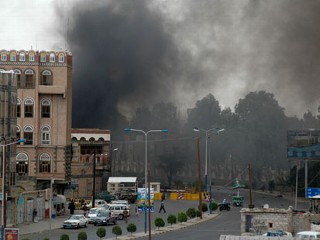
Smoke is seen billowing outside the U.S. embassy in Sanaa September 17, 2008. A car bomb set off a series of explosions outside the heavily fortified embassy in Yemen on Wednesday and a Yemeni security source said at least 16 people, including six attackers, were killed. Collapse
(Yemen News Agency, via Reuters)

U.S. Embassy in Yemen Attacked

By Ellen Knickmeyer, Washington Post Foreign Service, Wednesday, September 17, 2008

SANAA, Yemen, Sept. 17 — Attackers exploded a vehicle bomb outside the main gate of the U.S. Embassy in Yemen on Wednesday in what appeared to be a well-coordinated assault that triggered more explosions and heavy gunfire around the compound.

Yemen’s official Saba news agency said 16 people died in the incident, including six Yemeni soldiers, four civilians and six attackers. One of the civilians was an Indian woman at the embassy on business.

There were no immediate reports of American casualties. The embassy is located in the center of Sanaa, Yemen’s capital, but the building is set far back from an outer security wall.

There was no immediate claim of responsibility. Continue reading Bomb Attack on U.S. Embassy in Yemen

Water Scarcity in Yemen


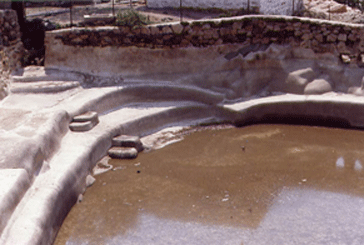
Cistern collecting water in Hayfan

Tomorrow morning I will be giving a presentation at USAID in Washington on the development problems surrounding water resources in Yemen. As almost anyone involved in Yemen’s development knows, the country is rapidly running out of water. The handwriting has been on the wall for some time now, as the following quotes show:

“In general, the cultivators make good use of the water available. What is mostly needed is an increase in supply.” FAO Mission to Yemen, 1955

“Water is the limiting factor in most of the Yemen development projects.” Water Resources Sector Study in the YAR, USAID, 1977

“Water is a scarce resource in Yemen; there is not enough to satisfy present and potential demand.” Water Policy Initiatives for Yemen, CID for USAID, 1980

“… available information indicates that groundwater has been severely overdeveloped.” Irrigation Sector Study, World Bank, 1980

How did this happen? Continue reading Water Scarcity in Yemen

Yemen sleepwalks into water nightmare

By Alistair Lyon, Special Correspondent, Environmental News Network, March 1, 2008

BEIT HUJAIRA, Yemen (Reuters) – Black-clad women trudge across a stony plateau in the Yemeni highlands to haul water in yellow plastic cans from wells that will soon dry up.

“We come here three or four times a day,” says Adiba Sena, as another woman draws water six metres (20 feet) to the surface and pours it into jerry cans lashed to her grey donkey. “We use it to clean, cook, wash — we have no pipes that reach us.”

These women are at the sharp end of what Yemen’s water and environment minister describes as a collapse of national water resources so severe it cannot be reversed, only delayed at best. Continue reading Yemen sleepwalks into water nightmare

Al-Qaeda’s war in Yemen

By: Aqeel Al-Halali, The Yemen Times, August 7, 2008

SANA’A, Aug. 6 – A leading Al-Qaeda figure in Yemen has threatened to execute armed attacks “at larger scales” if the Yemeni government doesn’t release his detained colleagues from prison.

This comes a day after a government announcement that it is interrogating suspects in the July 25th suicide bombing that targeted a camp in Hadramout governorate’s Sayoun city, 794 kilometers east of Sana’a.

In a taped recording, Yemeni Al-Qaeda leader Hamza Al-Quaity stated, “Your worries are our worries, your sorrows are ours and your grief is our grief. We’ll never forget you, Allah willing. As for you, oh [Ariel] Sharon of Yemen, [Political Security director] Ghalib Ba Gumesh, you’ll see how our colleagues will be freed from your prisons, Allah willing.” Continue reading Al-Qaeda’s war in Yemen

Peaks of Yemeni poetry he summons


[The following is Najwa Adra’s review of two books by anthropologist Steven C. Caton, who conducted ethnographic fieldwork in Yemen in 1979-1981. It was first published in
Yemen Update, #48 (2006):46-50.]


“Peaks of Yemen I Summon”: Poetry as Cultural Practice in a North Yemeni Tribe
, by Steven C. Caton
Berkeley, University of California Press, 1990
ISBN # 0-520-06766-5
351 pp., illus., maps, hardcover

Yemen Chronicle: An Anthropology of War and Mediation
, by Steven C. Caton
New York, Hill and Wang, 2005
ISBN-13: 978-0-8090
341 pp., maps, no illus., hardcover (also available in paper)

Reviewed by Najwa Adra

“Peaks of Yemen I Summon”: Poetry as Cultural Practice in a North Yemeni Tribe and Yemen Chronicle: An Anthropology of War and Mediation, published 15 years apart, should be read as two complementary parts of a whole. They document Steven Caton’s field research on tribal poetry in Khawlan at-Tiyal in 1979-81. Together, these books are important contributions to theory in anthropology, the ethnography of Yemen, and perhaps literary theory and political science as well. The first book is a technical discussion of tribal poetry as cultural practice; the second is a personal, reflexive description of the author’s experiences in the field. It provides rich contextual data that shed light on, and help support, the author’s argument in the first book. Continue reading Peaks of Yemeni poetry he summons