Category Archives: Yemen

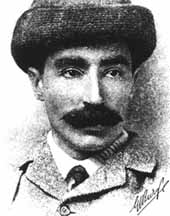
Bury on Yemen

[Note: One of the early 19th century travelers to Yemen was the British birder G. Wyman Bury. His Arabia Infelix, or The Turks in Yamen (London: MacMillan, 1915) is a personal and informative account of his visit to the southern part of Yemen, especially Aden and its hinterlands. Near the end of his book, he discusses the political climate of his day, when Britain was firmly in control of Aden as part of its Indian Empire. Clearly biased in favor of his own British order, there is nevertheless a note of irony for a country which until this day has yet to attain stability.]

The Yameni is not fanatical. He has his own religious views, but realizes, from the sects into which his own people are divided, that there are at least two sides to every religious question.

He is a patriot ; and who, indeed, could help loving a country like the highlands of Yamen, in spite of past and present woes ? His patriotism, however, does not blind him to the fact that his local rulers have done and can do little for the welfare of his country. He would gladly throw off his present yoke for any change of government that promised more stability. Continue reading Bury on Yemen

Healing Herbs in Yemen


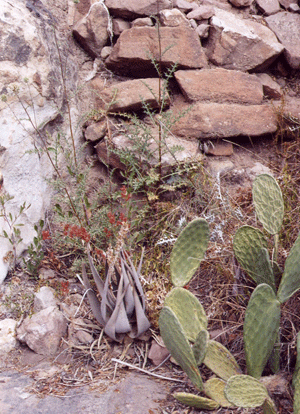
Aloe and Opuntia (balas Turkî) in al-Ahjur, central highlands of Yemen

Today I am flying on Lufthansa to Leipzig, and then on to Halle Wittenberg for a conference called “The use of herbs in Yemeni healing practices. An interdisciplinary workshop on traditional knowledge and cultural concepts in scientific perspective.“ The conference takes place September 25-26, 2009 at the Orientwissenschaftliches Zentrum , Martin-Luther-Universität Halle-Wittenberg, Germany. It has been funded by the Royal Ontario Museum Foundation, Ryerson University (both Toronto/Canada), and Martin-Luther-Universität Halle-Wittenberg, Germany. Click here for the order of the program.

The organizers are Dr Hanne Schönig (Orientwissenschaftliches Zentrum
Martin-Luther-Universität Halle-Wittenberg, homepage: http://www.owz.uni-halle.de/owz.php?pid=2) and Dr Ingrid Hehmeyer (Department of History, Ryerson University, Toronto, homepage: http://www.ryerson.ca/history/faculty/Hehmeyeri.html) and Dr Anne Regourd, Collaborateur Scientifique, Dept of Islamic arts, Musée du Louvre, Paris – France, homepage: http://www.anne.regourd.org.

The conference participants and papers are noted below: Continue reading Healing Herbs in Yemen

Bani Hushaysh Archaeology

Archeological sites in Bani Hushaish suffer from vandalism

by Mansur Ali al-Muntasir, Yemen Observer, February 3, 2009

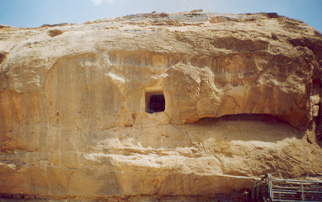
The Bani Hushaish district in the Sana’a governorate is 30 km east of the capital, and contains several important archeological sites.

Yemen has a great wealth of ancient archeological sites many of which date as far back as the pre-Islamic era and many more site which are still waiting to be discovered and documented. There is a fear though amongst the Yemen’s archeological establishment that without adequate protection and preservation much of Yemen’s historical record could be lost to natural and human damage. This article seeks to highlight the richness of Yemen’s archeological heritage and the need to preserve and document such heritage for future generations.

The most important of the discovered archeological sites is in Shibam al-Ghras, where several mummies were found. The district contains several other neglected sites, which have not yet been identified by archeological authorities. This is disturbing; as these sites have been damaged as a result of official negligence, and a lack of public awareness about their value and importance to Yemeni heritage. Continue reading Bani Hushaysh Archaeology

Monkeying Around in Old Aden

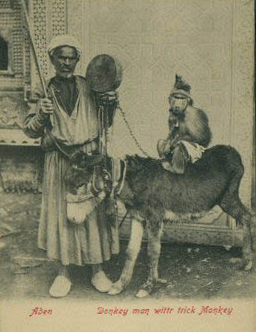
Here is an old photograph entitled “Donkey Man with Trick Monkey,” taken in Aden during the days of the British protectorate. It is not just any kind of “monkey,” of course. Sitting on the donkey is Papio hamadryas, the baboon, usually called rubâh in Yemen. It appears, in deference to the British colonial presence, that the monk is wearing britches.

Saudi- Iranian War fought in Sa’ada


Destruction of a minaret in the recent fighting at Sa’da, Yemen

by Hakim Almasmari, Yemen Post, August 31, 2009

With every day that passes, we come close to believe that the war in Sa’ada is a Saudi-Iranian war, not a Yemeni one.
Both foreign countries are desperate for more regional power while both are also worried of losing greatly. Saudi Arabia does not want Houthis controlling northern parts of Yemen for one main reason; southern Saudi has a large number of Shiite’s which could make them turn against their country as well. Saudi also fears that Shiite’s already have a militant group in the north of Arabia (Hezbollah), and are now looking for one in the south of Arabia (Houthis). Saudi Arabia paid billions of dollars to keep Hezbollah out of rule in Lebanon and somewhat came out victorious for the meantime, and is doing the same in Yemen. Continue reading Saudi- Iranian War fought in Sa’ada

Love Trumps Religion in Yemen


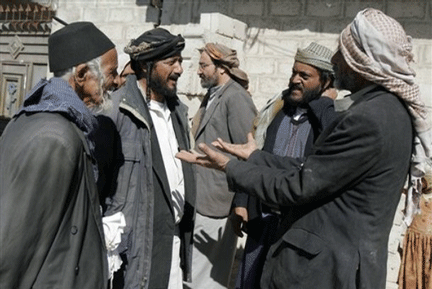
Yemeni Jews and Muslims talk at the village of Kharef, 50 miles, 80 kilometers, north of the capital Sanaa, Yemen, Monday, Dec. 15, 2008. Photograph by Mohammad al-Qadhi, AP

Complete Story of Jewish Liya’s Islam, Divorce and Marriage

Yemen Post, July 26, 2009

Over the recent period, the issues of Jewish minority have been hitting the titles in media outlets and their news is widely covered at local and international levels.

These news stories range from “Ninawa” embracing Islam and getting married to “Hani Saran”, forced migration of “Al Salem Jews” from Sa’ada and granting them apartments in the Sana’a Tourism City after being threatened by Houthis, killing incident of Masha Ya’aish at the hands of a former military pilot to the two-time marriage of “Liya” bint Sa’eed in a week and later her elopement with her Muslim husband to the nearby Arhab tribe and later on to the Al-Souk Al-Jadid in Amran’s Kharef area. Continue reading Love Trumps Religion in Yemen

Flipping through Late 19th Century Yemen

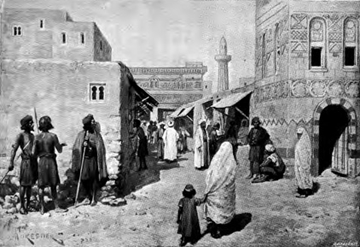
My fascination with flipbooks continues. For an interesting read about Yemen just over a century ago, check out the flipbook version of Walter Harris’s travel account. This has a number of illustrations, as illustrated above.

Among his exploits, Harris obtained an interview with the Sultan of Lahj at the time. Here is his description of the trial of smoking a hubble bubble:

The hubble-bubble was a sore trial. I was gradually, under the guidance of Said, learning to inhale it; but to have constantly to fill my lungs with the strong smoke was by no means a pleasant task to a novice like myself. Continue reading Flipping through Late 19th Century Yemen

Tracing the History of Qat


Selling qât in Yemen. Photo by Pascal Maréchaux

Much has been written, pro and con, about the chewing of qât leaves in Yemen. In addition to the economic and social problems over qat, there is a historical puzzle. When and how did the plant Catha edulis come from Ethiopia, its botanical origin, to Yemen? Yemeni legend and folkore suggest that the stimulant qualities of qat leaves were first discovered by a goatherd who noticed the effect on goats who browsed on the plant. A variant of this goat legend, told to me in 1979 by a poet from Husn al-‘Arus, suggests that an Ethiopian came along to explain to the goatherd what was happening. The goat is one of the few animals that can be seen occasionally eating qât leaves, but the story is surely apocryphal. Sometimes it is told for the origin of coffee, another stimulant brought from East Africa. Continue reading Tracing the History of Qat