Category Archives: Yemen

In Memoriam: Selma Al-Radi


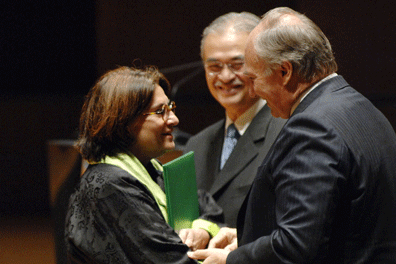
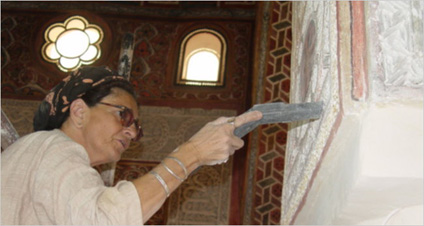
Dr. Selma Al-Radi, the Iraqi project director who restored the Amiriya complex in Rada, Yemen, over a 26 year period, receiving her 2007 Aga Khan Award for Architecture. The winners are being congratulated by Malaysian Prime Minister Badawi and His Highness the Aga Khan. Photo credit: AKDN/Gary Otte

Selma Al-Radi died peacefully at her home in New York City on October 7, 2010. She was 71 and was surrounded by family and friends. Often described as “a force of nature” by many, she was slowly robbed of that energy by her Alzheimer’s affliction, leaving a ruin that was rapidly demolished by ovarian cancer in a little over a year after symptoms were first detected.

Selma was born on 23 July 1939 in Baghdad and grew up in many countries but largely in Iran and India where her father served as the Iraqi Ambassador for a number of years. She graduated from Cambridge University in Archaeology and Ancient Semitic Languages, and earned her Master’s degree at Columbia where she came under the influence of her lifelong mentor, the late Dr. Edith Porada. She obtained her PhD at the University of Amsterdam but remained under the mentorship of Dr. Porada along with Dr. Maurits van Loon. Her thesis work focused on a Neolithic site in Cyprus (Phlamoudhi Vounari).

A consummate “dirt” archaeologist, working mainly on excavations in the field, Selma excavated on sites in most of the Middle East including Iraq, Syria, Turkey, Lebanon, Kuwait, Egypt, and Yemen. But Yemen was where she would spend much of her career. Continue reading In Memoriam: Selma Al-Radi

What if Obama’s Yemen policy works?


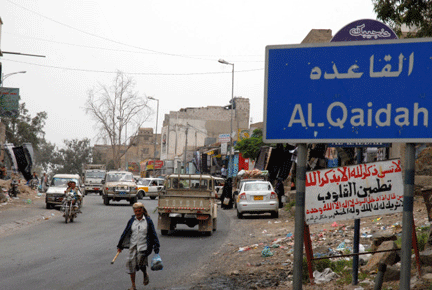
The town (long before Osama Bin Laden) of al-Qaida in Yemen

by Aaron Zelin, Foreignpolicy.com, September 22, 2010

In the past month, Yemen has returned to the spotlight. The CIA now believes that the Yemen-based al Qaeda in the Arabian Peninsula (AQAP) is a larger security threat to the United States than al Qaeda Central in Pakistan. Since then, press accounts have stated that the United States government plans to carry out drone attacks in Yemen, and reported that U.S. Central Command plans to give $1.2 billion in aid to Yemen’s military over a five-year period. But such policies, no matter how well-intentioned, are unlikely to solve the very real challenges posed by al Qaeda’s presence in Yemen and may well make the situation worse.

It originally appeared that there was widespread consensus in the government on providing such military aid to Yemen. But a recent article in the New York Times highlights that there is a vigorous debate within the Obama administration about the efficacy of such aid. The Obama administration has been debating the legality of droning an American citizen (i.e. Anwar al-Awlaki). Before rushing into a major new program, it’s worth recalling the reasons why past U.S.-backed efforts aimed at eliminating al Qaeda’s presence in Yemen have failed. Continue reading What if Obama’s Yemen policy works?

Pictures at a Yemeni exhibition


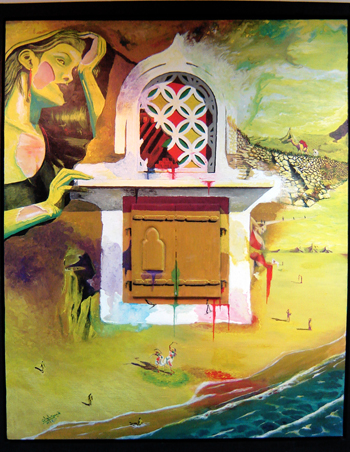
Painting by Qais Saleh Ahmed Aluan, founding member and vice-director of the Bait al-Fann (House of Art) in Yarim (Ibb Governorate)

The media focus on Muslim grievances over images of the Prophet Muhammad obscures the fact that there is a vibrant artistic tradition throughout the Islamic world. Take Yemen, for example. There are art centers in various parts of the country. Here is a Youtube trip through Bayt al-Fann (The House of Art) in Hodeidah. I only wish they had used music by Mussorgsky…

Economisstep


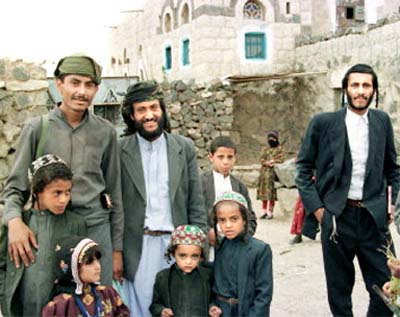
The Economist is generally considered one of the better journalistic bright spots for periodical subscribers. The editors lean to the conservative side, but usually provide articles with the background and rationale to make informative reading. However, a short article released in the latest issue is misinformed and borders on propaganda. There is no byline, at least in the online edition I read, but the writer is poorly informed about Yemen. It is true that Yemenite Jews have suffered because of the political actions of Israel. Like most Arab nations, Yemeni Arabs tend to side with the plight of the Palestinians. Yes, they are exposed to a steady stream of anti-Zionist news, but the government itself has protected the Jewish community. Most Yemenis do not swallow the government propaganda whole and there is still a great deal of respect for the Yemenite Jewish tradition in Yemen. The distinction between “Jew” and “Zionist” does exist.

Even if the author visited Sanaa and Jibla, he has totally missed the amount of unrest among the population. To state “Yemenis rarely protest publicly against their own miserable circumstances at home” is quite naive. Continue reading Economisstep

Yemen: not on the verge of collapse

by Steven C. Caton, The Middle East Channel, August 11, 2010

The Republic of Yemen is often spoken of in the press and in policy circles as a society on the verge of collapse (last year it was “another Somalia”), based largely on two claims, the first being the supposed weakness of its state, the other the supposed lawlessness of its tribal population that makes up the majority ethnic group (about seventy-five percent are settled agriculturalists in the mountains and another five per cent, nomadic Bedouin in the eastern desert). And supposedly being on the verge of collapse, Yemen is seen as vulnerable to take-over by terrorist organizations such as al-Qaeda that threaten America’s and the region’s security. Let us consider how tribe and state, law and conflict operate in Yemen that few analysts seem to grasp when they make these pronouncements.

History may provide some perspective. There has been a state or dawlah in Yemen for thousands of years, whether the Sabaean state that built Marib Dam and was the reputed homeland of the Queen of Sheba, or the Islamic state created shortly after the advent of Islam which lasted for a thousand years, or the republican state that came into being in 1962 and has lasted until the present day, despite two bitter civil wars. To be sure, the state has waxed and waned in power and contracted or expanded in territory during this history, and it has faced formidable outside opponents, beginning with the Romans and most recently with al-Qaeda, but it has never fully collapsed or disappeared from the scene. It is unlikely to do so in the present in spite of arguments that the current regime is at a tipping point and about to fall apart because of an unprecedented number of seemingly intractable problems facing it (an ever weakening economy, unsustainable water consumption, projected diminished oil reserves, conflicts between the state and certain regional populations, rampant corruption, and let us not forget al-Qaeda). Continue reading Yemen: not on the verge of collapse

Images from the Hadramawt

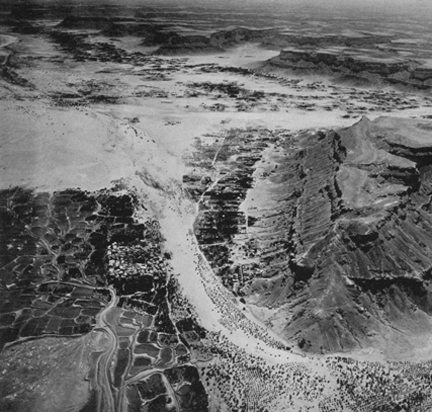
Note: The following images were taken in the early part of the 20th century when the British were in control of the Aden Protectorate.


Shibam, looking down the Wadi Hadhramaut towards Seiyun. Shibam is built on a low hill at the tip of a plateau spur and, for lack of space, grew upward; the buildings are eight to ten stories high. The landlord occupies the upper stories and these parts are whitewashed; the more whitewash, the wealthier the owner. Note the abandoned fields embanked to prevent runoff of water. The upper right-hand margin shows the plateau topography in the direction of the sea, a hundred miles distant.

Continue reading Images from the Hadramawt

Worth a Response: Why Yemen is not Afghanistan


“The village of Rihab in Wadi Dawan, a valley that is the ancestral home of Bin Laden”; Simon Norfolk/Institute, for The New York Times

Yemen hardly ever makes the news unless a journalist wants to rail against the green-dribbling khat habit of grown men who wear skirts or trump with the terrorism card. In the Sunday Magazine of The New York Times, Robert F. Worth asks the provocative question: “Is Yemen the Next Afghanistan?” For an article that begins with a photograph of the valley “that is the ancestral home of Bin Laden” and mentions an American cruise missile in the first line, it hardly takes a Ph.D. to figure out what the answer is most likely to be in the mind of the reader. Worthy reporter that he is, The New York Times Middle East correspondent does not directly answer the question. He does not need to, since the Al Qaeda-laced narrative itself hinges on the comparison. The article ends with a visit to an “old man with a deeply lined face” and who walks with a cane. When asked if his son, an Al Qaeda figure described in the story, was really part of the plot in the 2000 bombing of the U.S.S. Cole, the father responds:

‘No,’ he said, ‘ I don’t believe this.’ He was silent for a long time, staring at the closed door of the house, which was illuminated at its edges by a bright rectangle of afternoon sunlight. then he spoke again.
‘He is a mujahid,’ he said, or holy warrior. ‘He is fighting those who occupy Arab lands. He is fighting unbelievers.’

I have read a number of articles by journalist Worth, usually with a favorable view of his ability to introduce nuance into what is generally a black-and-white portrayal of things Arab and Islamic. For this article, he contacted diplomats (former Ambassador Hull) and scholars (Gregory Johnson) who are knowledgable about recent political events in Yemen. He is also to be commended for learning some Arabic, although I am not sure his year-long training in classical will be of much help in casual conversation in dialect. Yet he visited Yemen and actually talked to local people and not just the other reporters in the pool. In this sense, the reporting is not bad, certainly not like The Daily News or Fox News engineering. The problem is that neither is the article very good. The question in the title, which perhaps was not the journalist’s choosing given the control of editors, is blatantly rhetorical, not a genuine search for an answer that goes beyond the verbal War on Terror jousting on all sides of the aisle in Washington and in much of the media. Continue reading Worth a Response: Why Yemen is not Afghanistan