Category Archives: Yemen

Letter from Islah to Tawakkul Karman


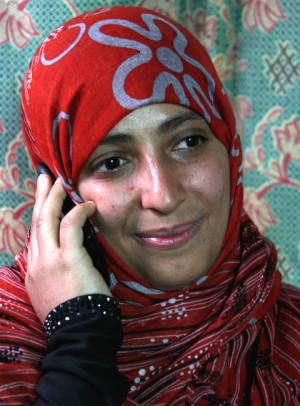
Tawakkul Karman

Yesterday I wondered how the Yemeni party Islah would respond to the Nobel Prize being given to one of its members. Here is the official letter, congratulating her, sent to Karman from Muhammad Abdullah al-Yadumi,

بسم الله الرحمن الرحيم

الأخت المناضلة / توكل عبدالسلام كرمان

رئيس منظمة صحفيات بلا قيود, عضو مجلس شورى التجمع اليمني للإصلاح

تحية وتقدير وبعد :

بكل ابتهاج تلقينا في التجمع اليمني للإصلاح إعلان فوزكم بجائزة نوبل للسلام كأول امرأة عربية تحظى بهذا التكريم وأول شخصية يمنية تمنح هذه الثقة الدولية الهامة.

إننا ونحن نهنئكم بهذا الإنجاز التاريخي نعتبر هذا الفوز مكسبا للثورة اليمنية السلمية وللمرأة اليمنية المناضلة والواعية القادرة على صنع النجاح رغم عوائق التخلف وموروثات الإستبداد التي حالت بين شعبنا وبين الإبداع لعقود من الزمن.

كما أن تكريمكم اليوم بجائزة نوبل للسلام يعد تتويجا مستحقا لجهود سنوات من نضالكم السلمي الدؤوب وكفاحكم المرير ضد منظومة الجهل والظلم والفساد في مختلف الميادين الإعلامية والحقوقية والسياسية ونصرة المظلومين وغيرها من المجالات وصولاً إلى العمل الثوري السلمي الذي مازال شعبنا برجاله ونسائه وشبابه وشيوخه يخوضه دون استكانة أو لين حتى يتحقق له ما يصبو إليه من حرية وكرامة وعدالة وحكم رشيد .

كما أننا نرى في هذا التكريم شهادة أممية على حضارية شعبنا اليمني وعدالة مطالبه وسلامة نهجه السلمي في التغيير، متمنين في هذا السياق ان يرافق هذا الإعتراف من المجتمع المدني الدولي بعدالة المطالب اليمنية إعتراف سياسي دولي بهذه المطالب وان يسارع العالم بأسره الى الوقوف مع الشعب اليمني التواق للحرية والتغيير.

نكرر تهانينا الصادقة لكم ولكل ذوي المبادرات الرائدة في وطننا الحبيب ، مع تمنياتنا لكم بالتوفيق والنجاح ومزيداً من العطاء.

والسلام عليكم ورحمة الله وبركاته،،

أخوكم /

محمد بن عبدالله اليدومي

رئيس الهيئة العليا للتجمع اليمني للإصلاح

Yemeni woman shares Nobel Peace Prize


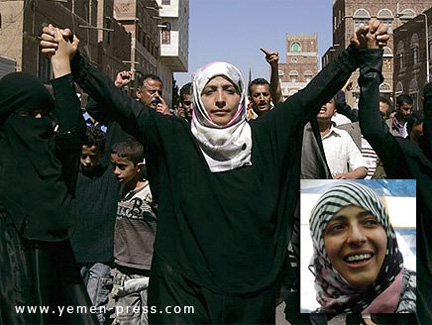
The Nobel Peace Prize for 2011 has just been released with three recipients: Ellen Johnson Sirleaf, Lehmah Gbowee and Tawwakul Karman. All three were chosen “for their non-violent struggle for the safety of women and for women’s rights to full participation in peace-building work.” Karman is Yemeni; but beyond this she is the first Arab woman to win a Nobel prize, a point proudly noted on the Yemeni media site Yemen Press. It will be interesting to watch the reaction to the choice. Here is an activist who took to the streets to promote a peaceful transition from the corrupt secular dynasty of Ali Abdullah Salih. She is one of many Yemenis sharing the same goal and not a principle organizer, although her superb English skills attracted attention in the foreign media. She is also actively involved in the powerful Islamic party of Islah.

As always there will be much second guessing as to why these particular individuals were chosen. I suspect that Karman was not near the top of any speculation list. The Nobel Peace Prize, however, is the most symbolic of these “dynamic” Swedish awards, with the aim of promoting an idea more than finding the “best qualified” candidate. The stated aim this year, however, was a focus on the role of women as peacemakers. Fortunately there are many women activists peacefully advocating against corrupt politics and prejudicial practices. The choice this year appears to be a consciously rounded decision, also including the Liberian president Ellen Sirleaf and Lehmah Gbowee, a social worker also involved in the peace movement in Liberia. If it had just been Sirleaf, one might have dismissed the choice as yet another politician, no matter how worthy, but including Gbowee and Karman may have more to do with inspiring more women to participate at the local level than their actual accomplishments or impact.

As a senior member of the prominent Yemeni Islamic party Islah, Karman does not fit the mold most Westerners hold of Muslim women. She covers her hair with a scarf, but without the extreme niqab or even the more ubiquitous Yemeni sharshaf ( a full-length black outer veil introduced to Yemen by the Ottoman Turks). While the media is for the most part fixated on the masculine culture of Al Qaida, the role of women in Yemen is either ignored or stereotyped. So this choice will draw attention to the fact that there are women who are proud to be Muslim and do not view themselves as servile slaves. But it will also, I suspect, result in detractors within Yemen who will be jealous of the attention she is receiving and perhaps even dismiss it as yet another “Western” intrusion. Will the leaders of Islah promote this honor to one of their members? Will rival Islamic groups use her as a wedge issue? Continue reading Yemeni woman shares Nobel Peace Prize

Walter Dostal (1928-2011)


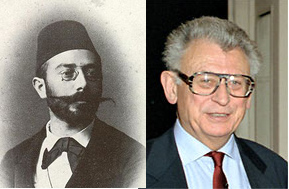
Eduard Glaser (1855-1908), left; Walter Dostal (1928-2011), right

[In early August the academic community lost one of the pioneers of ethnographic study on the Arabian Peninsula, the distinguished Austrian scholar Walter Dostal. Here is the obituary from the Austrian Academy of Sciences website.]

With Walter Dostal’s passing away in Vienna on August 6th/7th 2011, the anthropological communities in Austria, Central Europe and the German-speaking countries lose one of their best-known representatives shaping the field throughout the latter quarter of the 20th century.
Dostal was best known for his ethnographic studies of Arabian and Middle Eastern societies, but he also contributed substantially to anthropological theory – with particular emphasis on the interplay between environment, society, and history. As a leading expert for the Arab peninsula at this Academy, Dostal continued a remarkable research record into the early 21st century which at the Academy of Sciences goes back to the late 19th century.

Dostal had belonged to the first generation of anthropology students trained after the second world war, and his scholarly work was committed to build a new and internationally oriented foundation for the discipline once called “Völkerkunde” in the German-speaking countries after 1945. Born on May 15th 1928 in Grulich near Brno (today: Czech Republic), Dostal and his family moved at the end of the war to Vienna where he began his studies in anthropology. His critical engagement with the so-called “Culture Circles” theory led him to reject any speculative historical models, and to appreciate the empirical archaeological and textual evidence. Formative influences during those early years of his career were Robert Heine-Geldern (a corresponding member of the AAS) and Joseph Henninger. After his dissertation on Semitic-speaking peoples he began a first sequence of ethnographic fieldwork in the Arab peninsula, which he combined with international research sojourns in Frankfurt and Rome, and his first position as Curator for the Middle Eastern section at Vienna’s Ethnology Museum. Continue reading Walter Dostal (1928-2011)

A third of a century and counting…

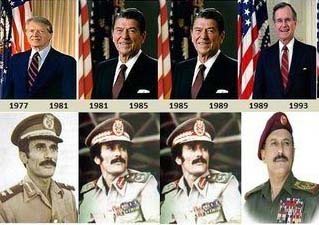
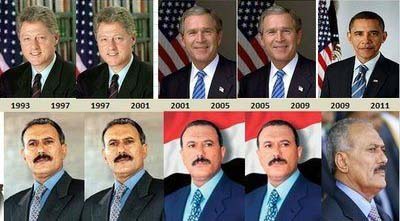
Very few people live for an entire century. I had a great aunt who was born in 1899 and lived into the first part of the 21st century, thus straddling three arbitrarily separated centuries. Imagine someone alive before Henry Ford’s “Tin Lizzy” and the airplane but around to see the cell phone. I realize that a third of a century is not a long period of time against the fourscore and ten of biblical proportions, but it is an eternity in political terms. Few leaders these days survive long enough, no matter how popular or powerful. One who has lasted 34 years is Yemen’s Ali Abdullah Salih, who started out in a military coup in 1978 in North Yemen, helped united north and south in 1990 and has ruled both since with the ongoing pretense of national elections. He is in theory allowed two more years in his last election cycle, which he had “reluctantly” agreed to run in. But in February, hundreds of thousands of Yemeni citizens thought enough was enough and Salih’s support has dwindled dramatically. In early June he was almost killed in a bomb blast, but he has now returned to Yemen and his presence makes the situation in the country even more volatile. In 34 years you make a lot of enemies, but Salih has been defiant, pulling out all the stops to protect his wealth and his power.

The best way to visualize 34 years is to look at the photographic trajectory of his power against the various American Presidents he has associated with as a fellow state leader. The extraordinary picture published by Yemen Press and shown above is quite striking. Continue reading A third of a century and counting…

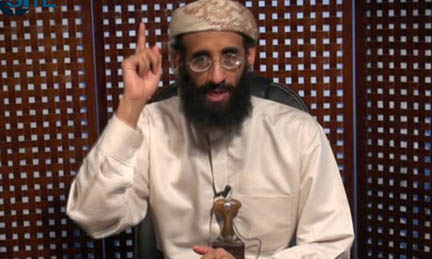
US drone killing of Anwar al-Awlaki reinforces terrorists


by Maajid Nawaz, The Guardian, October 1, 2011

As Anwar al-Awlaki became the first individual to be summarily executed by his own government in the “war on terror” on Friday, we are reminded of the dark side in this relentless pursuit for security.

Awlaki was an evil man who preached against humanity. As a counter-extremism adviser, I dedicate all my energies to discrediting his ilk. I am under no illusion of the danger that he posed. I live with such danger every day, through my work. Awlaki’s desire to arbitrarily kill, deny rights and bypass due process is what made him evil. In summarily executing him in this way, the US has just called the kettle black.

Just as achieving liberty takes years of bloody struggle, its violation is rarely brought about overnight. Arbitrary detention, extraordinary rendition, targeted killings and “enhanced interrogation” – otherwise known as torture – are but some of the measures that have slowly been re-introduced into human practice by the US. Now, add to that list the summary execution of a citizen. Continue reading US drone killing of Anwar al-Awlaki reinforces terrorists

Ali Abdullah Salih: Time will tell


Photograph by Yahya Arhab, EPA

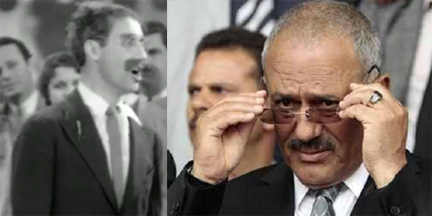
Yesterday Yemen’s “embattled” President Ali Abdullah Salih granted an interview to Time Magazine and The Washington Post. While not very enlightening, it does suggest a new sign of desperation. The interview transcript (in English translation of course) is online. He once again played the blame game, insisting that he has been willing all along to abide the GCC agreement and step down.

Then there is the last question. Dodging any direct answer to the official U.S. call for him to step down, he pulls what may be the most desperate part of the interview — talking directly to the American people. The message is one that should resonate with the Tea Partyers who still think President Obama is a Muslim(at least those too dumb to realize who Salih is]. Here is Ali Abdullah Salih, the good dictator who can rid his country of the evil al Qaeda terrorists. Here is the gist:

I want to ask you about Yemen and U.S. relations, which is important: On the day you returned to Yemen …
[Salih] This is the last question. (See a video on the uprisings in Yemen.)

On the day you returned to Yemen …
[Salih] The Yemeni-American relationship is good. In fact, it has not been affected during the past 33 years. And we have relationships with many political powers in Washington, whether they are from the Democratic Party or the Republican Party. There have been some differences during the last Gulf War because of the Yemeni stance, but then the Americans realized that we were right and that we were not just defending the Iraqi regime. Continue reading Ali Abdullah Salih: Time will tell

Tabsir Redux: Flipping through Yemen a Millennium Ago


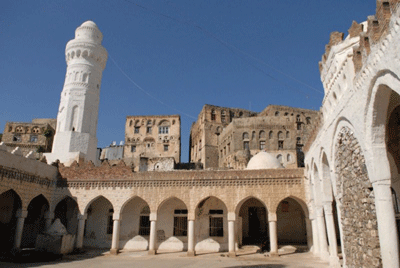
Mosque in Jiblah, Yemen

There was a time when books were hard to come by. Either they cost too much or were inaccessible in a private or exclusive university library. Whatever else the world wide web has done (and that is a mouthful), it now functions as an archive. More and more, the rare and out-of-print books I used to be forced to read in a library reading room are becoming available online. Mr. Gutenberg might roll over in his Grab at the very thought of a pdf file, but print has taken a new and universal turn. I especially enjoy the “flipbook”, which simulates turning the pages of images of the original. For an enjoyable read on the early history of Yemen, there is the flipbook version of Henry Cassels Kay’s translation called YAMAN, ITS EARLY MEDIAEVAL HISTORY, published in London in 1892. This has excerpts (not always trustworthy in their translation) from Umarah ibn Ali al-Hakami (1120/21-1174), Ibn Khaldun (1332-1406); Muhammad ibn Yaqub al-Janadi (d. 1332?).

The sad thing is that well over a century ago, Kay lamented that there was virtually nothing available on the history of Yemen, which had become of strategic interest to the British empire. Continue reading Tabsir Redux: Flipping through Yemen a Millennium Ago

Salih’s Latest Speech


[Over at Waq al-Waq, Greg Johnsen has a good read on Salih’s latest speech after his return to Yemen.]

Salih’s Speech (Instant Analysis)
by Gregory Johnsen, Waq al-Waq, September 25, 2011

Days after dramatically returning from Saudi Arabia, President Ali Abdullah Salih did what he does in these situations: he gave a speech.

The international media will likely lead with the fact that Salih called for early elections (in fact, here is an early al-Jazeera piece saying just that). But what this analysis misses is the caveat – that ever present out – that Salih gave himself, saying that elections would only take place in the context of the GCC deal.

The GCC deal, as those of you who read Waq al-waq frequently know, is worthless. Not only is it impossible to enforce – as Salih’s will-I, won’t-I dance illustrates – but there are so many loopholes in the plan that even if Salih did sign it he could easily manipulate the aftermath of the deal to ensure that a trusted ally or relative succeeded him as president, or find some excuse to continue in power.

To that end, Salih reaffirmed that his vice president Hadi is authorized to negotiate and eventually sign the GCC deal. This is worthless. And Salih knows it.

Numerous high-level Yemeni figures have already signed the deal, the signature that is missing is Salih’s. This is yet one more evasion from a president who sees his strategy of duck and delay starting to pay-off. Continue reading Salih’s Latest Speech