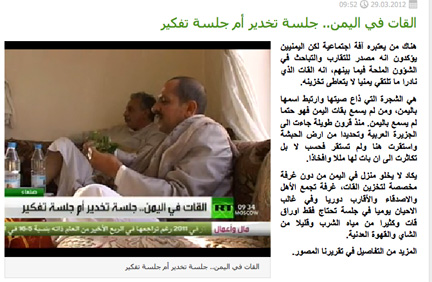
Here is a short, but informative, video in Arabic on the use of qât (Catha edulis) in Yemen, via the Arabic service of Russia Today.
Here is a short, but informative, video in Arabic on the use of qât (Catha edulis) in Yemen, via the Arabic service of Russia Today.
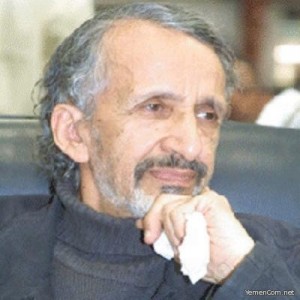
المتوكل: Øادثة الموتور سياسية والمستعجلين على الهيكلة لديهم برنامج يريدوا يبرموه
السبت, مارس 31, 2012 ALHawyah
قال الدكتور Ù…Øمد عبد الملك المتوكل أنه لا يستطيع القول أن الØادثة التي تعرض لها ÙÙŠ نوÙمبر من العام الماضي Øادثة بريئة “لكنه موتور سياسي ناتج عن عدد من القضايا التي كنت أطرØها على المشترك وأولها: قضية عسكرة الثورةâ€.
وأضا٠ÙÙŠ Øوا-ره مع صØÙŠÙØ© الهوية نشرته ÙÙŠ عددها الصادر الاربعاء الماضي -وهو يسرد ملابسات الØادثة قائلاً: طرØت على المشترك قضية عسكرة الثورة، Øيث قلت لهم أن الأخوان المسلمين هم الذين جاءوا بالعسكر إلى السلطة Ùرد علي عبد الوهاب الآنسي بقوله: أنت تتهم الإصلاØØŸ قلت له لماذا لا يوجد إسلاميون غيركم؟ الاتØاد إسلامي والشيخ إسلامي ولكن أنا اقصد الإسلاميين ÙÙŠ العالم العربي كله. Ùقال Ù…Øمد Ù‚Øطان مداخلاً علي Ù…Øسن مستعد أن يترك السلطة Ùرديت عليه: القضية ليست قضية شخص، وإنما قضية أسسâ€. Øسب قوله.
وأضا٠المتوكل: “القضية الثانية، دعوتي إلى ضرورة إيجاد قوى متعددة من أجل توازن القوى وقد بدأنا نبØØ« ميزانية توازن قوى Øيث اتÙقنا مع الشامي وأبو Ù„Øوم والØوثيين وبدأنا نتÙÙ‚ مع الØراك ÙÙŠ الجنوب ومع الشباب وذلك لإيجاد توازن قوى نشط يؤمن بالتØال٠ويؤمن بالآخرâ€.
وأرد٠قائلاً: “وهذه القضايا كان عبد الكريم الارياني قد أتصل بي وقال أنهم الآن يعملون مؤسسة لتنمية الوعي، هذه المؤسسة Ùيها من الأØزاب ومن المستقلين والمؤتمر، يريدوا أن يوجدوا توازن قوى، وقد Øضرت معهم الاجتماع ÙÙŠ ØµØ¨Ø§Ø Ø°Ù„Ùƒ اليومâ€.
ويضي٠المتوكل: “بعد انتهاء الاجتماع طلبوا مني Øضور اجتماع آخر ÙÙŠ المساء قلت لهم لا أعر٠مقركم، قالوا: سنبعث لك سيارة تأخذك، ÙˆÙعلاً أتت السيارة، ولكن ÙÙŠ وقت متأخر من الليل، وذهبت معهم، وصلنا إلى شارع الشرطة وكان هناك زØمة، Ùقالوا لي لا نستطيع الدخول من هنا، وسندخل من شارع آخر، Ùقلت لا مانع، وعندها دخلنا شارع آخر ومشينا، ولم أشعر بعد ذلك بما Øصل لي إلا بعد أن تم نقلي إلى الأردن وخرجت من العناية المركزة ورأيت أمامي أولادي ولا أعر٠السببâ€. Øسب قبوله.
أما القضية الثالثة Ùيقول المتوكل: “طلبت تشكيل لجنة لعملية إعادة التÙكير ÙÙŠ هيكلة القوات المسلØØ© وهذا ما أزعج الطرÙينâ€.
Continue reading Muhammad Abd al-Malik al-Mutawakkil on the Situation in Yemen
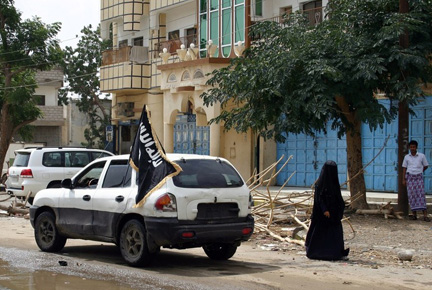
A Yemeni woman walks past a vehicle adorned with an Islamic flag in the town of Jaar, in the southern Abyan province, on January 25, 2012.
JAAR, 27 March 2012 (IRIN) – At first glance the city of Jaar, in Abyan Governorate near the Gulf of Aden, resembles many Yemeni towns struggling to rebuild after a year of nationwide protests shackled the central government’s ability to provide basic services.
Donkey carts line litter-strewn streets, and feral cats and dogs tiptoe past bullet-pocked storefronts and vacant buildings. Gaunt, bearded men drink tea and chew khat while shouting to each other across the street. In many respects, however, the remote settlement is different.
Controlled by a militant group called Ansar Al Sharia (Partisans of Islamic Law), the city is patrolled by armed militants in army trucks pillaged from the Yemeni military weeks earlier. The group’s black-and-white flag – a symbol of stability, according to Ansar al Sharia – flies at each entrance to the city, flapping behind Kalashnikov-toting soldiers riding motorcycles.
In a rare visit to Jaar on 5 March – the day after Ansar Al Sharia soldiers stormed a Yemeni military base outside Zinjibar killing more than 150 Yemeni soldiers and capturing 73 more – IRIN met civilians living under the expanding jihadist government.
Yemeni authorities believe the group is linked to Al Qaeda. Some local residents of Jaar said life under Ansar al Sharia was stable. One passer-by, when asked by a jihadist official what he thought of the “new [militant] governmentâ€, said it was “peaceful†and “niceâ€. Continue reading YEMEN: Behind militia lines in Jaar
The DÄ«wÄn of ḤÄjj DÄkÅn, published by the American Institute for Yemeni Studies in 2011, is a collection of eighteen poems in the endangered Mahri language of Yemen and Oman, one of the last, non-Arabic indigenous languages of the Arabian Peninsula. This publication marks an important step in the history of the Mahri language since it contains its first literary texts meant for a local readership. ḤÄjj DÄkÅn, a pioneer of modern Mahri sung-poetry, has included an Arabic translation for each Mahri poem, which is supplemented by an English translation and transliteration into Latin characters provided by Samuel Liebhaber. The DÄ«wÄn is introduced by commentary that places the innovations of ḤÄjj DÄkÅn’s lyric qaṣīdas in their cultural and linguistic context. A facsimile of ḤÄjj’s original handwritten manuscript is included in the DÄ«wÄn. Starting in June 2012, audio and visual recordings of each poem in recitation will be accessible online on the site: http://blogs.middlebury.edu/mahripoetry/.
Sample poem, #6 from The DÄ«wÄn of ḤÄjj DÄkÅn
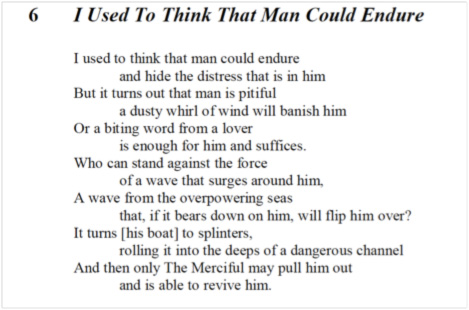
English translation
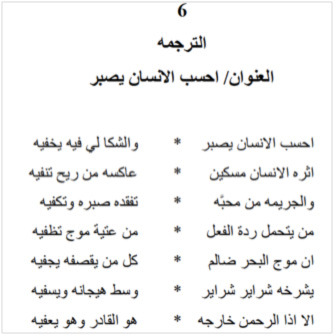
Arabic translation
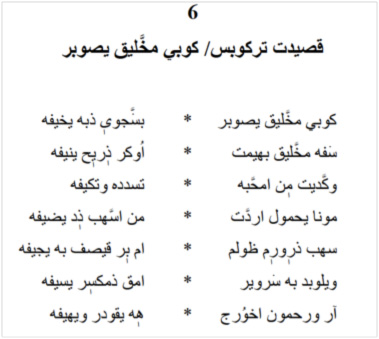
Mahri
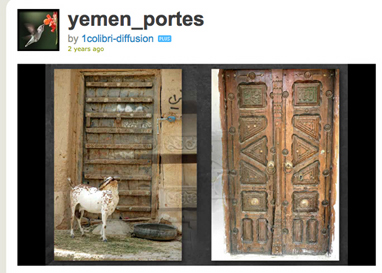
For a nice photographic collage of Yemeni doors, check out this VIMEO offering.
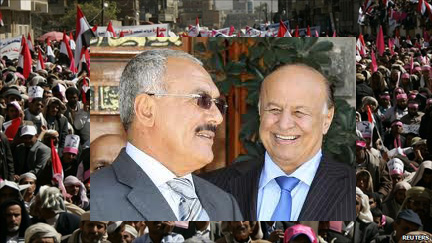
I was interviewed yesterday on the “Worldview” Program of WBEZ, Chicago. To listen to the broadcast, click here.
Yemen’s new president, Abdu Rabbu Mansour Hadi, has been in power nearly a month. He’s facing trouble in the southern province of Abyan. According to the United Nations High Commissioner for Refugees (UNHCR), the fighting has displaced more than 150,000 people since militants seized several cities in the province last May. Worldview will discuss the humanitarian crisis with Daniel Varisco, professor of anthropology at Hofstra University.
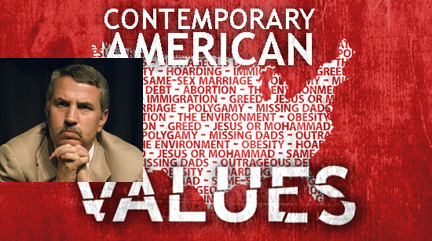
This post is not about the value of journalism, but about the blind prejudice that infiltrates much journalistic writing about values. I am not talking about the caricature newscasting of a Fox News Geraldo Rivera, who thinks wearing a hoodie is a problem (just like some maintain that a woman wearing a miniskirt is asking for “it”). Rather it is the prize-touting expert-of-all-trades mentality of Thomas Friedman, whose talking-head status is, in journalistic terms, astronomical. Yesterday, Friedman posted a commentary in The New York Times entitled “A Festival of Lies.”
Friedman begins with a quote from the historian Victor Davis Hanson in The National Review:
“Military assistance or punitive intervention without follow-up mostly failed. The verdict on far more costly nation-building is still out. Trying to help popular insurgents topple unpopular dictators does not guarantee anything better. Propping up dictators with military aid is both odious and counterproductive. Keeping clear of maniacal regimes leads to either nuclear acquisition or genocide — or 16 acres of rubble in Manhattan. What have we learned? Tribalism, oil, and Islamic fundamentalism are a bad mix that leaves Americans sick and tired of the Middle East — both when they get in it and when they try to stay out of it.â€
I certainly agree with Friedman’s gut reaction that “And that is why it’s time to rethink everything we’re doing out there. What the Middle East needs most from America today are modern schools and hard truths, and we haven’t found a way to offer either.” Bravo. Bombs make enemies and schools build friendships: this hardly seems like a new revelation, but it is the kind of truth spoken to power that needs to be voiced time and time again.
But it is what underlies the rationale where I find an all-too-familiar ritual of truths that carry along the heavy baggage of assumptions that belie the argument being made. Continue reading Sharing our values…
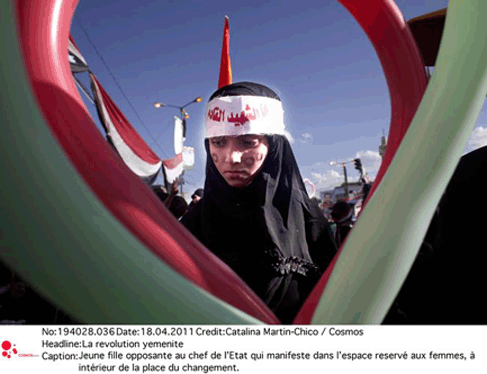
The website arabwomenspring has posted a summary of Yemeni women’s participation in the recent political protests and historical background on their role in governance. Below is an outline of the contents of the online report:
1 Women’s participation in demonstrations
1.1 Time-line of key events
2 Women’s participation in political life: opportunities and obstacles
2.1 Representation in government
2.2 Representation in parliament
2.3 Representation in local councils
2.4 Representation in the judiciary
3 A discriminatory legal framework
3.1 CEDAW
3.2 The Constitution
3.3 Other discriminatory laws
4 Further reading