Category Archives: Syria

Adonis on the Age of Darkness

Cairo Review, May 14, 2014

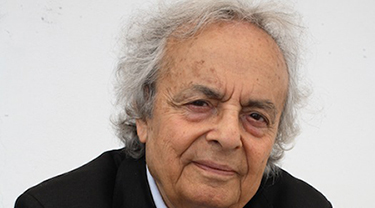
A half century ago, the poet Ali Ahmad Said Esber, better known by his pen name Adonis, left Syria for exile, first to Lebanon and then France. He lives on an upper floor of a new apartment tower in the Paris suburb of Courbevoie, steps from La Grande Arche in the modern business district of La Défense. Embroidered cushions from his homeland are on the sofa, abstract paintings on the walls; Arabic and French newspapers are piled around, next to music CDs of Bach and Mahler; Lebanese sweets are served on a platter along with cups of Nescafé. He never stays in one place for long; at the end of April, he was off to New York to open the PEN World Voices Festival with Salman Rushdie and Noam Chomsky.

Adonis, 84, is widely recognized as the greatest living Arab poet. He began writing verse as a teenager in Qassabin, a village in Syria’s Latakia province. In Beirut in the 1950s, he started a modernist revolution that the Guardian has called “a seismic influence on Arabic poetry comparable to T.S. Eliot’s in the Anglophone world.” He has published twenty volumes of poetry and thirteen books of literary criticism, reflecting on everything from love and Arab nationalism to American power; in 2011, he became the first Arab writer to win the prestigious Goethe Prize for literature. Adonis, meanwhile, has long been a leading public intellectual in the Arab world. His most recent writings are collected in Printemps Arabes: Religion et Révolution, published in France earlier this year by Éditions de La Différence. According to his English translator, Khaled Mattawa, Adonis believes that Arabic poetry has the responsibility of igniting a “mental overhaul of Arab culture.” Cairo Review Managing Editor Scott MacLeod and journalist Jonathan Randal interviewed Adonis in Courbevoie on April 11, 2014.

CAIRO REVIEW: Critics say your poems carry a lot of anger, but you have written some sweet poems. “The rose leaves its flowerbed/To meet her/The sun is naked/In autumn, nothing except a thread of cloud around her waist/This is how love arrives/In the village where I was born.”
ADONIS: Yes, romantic.

CAIRO REVIEW: How old were you when you wrote that?
ADONIS: I forget.

CAIRO REVIEW: Has Syria plunged into a dark age?
ADONIS: Well, the Arab world is living, and for a long time has been living, in a kind of age of darkness. Syria is part of that. But we can’t judge the future. I think that there are always some strengths in the people, to find solutions, escapes/exits, new horizons. I believe in that. The human being is a decent creature, who is manipulated by everything.

CAIRO REVIEW: When you were sixteen, was it a better moment?
ADONIS: Beginning when I was fifteen, we had plans. We could feel it, personally, lots of people of my generation. We had a kind of hope and vitality, a hope to change things, do something better. But from that moment of my adolescence, we also felt that there was nothing we could do in our society if the revolution was going to remain politically institutionalized. Without the separation of religion from the state, there was nothing we could do. I felt that for a long time.

CAIRO REVIEW: Was religious fundamentalism a danger at that time?
ADONIS: No. There wasn’t the ideological aspect of religion in my youth. It was almost invisible. Religion was never a problem. With my friends at school, I never asked, “What’s your religion?” Never. It didn’t exist. Continue reading Adonis on the Age of Darkness
40 Maps that Explain the Middle East

There is a very interesting set of 40 maps that Max Fisher has put together on one website to explain the history of the Middle East. Check it out here.

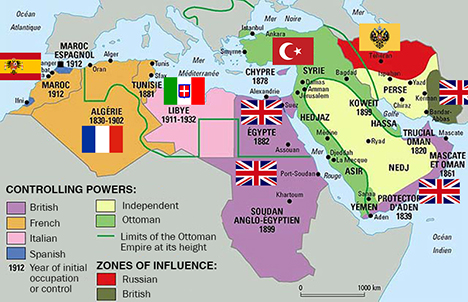
Below are Map #7 and Map #23

What the Middle East looked like in 1914

This is a pivotal year, during the Middle East’s gradual transfer from 500 years of Ottoman rule to 50 to 100 years of European rule. Western Europe was getting richer and more powerful as it carved up Africa, including the Arab states of North Africa, into colonial possessions. Virtually the entire region was ruled outright by Europeans or Ottomans, save some parts of Iran and the Arabian peninsula divided into European “zones of influence.” When World War I ended a few years later, the rest of the defeated Ottoman Empire would be carved up among the Europeans. The lines between French, Italian, Spanish, and British rule are crucial for understanding the region today – not just because they ruled differently and imposed different policies, but because the boundaries between European empires later became the official borders of independence, whether they made sense or not.

Syria’s refugee crisis

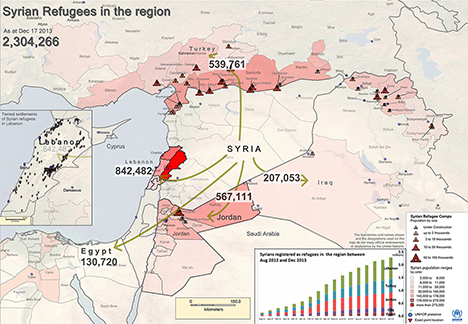
Syria’s civil war hasn’t just been a national catastrophe for Syria, but for neighboring countries as well. The war has displaced millions of Syrians into the rest of the Middle East and into parts of Europe, where they live in vast refugee camps that are major drains on already-scarce national resources. This map shows the refugees; it does not show the additional 6.5 million Syrians displaced within Syria. Their impact is especially felt in Jordan and Lebanon, which already have large Palestinian refugee populations; as many as one in five people in those countries is a refugee. While the US and other countries have committed some aid for refugees, the United Nations says it’s not nearly enough to provide them with basic essentials.

Creating and Preserving Cultural Heritage in the Arab World


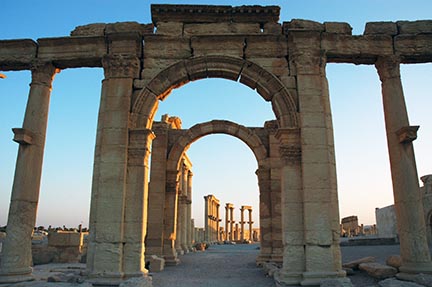
Illegal excavations and military use have recently endangered Palmyra, Syria, a UNESCO World Heritage Site. Photo: UNESCO/Ron von Oers

by Shatha Almutawa, American Historical Association, April 2014

A car bomb exploded outside the Museum of Islamic Art in Cairo on January 24, 2014. The Egyptian Heritage Rescue Team arrived on the scene and began to assess the damage and prepare artifacts to be moved to another building. Trained by the International Centre for the Study of the Preservation and Restoration of Cultural Property, the Egyptian volunteers worked with museum staff until all the artwork was safely relocated.

In Syria, following the destruction of the minaret at Aleppo’s Umayyad Mosque last spring, people made their way to the mosque to save the stones for later rebuilding. Some lost their lives in the process. The mosque had been used by rebels, the Syrian army was attacking from the outside, and fighting continued as volunteers worked to protect the stones. As political instability continues in the wake of the Arab Spring, cultural heritage sites and objects are often endangered.

Scholars and activists working on issues relating to the preservation of cultural heritage in the Middle East convened on February 28 at the Smithsonian’s Freer Gallery to discuss the Arab Spring’s impact on monuments, historic neighborhoods, and culture in the region. Lisa Ackerman, executive vice president and chief operating officer at World Monuments Fund, spoke about the importance of providing training to communities around historic sites in times of peace and after conflicts, so that locals can preserve their own heritage. She also mentioned the reality that in times of war, troops are trained to find strategic locations to use as bases; historic sites, as she explained in a later e-mail, “are often located in strategic positions with existing infrastructure, such as roads and nearby accommodations, or, as we’ve seen in Syria, are often situated at the highest points, providing a location advantage.” As an example, the US Army in Iraq chose Babylon for its Camp Alpha, which resulted in damages to its ancient walls and gates. Continue reading Creating and Preserving Cultural Heritage in the Arab World

Ba’d Kharab Halab


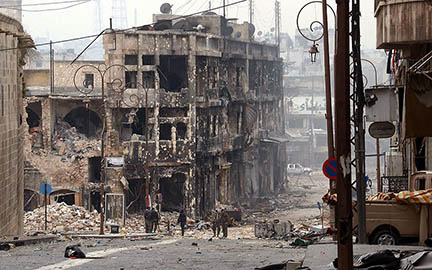
January 2013: Syrian government troops take position in a heavily damaged area in the old city of Aleppo; AFP/GETTY

There is a well-known, and after 2003 quite apt, proverb in Arabic: “After the destruction of Basra” (Ba’d kharab Basra). It originally referred to a slave revolt in Basra, the southern Iraqi port, in the 9th century. But it still resonates a millennium later. The savage violence that has left Syria in turmoil not seen since the days of the Mongols has now reduced major parts of one of the splendid cities of the Middle East to rubble. Now we see the destruction of Aleppo (Halab in Arabic), once Syria’s second largest city, with little evidence of a resolution of the fighting. Even the old suq has been destroyed beyond recognition. UNESCO designated Aleppo a World Heritage site, but this status has not saved it from massive destruction.


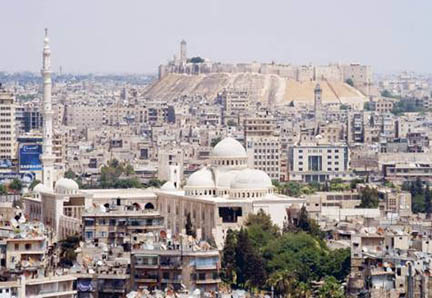
The Aleppo of the recent past

For the last three months the government of Bashir al-Asad has been dropping barrels — more than a thousand — of barrel bombs, making much of the city a ghost town. Some estimates indicate that 90% of Aleppo’s population has been forced out.

Sad pictures are readily available on the internet and on Youtube. But the horror of kharab continues. It appears that al-Asad is content to be the dictator of Damascus and let the rest of Syria be damned. Of course, he has his accomplices, the fanatic jihadists who are as vicious as the regime they are intent on toppling. Meanwhile the Syrian people suffer and the rest of the world either ignores this or makes things worse by supporting one side or the other with arms. If only we had a new proverb: ba’d kharab this insanity!

#WithSyria and Banksy: Saving Syria through Orientalism


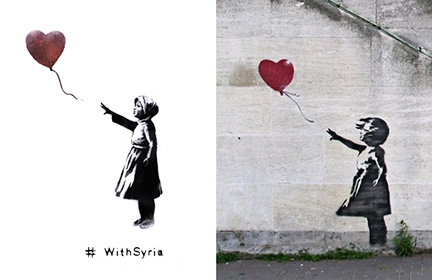
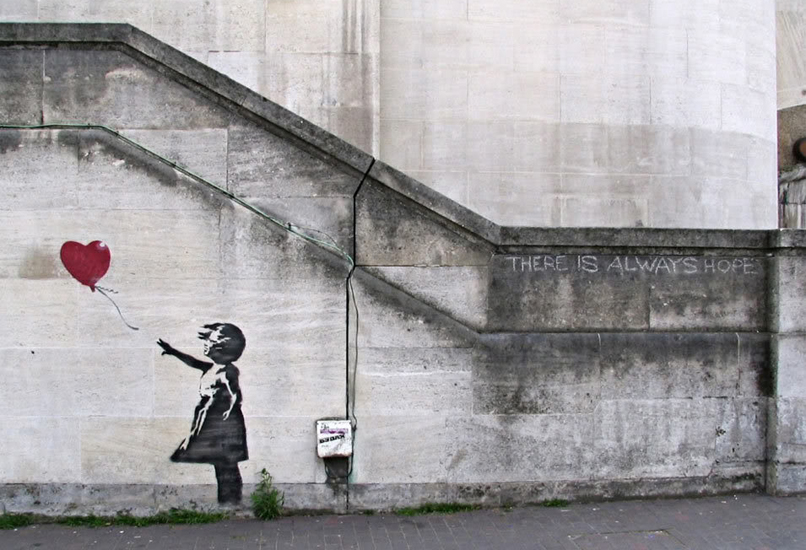
Banksy’s two girls: #WithSyria campaign (L) and “There is always hope” (R)

by Hisham Ashkar, on/off..but mostly off, March 7, 2014

Ahead of the third anniversary of the Syrian uprising, a coalition of international organizations was formed, #WithSyria, urging people around the world to hold vigils on 15 March, with the aim to “show our leaders that we will not give up on the people of Syria, that they must act to bring an end to the bloodshed and to get aid to all those who need it.”

Among the organizations, we can find Amnesty International, Save the Children, Reporters Sans Frontières and the Church of England.

In their mobilization effort, they recruited Banksy, and indeed the famous anonymous British graffiti artist didn’t fail to impress us once again. He produced an original Banksy for the campaign, that Amnesty proudly twitted it.

This new Banksy reminds us of an old Banksy: A young girl losing a heart-shaped balloon to the wind. Behind her on the staircase is written “There is always hope.” The graffiti was made in 2007.

For #WithSyria campaign, the little girl was given a veil. Well yes, it’s very logical! Syria is a Muslim country. Muslim women are dotted with veils. So to be politically correct , and to take in consideration and not to offend the feeling of Muslims, the little girl wears a veil.

Maybe Banksy didn’t thought much of that while drawing his work. But this reveals an unbearable amount of ignorance, stereotyping and orientalism, not only from Banksy, but also from the organizations in #WithSyria camapign. Continue reading #WithSyria and Banksy: Saving Syria through Orientalism

Syria’s war must end

By Stephen Hawking, Washington Post, February 14

Stephen Hawking is the author of “A Brief History of Time” and a former professor of mathematics at the University of Cambridge.

The Greek philosopher Aristotle believed that the universe had existed forever. The reason humanity was not more developed, he believed, was that floods or other natural disasters repeatedly set civilization back to the beginning.

Today, humans are developing ever faster. Our knowledge is growing exponentially and with it, our technology. But humans still have the instincts, and in particular the aggressive impulses, that we had in caveman days. Aggression has had definite advantages for survival, but when modern technology meets ancient aggression the entire human race and much of the rest of life on Earth is at risk.

Today in Syria we see modern technology in the form of bombs, chemicals and other weapons being used to further so-called intelligent political ends.

But it does not feel intelligent to watch as more than 100,000 people are killed or while children are targeted. It feels downright stupid, and worse, to prevent humanitarian supplies from reaching clinics where, as Save the Children will document in a forthcoming report, children are having limbs amputated for lack of basic facilities and newborn babies are dying in incubators for lack of power. Continue reading Syria’s war must end

The Riya-lity of Power

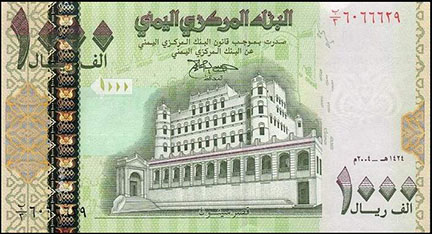
Michel Foucault, the French philosopher/historian, is oft quoted for equating knowledge (savoir) with power (pouvoir). Thanks to investigative reporting by Yemeni journalists, we now have knowledge about how Ali Abdullah Salih, the former President of Yemen, used his power to create riyal-ity, that is fabulous wealth skimmed off Yemen’s oil revenues in riyals. As reported in Yemen Press, Salih funneled millions of his wealth to the United Arab Emirates, also having villas built for his family. He has also distributed his vast wealth, as yet unaccounted for, to Morocco, France, Germany and Italy. It is reported that he did not use his own name, but those of family members.

So what else is new? Dictators, like kings and sultans of the past, have always enriched themselves while poor people starved on the streets. The more power tends to be absolute,or near absolute, the more the coffers get filled. Mamluk sultans in Egypt would periodically sack wealthy officials or merchants just to absorb their wealth. While most contemporary states have safeguards to prevent wholesale laundering of a country’s wealth, dictators generally define their own rules. While Asad hangs on to power in embattled Syria, there are no doubt several bank accounts full of cash if he ends up being forced out.

While it is true that there are various kinds of power, positive as well as negative, economics trumps the abstract notion of knowledge. Greed explains more than prejudice, although the two generally go hand in hand. Yemen is a special case in the seasonal shift following the Arab Spring. Continue reading The Riya-lity of Power