Category Archives: Syria

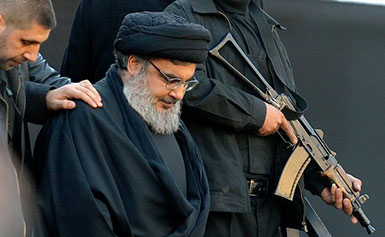
Hezbollah and Bashar: Another Unholy Alliance


Hezbollah leader Hassan Nasrallah; Photograph by Wael Hamzeh/European Pressphoto Agency

My friend Omid Safi has created a provocative blog entitled What Would Muhammad do? Today I would like to ratchet up the commentary game to an approach which may, at first glance, seem sacrilegious. Given that the Lebanese “Party of God” (Hezbollah) is now known to be sending its fighters to support the Syrian dictator Bashar al-Asad, it is time to ask “What Would Allah do?” As much as I admire the spiritual sentiment of the crucified mystic al-Hallaj, I am not advocating oneness with the Supreme Being. But if I were to try and imagine what Allah would say about the current trials besetting his umma, I think I might begin by insisting that those who spread messages of hate and turn jihad into an excuse for political gain stop using my name. The Shi’a at least had the common decency to call themselves shi’at Ali, rather than presume from the start that they exclusively spoke for me. If these partisans of the hundreds of sects that have evolved since the Prophet Muhammad received the Quran want to hear me, they should stop selecting isolated verses from my message for their own agendas. Submission to Allah is the message of Islam, not submission to any party claiming to be Allah’s party.

Muslims should remember the history not only of their faith, but also the religions founded by other of my prophets. Jews and Christians are not infidels; their lives are as precious to Allah as those of Muslims. Muhammad was sent as the “seal” of the prophets, not to brag that he was superior to my other prophets. Each prophet was sent for a specific purpose, to guide people at different times in history. Muhammad received the Quran not so everyone after that could stop time and live as though it was still 7th century Mecca and Medina. Look at his life and you will see that he was a mediator, who preached salam and knew full well that the greater jihad took place within the individual. Jews and Christians heard from their prophets that humans are not divine, not perfect, and easily seduced to go astray. But Moses gave commandments to run society, Jesus showed the power of love to conquer hatred and Muhammad was a living example of how to live, but not an icon to follow blindly because of the recorded faulty memories of his companions. Continue reading Hezbollah and Bashar: Another Unholy Alliance
Do We Care?


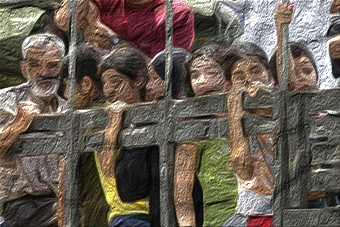
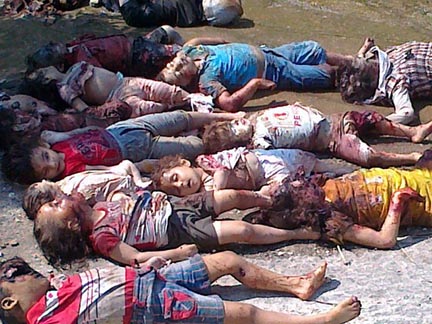
Scene after a massacre in a coastal Syrian village on May 4

Do we care? When the news media report yet another attack on civilians in Syria (or Iraq or Afghanistan or anywhere outside of Boston and New York), do we really care? It is hard to be sympathetic to the picture above without feeling the pain caused by imagining your own child’s body bloodied and lifeless. It is not easy for those of us in the fabled “land of the free” to admit that in war and civil strife everyone is presumed guilty by being in the way of a bomb and only proven innocent as a victim. These are bodies that have stopped growing, faces forever locked into expressions of horror. There can be no rest for these children in the grave for there can be no end to the grief of those who knew them.

But what do we care? It did not happen here. We make sure of that by sending arms to our erstwhile allies and droning anyone abroad who looks like a terrorist. As long as we proclaim our rhetorical support for human dignity, who can blame us? This was the act of a vicious dictator struggling to hold on to absolute power. Asad is Russia’s bastard, not ours. The weapons used to rip apart these childrens’ lives were Cold-War-forged Soviet, not Free World. Thank God, our God of course, there is no “Made in the USA” trademark on any of the bombs used here. But our’s will soon be in play here, as they are in Iraq and Afghanistan and Pakistan and Yemen, and even more children will never be able to play again.

Should we care? We did not know them. There are seven billion of us living and dying on this planet. What does it matter if a few children do not have a chance to live? Perhaps they would die of cancer before their teens or be run over by a car? What if one of these children had grown up to be a violent terrorist and take some of our lives? There are many ways not to look at these dead bodies, not to count them as our own. You can ignore what you see here, quickly click your mouse to escape caring. But tomorrow there will be another picture just like this, perhaps with women or men. Perhaps with soldiers who have little choice but to follow orders or risk their own lives. You need not worry, though, because you will not know any of them, not their names, not the sound of their laughter, not their dreams, not the goodness that shines through in every corner of our globally disconnected world.

So go ahead. Ignore what you see. Thank your God it’s not about you. Life goes on here no matter how many lives end over there. They say a picture is worth a thousand words. I have said what I want to say in less than 500. The rest is up to you.

Fatima’s Head

By Ziad Majed, al-Jadid

It is hard to imagine what happened to Fatima,* and it is hard to describe the silence that engulfed the witnesses of her death. I think the artistic works on Facebook that restored her head and depicted a rose garden or the moon or the sun have tried to compensate for that terrible silence and ease the pain of Fatima and her loved ones and all of us together.

What can be done to a Syrian child who “lost” her head?! And what can be said to a girl sprawled in her dress on the ground, arms spread wide, her small, drooping shoulders clinging to the wall directly?

Fatima Maghlaj did not understand what happened to her; she was headless all of a sudden. In an instant she lost the ability to dream and focus. She was paralyzed. She wanted to feel the dryness of her throat and ask for water. She wanted to call mother or father, but she could not make the words with her tongue and she could not find their picture in her memory. She tried to look around her to reassure herself that she was sleeping in a safe place to wait until these strange feelings of emptiness had ended. But her eyes and eyebrows and eyelashes were out of reach, scattered in the emptiness of the cold room. She found nothing but a tuft of hair that her mother had combed in preparation for her uncle’s wedding that evening. Continue reading Fatima’s Head

Syria Has a Massive Rape Crisis

by Lauren Wolfe, The Atlantic, April 3

One day in the fall of 2012, Syrian government troops brought a young Free Syrian Army soldier’s fiancée, sisters, mother, and female neighbors to the Syrian prison in which he was being held. One by one, he said, they were raped in front of him.

The 18-year-old had been an FSA soldier for less than a month when he was picked up. Crying uncontrollably as he recounted his torture while in detention to a psychiatrist named Yassar Kanawati, he said he suffers from a spinal injury inflicted by his captors. The other men detained with him were all raped, he told the doctor. When Kanawati asked if he, too, was raped, he went silent.

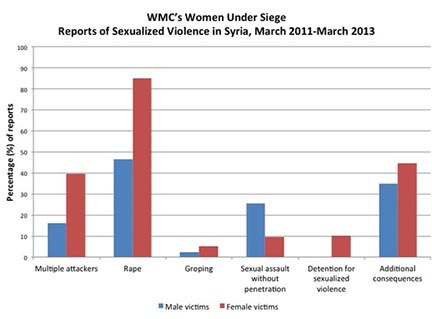
Although most coverage of the Syrian civil war tends to focus on the fighting between the two sides, this war, like most, has a more insidious dimension: rape has been reportedly used widely as a tool of control, intimidation, and humiliation throughout the conflict. And its effects, while not always fatal, are creating a nation of traumatized survivors — everyone from the direct victims of the attacks to their children, who may have witnessed or been otherwise affected by what has been perpetrated on their relatives.

In September 2012, I was at the United Nations when Norwegian Foreign Minister Espen Barth Eide shook up a fluorescent-lit room of bored-looking bureaucrats by saying that what happened during the Bosnian war is “repeating itself right now in Syria.” He was referring to the rape of tens of thousands of women in that country in the 1990s.

“With every war and major conflict, as an international community we say ‘never again’ to mass rape,” said Nobel Laureate Jody Williams, who is co-chair of the International Campaign to Stop Rape & Gender Violence in Conflict. [Full disclosure: I’m on the advisory committee of the campaign.] “Yet, in Syria, as countless women are again finding the war waged on their bodies–we are again standing by and wringing our hands.”

We said after the Holocaust we’d never forget; we said it after Darfur. We probably said it after the mass rapes of Bosnia and Rwanda, but maybe that was more of a “we shouldn’t forget,” since there was so much global guilt that we just sort of sat back and let similar tragedies occur since and only came to the realization later — we forgot.

Could we have forgotten that the unfolding human catastrophe in Syria exists before it’s even over? Continue reading Syria Has a Massive Rape Crisis

Islamic law in Syria: the Class of 1925-26


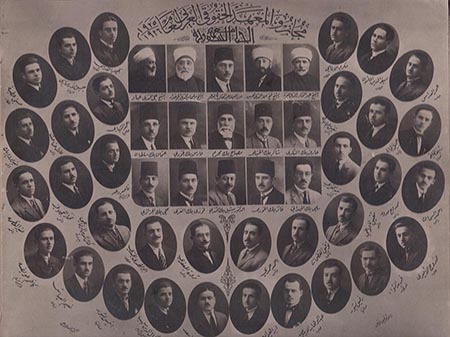
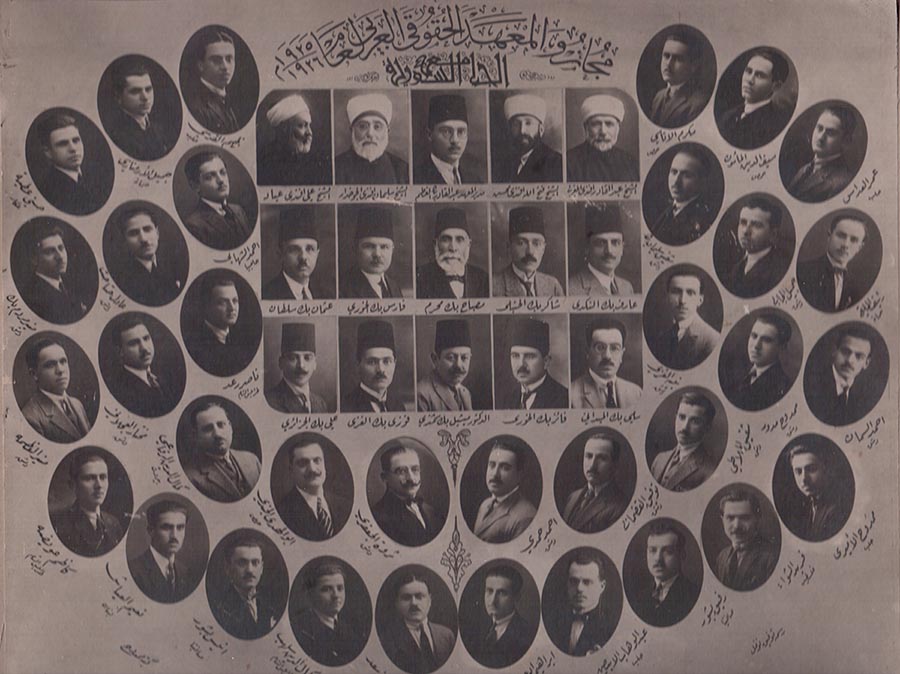
The graduating class surrounding their professors for the University of Syria’s Institute for Arabic Law in 1925-26; for a larger image, click here

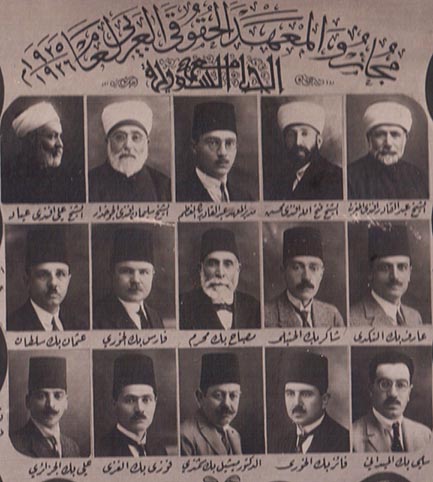
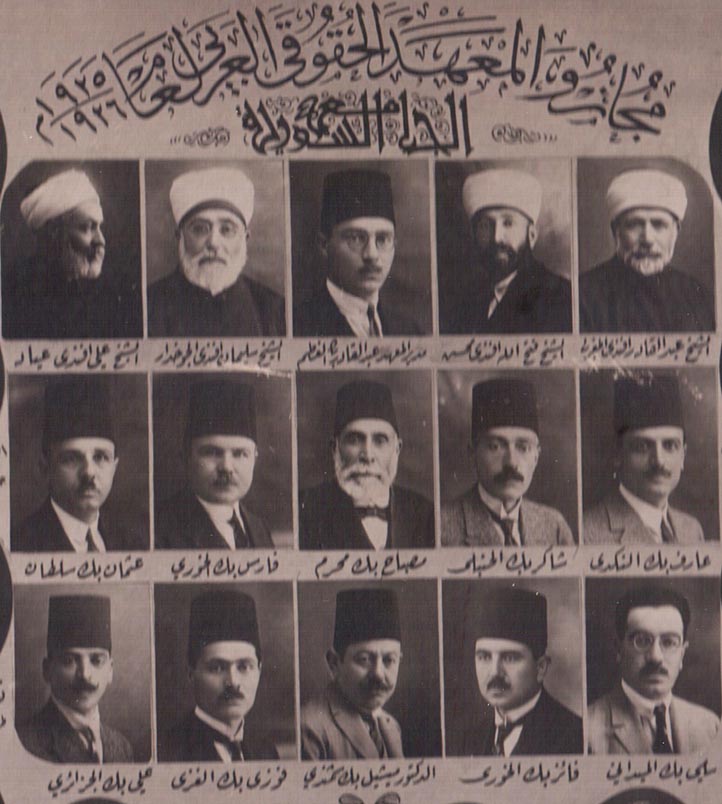
The image above shows the graduating class from the University of Syria’s Institute for Arabic Law in 1925-26. Among the professors is Fath Allah ‘Ali Adibe (top row, second from right), a graduate of al-Azhar and the grandfather of Dr. Najwa Adra. He is in the minority of professors sporting beards, although the moustache was clearly a necessity and only one of the scholars has a bare head and he is one of the few with spectacles. What is fascinating is the representation of the students, who are dressed entirely in Western suit and tie. About half have their moustache intact, with one showing a handlebar worthy of a Viennese gentleman. School graduation pictures like these are priceless. Would it not be a worthy project for someone or some school to archive these for the Middle East? Any takers out there?


The professors for the University of Syria’s Institute for Arabic Law in 1925-26; for a larger image, click here

What ails humanitarian aid in Lebanon


The high social price of media and humanitarian dissimulation in North Lebanon.

by Estella Carpi

In the aid provision sphere of North Lebanon, international media in close connection with humanitarian agencies often hasten to show how North Lebanon’s hospitality of Syrian refugees coming in large numbers to flee destruction, scarcity, repression, chronic fear and instability is huge. Such hospitality is actually a product of a quite complex picture with an up-close look, unlike the idyllic scenario humanitarian practitioners and local people usually provide. In addition, social dynamics are normally depicted in the media in ethnicized terms: that is to say Lebanese versus Syrians.

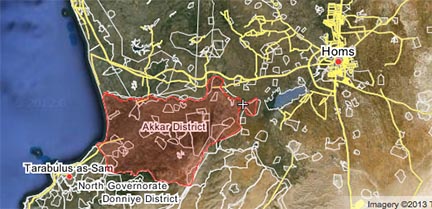
A few months ago, while conducting my fieldwork in Lebanon, I was told that some Lebanese threw stones to humanitarian workers during the food kits’ distribution for Syrian refugees in a town in Akkar, the northern region. The episode had been interpreted by local people themselves as an outburst of tension because of the sudden massive presence of humanitarian organizations in the area, which has always been neglected by state and non-state actors due to lack of political interests. The latter, in fact, were slightly more localized in Beirut and in the south of the country, vexed by Israeli occupation and by a consequent local impoverishment (1978-2000).

The humanitarian agencies operating in that town decided not to let journalists publish about the episode. Others published about it by contending that local people in North Lebanon would definitely stop “hostilities” and warm up if aid were provided to them too. The main reason behind the omission and amendment of this kind of information is apparently the intention not to generate further frictions between the local community and the Syrians. Continue reading What ails humanitarian aid in Lebanon

The high social price of humanitarian dissimulation


By Estella Carpi

A few months ago, while conducting my PhD fieldwork in North Lebanon, I shared my ideas on the current humanitarian assistance to Syrian refugees with a journalist working in Lebanon. I reported that I was told by some Lebanese from Halba that their neighbors threw stones at humanitarian workers during the food kits’ distribution for Syrian refugees in a little town in ‘Akkar (North Lebanon). Apparently it was just an outburst of tension because of the sudden massive presence of humanitarian organizations in loco. In the past they have always neglected this area in Lebanon due to lack of political interests, since the Israeli occupation and the consequent local impoverishment were primarily vexing the south of the country (1978-2000).

The humanitarian agency that the journalist was working for at that time first decided to omit such information before publishing the article. After that, in order not to be accused of censorship, with a cringe-worthy diplomatic move, they published it by elegantly modifying the content of the stones episode, and contending that local people in North Lebanon would definitely warm up if aid were provided to them too. This is a human dynamic that, unfortunately, I had never got the insight of in the field. The humanitarian agency at issue declared that this “information amendment” was carried out in a bid not to generate further frictions between the Lebanese and the Syrian communities. My “Wikileaks philosophy” pushes me instead to broach out the subject overtly and try to analyze it. Continue reading The high social price of humanitarian dissimulation