Category Archives: Countries

Tabsir Redux: Leaves from an old Bible Atlas #7


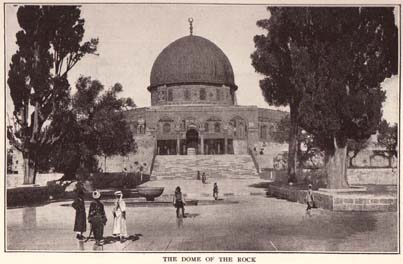
Hurlbutt’s Atlas, p. 137


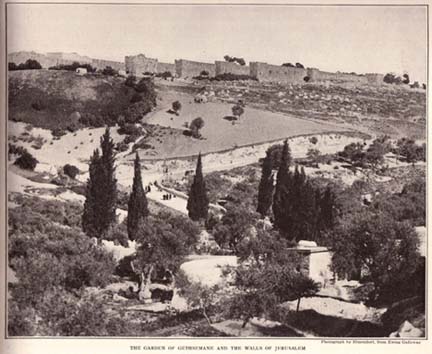
Hurlbutt’s Atlas, p. 133

The Christian fascination with the Holy Land as a window into interpretation of the Bible has a long and indeed fascinating history of its own. Here I continue the thread on Jesse Lyman Hurlbutt’s A Bible Atlas (New York: Rand McNally & Company, 1947, first published in 1882). As might be expected, a large part of the atlas is devoted to Jerusalem. Here are two century old pictures, one of the Dome of the Rock and the other a view of the Garden of Gethsemane looking toward an uncluttered landscape beneath the old city walls of Jerusalem.

[Tabsir Redux is a reposting of earlier posts on the blog, since memories are fickle and some things deserve a second viewing. This post was originally made on October 26, 2010.]

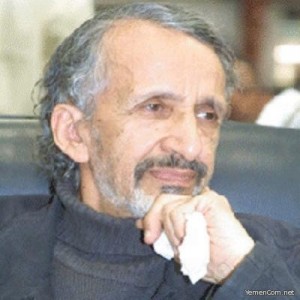
Muhammad Abd al-Malik al-Mutawakkil on the Situation in Yemen


المتوكل: حادثة الموتور سياسية والمستعجلين على الهيكلة لديهم برنامج يريدوا يبرموه
السبت, مارس 31, 2012 ALHawyah

قال الدكتور محمد عبد الملك المتوكل أنه لا يستطيع القول أن الحادثة التي تعرض لها في نوفمبر من العام الماضي حادثة بريئة “لكنه موتور سياسي ناتج عن عدد من القضايا التي كنت أطرحها على المشترك وأولها: قضية عسكرة الثورة”.
وأضاف في حوا-ره مع صحيفة الهوية نشرته في عددها الصادر الاربعاء الماضي -وهو يسرد ملابسات الحادثة قائلاً: طرحت على المشترك قضية عسكرة الثورة، حيث قلت لهم أن الأخوان المسلمين هم الذين جاءوا بالعسكر إلى السلطة فرد علي عبد الوهاب الآنسي بقوله: أنت تتهم الإصلاح؟ قلت له لماذا لا يوجد إسلاميون غيركم؟ الاتحاد إسلامي والشيخ إسلامي ولكن أنا اقصد الإسلاميين في العالم العربي كله. فقال محمد قحطان مداخلاً علي محسن مستعد أن يترك السلطة فرديت عليه: القضية ليست قضية شخص، وإنما قضية أسس”. حسب قوله.
وأضاف المتوكل: “القضية الثانية، دعوتي إلى ضرورة إيجاد قوى متعددة من أجل توازن القوى وقد بدأنا نبحث ميزانية توازن قوى حيث اتفقنا مع الشامي وأبو لحوم والحوثيين وبدأنا نتفق مع الحراك في الجنوب ومع الشباب وذلك لإيجاد توازن قوى نشط يؤمن بالتحالف ويؤمن بالآخر”.
وأردف قائلاً: “وهذه القضايا كان عبد الكريم الارياني قد أتصل بي وقال أنهم الآن يعملون مؤسسة لتنمية الوعي، هذه المؤسسة فيها من الأحزاب ومن المستقلين والمؤتمر، يريدوا أن يوجدوا توازن قوى، وقد حضرت معهم الاجتماع في صباح ذلك اليوم”.
ويضيف المتوكل: “بعد انتهاء الاجتماع طلبوا مني حضور اجتماع آخر في المساء قلت لهم لا أعرف مقركم، قالوا: سنبعث لك سيارة تأخذك، وفعلاً أتت السيارة، ولكن في وقت متأخر من الليل، وذهبت معهم، وصلنا إلى شارع الشرطة وكان هناك زحمة، فقالوا لي لا نستطيع الدخول من هنا، وسندخل من شارع آخر، فقلت لا مانع، وعندها دخلنا شارع آخر ومشينا، ولم أشعر بعد ذلك بما حصل لي إلا بعد أن تم نقلي إلى الأردن وخرجت من العناية المركزة ورأيت أمامي أولادي ولا أعرف السبب”. حسب قبوله.
أما القضية الثالثة فيقول المتوكل: “طلبت تشكيل لجنة لعملية إعادة التفكير في هيكلة القوات المسلحة وهذا ما أزعج الطرفين”.
Continue reading Muhammad Abd al-Malik al-Mutawakkil on the Situation in Yemen

YEMEN: Behind militia lines in Jaar


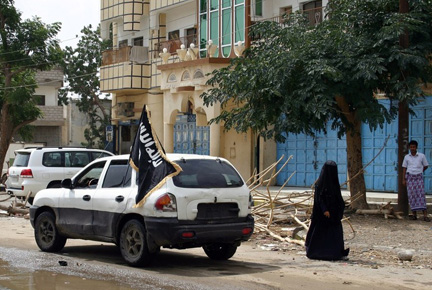
A Yemeni woman walks past a vehicle adorned with an Islamic flag in the town of Jaar, in the southern Abyan province, on January 25, 2012.

JAAR, 27 March 2012 (IRIN) – At first glance the city of Jaar, in Abyan Governorate near the Gulf of Aden, resembles many Yemeni towns struggling to rebuild after a year of nationwide protests shackled the central government’s ability to provide basic services.

Donkey carts line litter-strewn streets, and feral cats and dogs tiptoe past bullet-pocked storefronts and vacant buildings. Gaunt, bearded men drink tea and chew khat while shouting to each other across the street. In many respects, however, the remote settlement is different.

Controlled by a militant group called Ansar Al Sharia (Partisans of Islamic Law), the city is patrolled by armed militants in army trucks pillaged from the Yemeni military weeks earlier. The group’s black-and-white flag – a symbol of stability, according to Ansar al Sharia – flies at each entrance to the city, flapping behind Kalashnikov-toting soldiers riding motorcycles.

In a rare visit to Jaar on 5 March – the day after Ansar Al Sharia soldiers stormed a Yemeni military base outside Zinjibar killing more than 150 Yemeni soldiers and capturing 73 more – IRIN met civilians living under the expanding jihadist government.

Yemeni authorities believe the group is linked to Al Qaeda. Some local residents of Jaar said life under Ansar al Sharia was stable. One passer-by, when asked by a jihadist official what he thought of the “new [militant] government”, said it was “peaceful” and “nice”. Continue reading YEMEN: Behind militia lines in Jaar

New Work on Mahri Poetry

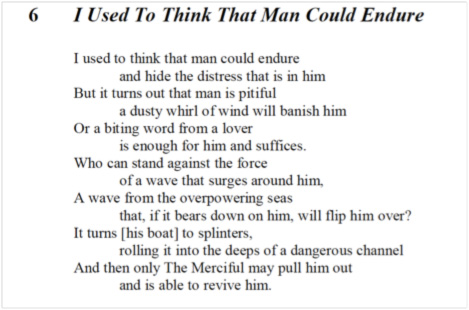
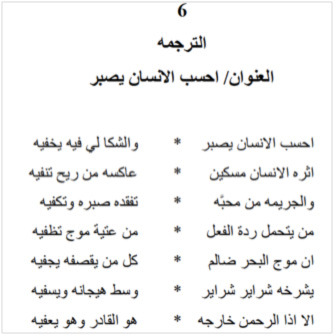
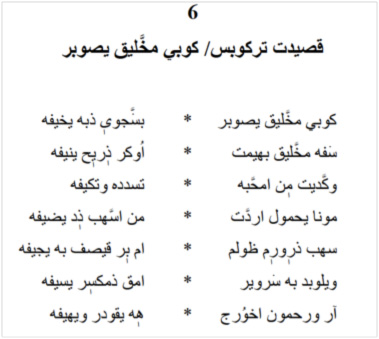
The Dīwān of Ḥājj Dākōn, published by the American Institute for Yemeni Studies in 2011, is a collection of eighteen poems in the endangered Mahri language of Yemen and Oman, one of the last, non-Arabic indigenous languages of the Arabian Peninsula. This publication marks an important step in the history of the Mahri language since it contains its first literary texts meant for a local readership. Ḥājj Dākōn, a pioneer of modern Mahri sung-poetry, has included an Arabic translation for each Mahri poem, which is supplemented by an English translation and transliteration into Latin characters provided by Samuel Liebhaber. The Dīwān is introduced by commentary that places the innovations of Ḥājj Dākōn’s lyric qaṣīdas in their cultural and linguistic context. A facsimile of Ḥājj’s original handwritten manuscript is included in the Dīwān. Starting in June 2012, audio and visual recordings of each poem in recitation will be accessible online on the site: http://blogs.middlebury.edu/mahripoetry/.

Sample poem, #6 from The Dīwān of Ḥājj Dākōn


English translation


Arabic translation


Mahri

Continue reading New Work on Mahri Poetry

Israel’s Moral Peril

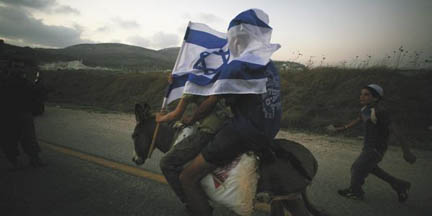
Children hold an Israeli flag in the Jewish settlement of Itamar on the West Bank; Photo by Rina Castelnuovo, The New York Times

By Alan Wolfe, The Chronicle of Higher Education, March 25

In the past few years, a trickle of dissent with respect to Israel has turned into a running stream. Books, articles, and Web sites critical of Israel’s treatment of the Palestinians, its acquiescence in the messianic designs of its settlers, its foreign-policy decisions on Gaza, Iran, and much more, and the increasing influence of the ultra-Orthodox over the character of its domestic life have begun to appear in significant numbers in America. Some, but not all, of these efforts, moreover, come from writers unused to being in the critical camp. The question is rapidly becoming not whether one should find fault with Israel, but how.

Two quite contrasting points of view have emerged among the critics. One can be called liberal and the other leftist. Liberals accept Israel’s legitimacy, search for ways that it can respect the rights of its non-Jewish citizens, and believe that the only viable future for the country is a two-state solution, one primarily Jewish, the other primarily Palestinian. Leftists view Israel’s creation in 1948 as an outgrowth of European colonialism, insist that as a Jewish state its character is inevitably racist, and lean toward the eventual creation of one state containing both Jews and Arabs. Should Israel’s actions continue to provoke opposition around the world, the question of which of these approaches will attract the most followers will become increasingly important.

I have a personal interest in this topic because I now count myself among the critics. For decades, I managed to write about some of the more controversial issues dominating the world without writing about the Middle East. The reason was simple: I was too intellectually paralyzed to do so. As a child, I had displayed an Israeli flag and carried blue-and-white coin boxes whose proceeds would plant trees in the new state. That, however, was about it: Serious Hebrew lessons, Zionist summer camps, and trips to the Middle East were of little interest to either my secular parents or me. Yet for all my family’s tendencies toward assimilation, Israel’s legitimacy was never questioned. Jews had been the victims of the greatest monster in history. Supporting the new state was the least the world could do to make up for it. We were, as I recall, vaguely aware that Arabs already lived on the land Israel claimed, but their complaints, to the degree that we heard them at all, seemed trivial by comparison to what had happened to our people. Continue reading Israel’s Moral Peril

Varisco on WBEZ


I was interviewed yesterday on the “Worldview” Program of WBEZ, Chicago. To listen to the broadcast, click here.

Yemen’s new president, Abdu Rabbu Mansour Hadi, has been in power nearly a month. He’s facing trouble in the southern province of Abyan. According to the United Nations High Commissioner for Refugees (UNHCR), the fighting has displaced more than 150,000 people since militants seized several cities in the province last May. Worldview will discuss the humanitarian crisis with Daniel Varisco, professor of anthropology at Hofstra University.