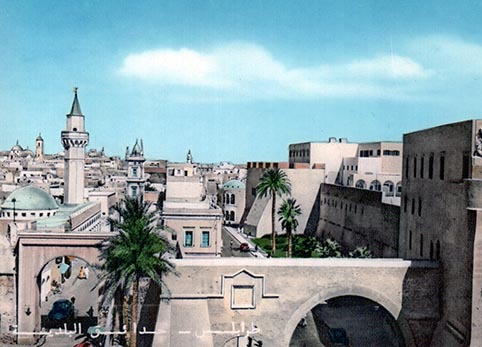
 Panorama of Tripoli
Above and below are postcards of scenes in Tripoli, Libya from the 1950s, when it was still a kingdom. All of these were distributed by Ediz. Ris. Foto AULA in Tripoli – Rop. vietata.
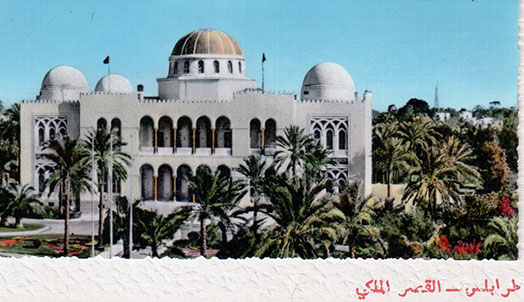 The King’s Palace
Panorama of Tripoli
Above and below are postcards of scenes in Tripoli, Libya from the 1950s, when it was still a kingdom. All of these were distributed by Ediz. Ris. Foto AULA in Tripoli – Rop. vietata.
The King’s Palace
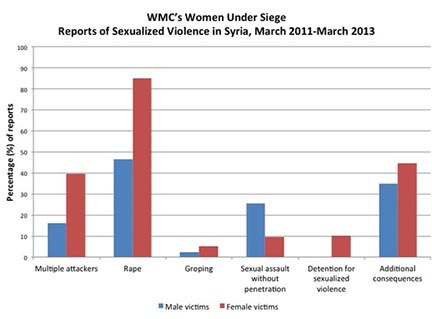
by Lauren Wolfe, The Atlantic, April 3
One day in the fall of 2012, Syrian government troops brought a young Free Syrian Army soldier’s fiancée, sisters, mother, and female neighbors to the Syrian prison in which he was being held. One by one, he said, they were raped in front of him.
The 18-year-old had been an FSA soldier for less than a month when he was picked up. Crying uncontrollably as he recounted his torture while in detention to a psychiatrist named Yassar Kanawati, he said he suffers from a spinal injury inflicted by his captors. The other men detained with him were all raped, he told the doctor. When Kanawati asked if he, too, was raped, he went silent.
Although most coverage of the Syrian civil war tends to focus on the fighting between the two sides, this war, like most, has a more insidious dimension: rape has been reportedly used widely as a tool of control, intimidation, and humiliation throughout the conflict. And its effects, while not always fatal, are creating a nation of traumatized survivors — everyone from the direct victims of the attacks to their children, who may have witnessed or been otherwise affected by what has been perpetrated on their relatives.
In September 2012, I was at the United Nations when Norwegian Foreign Minister Espen Barth Eide shook up a fluorescent-lit room of bored-looking bureaucrats by saying that what happened during the Bosnian war is “repeating itself right now in Syria.” He was referring to the rape of tens of thousands of women in that country in the 1990s.
“With every war and major conflict, as an international community we say ‘never again’ to mass rape,” said Nobel Laureate Jody Williams, who is co-chair of the International Campaign to Stop Rape & Gender Violence in Conflict. [Full disclosure: I’m on the advisory committee of the campaign.] “Yet, in Syria, as countless women are again finding the war waged on their bodies–we are again standing by and wringing our hands.”
We said after the Holocaust we’d never forget; we said it after Darfur. We probably said it after the mass rapes of Bosnia and Rwanda, but maybe that was more of a “we shouldn’t forget,” since there was so much global guilt that we just sort of sat back and let similar tragedies occur since and only came to the realization later — we forgot.
Could we have forgotten that the unfolding human catastrophe in Syria exists before it’s even over? Continue reading Syria Has a Massive Rape Crisis
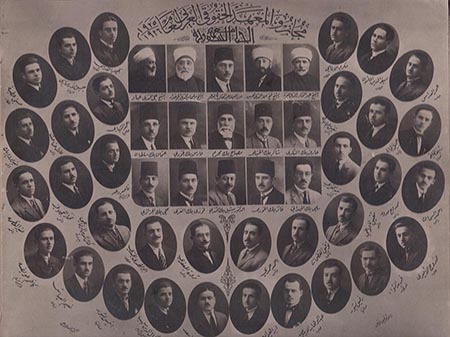
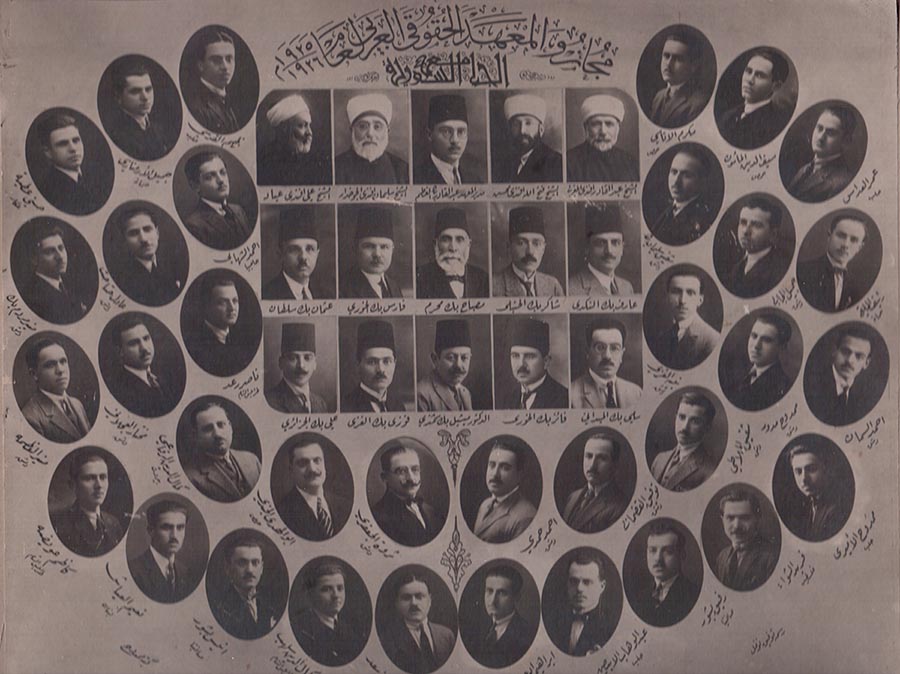
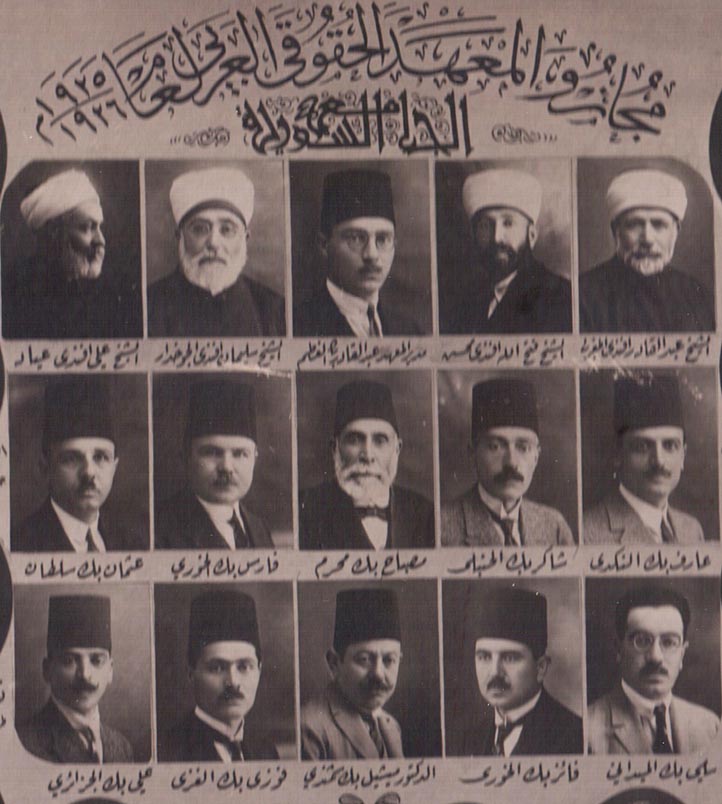
The graduating class surrounding their professors for the University of Syria’s Institute for Arabic Law in 1925-26; for a larger image, click here
The image above shows the graduating class from the University of Syria’s Institute for Arabic Law in 1925-26. Among the professors is Fath Allah ‘Ali Adibe (top row, second from right), a graduate of al-Azhar and the grandfather of Dr. Najwa Adra. He is in the minority of professors sporting beards, although the moustache was clearly a necessity and only one of the scholars has a bare head and he is one of the few with spectacles. What is fascinating is the representation of the students, who are dressed entirely in Western suit and tie. About half have their moustache intact, with one showing a handlebar worthy of a Viennese gentleman. School graduation pictures like these are priceless. Would it not be a worthy project for someone or some school to archive these for the Middle East? Any takers out there?
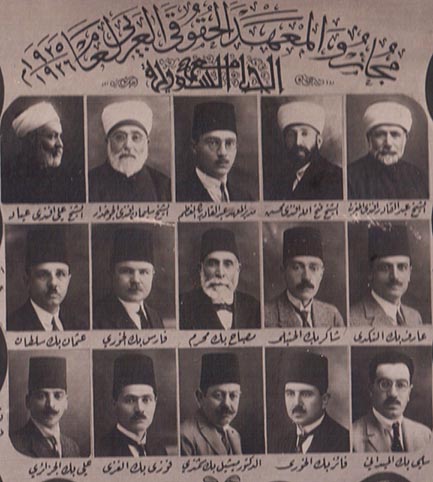
The professors for the University of Syria’s Institute for Arabic Law in 1925-26; for a larger image, click here
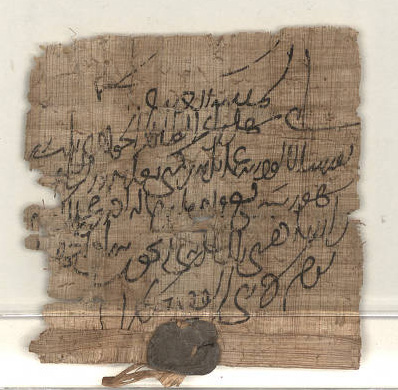
Arabic Papyrus #1564: Receipt for agricultural tax (1/3 of a dinar: from Ushmunayn in Middle Egypt. Compete scroll with seal in fine quality light brown papyrus. 9.3 x 8.3 cm written in black ink. Recto: 6 lines. In good condition. Verso: Two lines occupying the middle of the scroll. In good condition. 249 AH/863-4 CE
The Arabic Papyrus, Parchment & Paper Collection at the J. Willard Marriott Library, University of Utah is the largest of its kind in the United States. It contains 770 Arabic documents on papyrus and more than 1300 Arabic documents on paper, as well as several pieces on parchment.
Professor Aziz Suriyal Atiya, founder of the Middle East Center and the Middle East Library, compiled the collection. Dr. Atiya and his wife, Lola, purchased the collection over a period of several years from dealers in Egypt, Beirut, and London. The bulk of the collection originated in Egypt, in addition to a small group of fragments from the University of Chicago. A large number of pieces date to the period between 700 and 850 CE. The collection includes a significant number of documents from the pre-Ottoman period and thus offers unique source material on the political, economic, religious and intellectual life of Egypt during the first two centuries of Islamic rule and the period up to Ottoman domination.
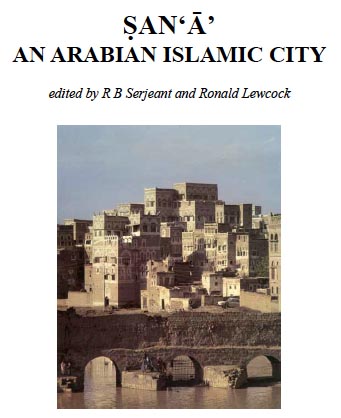
One of the most important volumes for anyone interested in Yemen is San’a’ An Arabian Islamic City, edited by R. B. Serjeant and R. Lewcock for the World of Islam Festival Trust in 1983. Long out-of-print, it is now being brought back into print. And there is a discount, if ordered before April 30, 2013.
The published price is £85.00 but the book is being offered at a pre-publication price of £50.00 until 30th of April 2013, quote SP13 to receive this offer.
For details, contact:
Vicki Coombs
Melisende UK Ltd
G8 Allen House
The Maltings, Station Road
Sawbridgeworth
Herts. CM21 9JX
+44 (0)1279 721398
www.melisende.com

Christians around the world celebrate Easter with thoughts of the empty tomb and resurrection of Christ. But there is more. Weather permitting, children are let loose in their Sunday best to hunt for Easter eggs, adding a secular, healthy, dietary blessing to the baskets of chocolate bunnies and jelly beans waiting at home. Even the White House lawn is set for the annual Easter Egg Roll (minus the Christian Rock) on Monday. It is as though many Christians are not content to leave the tomb empty. Apparently egged on by the spring fever of long forgotten fertility rites, the main message of Christianity gets sidetracked to a debate of anything but intellectual designing: which comes first, the Easter egg or the Easter bunny?
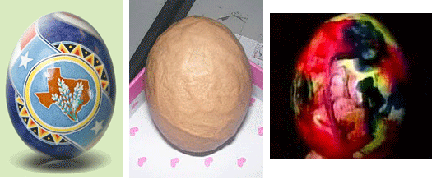
Eggs are not the exclusive mystical domain of Christendom (although the ludicrous lengths taken to parade a sacred holiday into outrageous bonnets and Texas-shaped eggs suggest we have entered the dispensation of Christendumb). Secular folk and agnostics eat their eggs for breakfast with bacon, toast and diner coffee. But all God’s children like eggs, including Muslims with internet savy and a taste for the miraculous. Take a gander (but do not confuse his spouse’s eggs with those shown here) at the three eggs shown below. What do you see different in the middle egg than the ones on either side (hint: the left is from the White House State of the Union Eggroll and the right is reported from last year’s Easter Sunday):

In the midst of all the bad news emanating from the Middle East, here is a youtube video of traditional Kurdish music with pastoral scenes in Kurdistan.