Category Archives: Countries

Drone Policy in Yemen

For anyone in the NYC region, I will be giving a talk at the COLUMBIA UNIVERSITY SEMINAR on KNOWLEDGE, TECHNOLOGY, and SOCIAL SYSTEMS on Wednesday, May 15, 7 pm (at Columbia University’s Faculty House). The title of the talk is: “Drone Strikes in the War on Terror: The Case of Post-Arab-Spring Yemen.” Unmanned drones have been used by the US military against terrorism in many areas of the world. In particular, these drones have become the US military’s weapon of choice in targeting terrorists in Yemen, where strikes quadrupled in 2012 from the previous year. This talk addresses the impact of these strikes on the political context within Yemen and the effectiveness of the strategy in combating Al Qaeda recruitment. The talk builds on a commentary published in the Middle East Muddle blog of the Anthropology News website.

For information on the talk, please contact me directly by email at daniel.m.varisco@hofstra.edu.

Tom Friedman (not Tom Sawyer) Abroad in Yemen


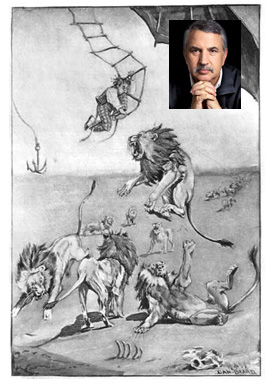
Background image is Daniel Beard illustration for the 1899 edition of Mark Twain’s Tom Sawyer Abroad

The well traveled journalist Thomas Friedman has popped up in Yemen, but apparently he has yet to find out that no one in Yemen drives a Lexus and Yemenis do not grow olive trees. Friedman has won many awards for his hot-air balloon reporting of events in the Middle East. He reminds me of Mark Twain’s Tom Sawyer Abroad, where the American boy hero gets a birds-eye view of Egypt and Palestine without ever escaping being mere “innocents abroad.”

Still, a postcard from Yemen via the New York Times op-ed page, by such a renowned journalist deserves a reading. As usual the journalist himself is one of the main attractions, including starting the very first sentence with an “I” to his own presence. I am not a fan of Friedman’s reportage, even when he claims some kind of inside knowledge about a place in the Middle East, but I do appreciate that two very important points are highlighted in his article: Yemen’s water crisis is a greater threat to instability than any political act and Yemen is poised to “have the best chance to start over – now – if they seize it.” I would only add this: if Saudi Arabia, the Gulf States and the U.S. do not keep the Yemenis from seizing and sustaining control of their own future.

Like Friedman, I have long known that Yemen is “a country of breathtaking beauty, with wonderful people” and, yes, it has become a “human development disaster.” But I would not explain this disaster away as simply due to “political mismanagement” by a string of military dictators. The United Nations, the World Bank, the United States, Britain, France, The Netherlands, Japan, China and a rather long list of foreign aid donors have pumped millions upon millions of dollars into a system without achieving any sustainable results. Saudi money has bankrolled the Ministry of Education, introducing a conservative Salafi brand of Islam that is overtly political. Yemeni workers have been treated like slum bums by the Saudis and Gulfies who hire and fire them at will. While Friedman is right to stress that the environmental and economic crisis created by the critical shortage of water, especially for domestic use in cities, is the major problem being faced, it is not “just about water” by any means. The heavens and fountains of the deep could open tomorrow and the mix of old and new ideologies (most coming from outside Yemen) would blossom like spring flowers after a desert rain. Continue reading Tom Friedman (not Tom Sawyer) Abroad in Yemen

Qat, Cosmopolitanism, and Modernity in Sanaa, Yemen

Webshaykh’s Note: An article entitled “Qat, Cosmopolitanism, and Modernity in Sana’a, Yemen” has been written by Irene van Oorschot, and published inArabian Humanities, Vol. 1, 2013. Her ethnographic study focuses on urban women in Sanaa. I attach here the beginning paragraphs, but urge readers to read the full article on Arabian Humanities, a new journal dealing with Yemen and the Arabian Peninsula.

The prevalence of qat consumption in Yemen strikes even the most casual of observers. Adolescent and adult men can be seen chewing in shops, taxis, and on the streets, while the many qat vendors in the streets and squares of Sana’a contribute —in the eyes of many tourists— to its quaint charm. While women do not usually chew qat in public places, married women chew qat in the privacy of their own or their female relatives’ houses. Chewing qat is however held to be shameful for unmarried women, a notion which is sometimes explained with reference to the alleged effects qat has on people’s libido. As a (sexual) stimulant, qat has no place in unmarried women’s lives. After all, they are not supposed to have premarital relationships, and as such are “not supposed to chew”. However, among unmarried women of the educated and urban elites, qat chewing is an popular way to spend one’s spare time:

“It is just a way to relax, to unwind, to be away from work, and to be with my friends,” Wafā’, an unmarried woman, told me. “My married sister chews qat, too, and she is even younger [than I am]! So why should I not get to chew qat and relax?” Continue reading Qat, Cosmopolitanism, and Modernity in Sanaa, Yemen

CIA, C.O.D., LOL


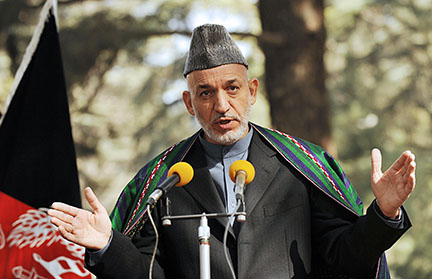
Afghan President Karzai explaining how large a bag he wants his CIA cash delivered in

Following the “revelation” that the CIA has been dropping off bags of cash to Afghan’s President Karzai, perhaps its acronym should also stand for Covert Insurance Allowance. What better way to spread democracy and freedom-loving among the Afghan people than to buy allegiance with greenbacks. After all, if Karzai is not supplied with freshly minted American dollars, how can he get the warlords to side with him. Let’s face it, the Taliban have stockpiled the opium, so Karzai needs some source of income for his fragile economy. As bribed supporters of American liberation, we can be assured that these warlords would never use any of that under-the-table funding to buy opium from the Taliban.

Many Americans are shocked that the CIA would provide clandestine aid to a foreign president who is pulled out on the kilim in public to be chided over Afghan’s notorious corruption. But rest assured that President Karzai gives America receipts for every dollar. These receipts are actually recycled and used as toilet paper back in CIA headquarters, resulting in a significant savings for the agency. The CIA can now cover its own shit without having to buy truckloads of Scots Tissues, much to the consternation of the Koch Brothers. Now that the shit has hit the fan, so to speak, more money will need to be provided to Karzai so that more receipts can make their way back to headquarters. There is plenty of cash available, despite sequestration, since so many of the other dictators that were getting genuine made-in-America bribes on the sly are gone. Continue reading CIA, C.O.D., LOL

Harun’s Harem Prime Time


From left, the women of Turkey’s Building Bridges: Ebru, Ece, Aysegul (who occasionally joins the four hosts on their show), Aylin, and Ceylan; Courtesy of A9 TV

[Webshaykh’s Note: I previously posted a blog commentary on the media beauties of Harun Yahya. A recent article in Slate is on the same group, and I post the start of the article below.]

The Versace Harem
A group of Muslim women with tight shirts, bright lipstick, a feminist mission, and total devotion to a creationist guru.

By Jenna Krajeski. Slate, Thursday, May 2, 2013

I first agreed to meet Ece, Ceylan, Aylin, and Ebru because I didn’t really believe they existed. They host the Turkish talk show Building Bridges and had recently gotten some attention, but not for the interviews. The women look astonishing. They are mostly bottle blonds, save for Ece, who has raven hair. Neon lipstick gives their lips a whole extra dimension. They coordinate outfits. At one of our meetings, they wore brightly colored satin pantsuits and T-shirts with designer brand names that stretched over their chests. What they talk about on Building Bridges—interfaith dialogue, women and Islam, the greatness of Turkey—isn’t particularly sexy, but their outfits are designed to make up for that. They are also devout Muslims—conservative, even—a supposed contradiction that is also the show’s allure.

Guests often appear—usually by Skype—with their eyebrows arched in the manner of a serious person certain he is the victim of a practical joke. But they proceed. The women sweetly dare the guests to suggest the hosts are anything but what they claim to be—activists, political commentators, Muslims—because of how they dress. During one interview, which I observed in the studio, Ceylan right away asked a German diplomat if a “true religious education” could “combat bigotry.” Continue reading Harun’s Harem Prime Time

The Morsi Blues

Egypt’s Economy, the Muslim Brotherhood & the U.S.

by Rachel Ehrenfeld and Ken Jensen, American Center for Democracy, May 2

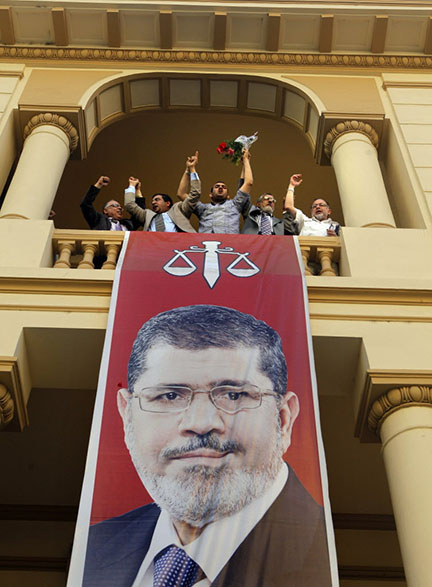
Under Muslim Brother Morsi’s inept economic team more than 4,500 factories have shut down. Egypt’s unemployment rate in the fourth quarter of 2012, have reached 13%, most of which, (77.5%) is among the 15-24 years old. Inflation has climbed much above the official 7.5% (March 2013), and foreign currency reserves declined to US $ 13,424 billion. The country spends about $14.5 billion subsidizing fuel and $4 billion subsidizing food each year. Nearly half of Egypt’s 90 million people live at or below the poverty line of $2 per day. The Egyptian Centre for Economic and Social Rights (ECESR), reports of “3,817 labor strikes and economically motivated social protests” following Morsi’s election, and more than 2,400 “between January and March” 2013.

Campuses all over the country are rocked by violent demonstrations, and “it’s getting worse by the day,” a student is quoted saying by Al-Hayat. Bloody clashes between students affiliated with Brotherhood and independent and opposition groups have been reported in Cairo’s Ain Shams University, and ongoing demonstrations in Al-Azhar University have gotten more violent after tainted food made dozen of students ill. Continue reading The Morsi Blues

The Vanishing Christians of Islam


Mosaic depiction of Mary holding an Arabic text, Convent of Our Lady, Greek Orthodox Church, Sednaya, Syria.

by Anouar Majid, Tingis Redux, April 14, 2013

Recently, Tawadros II, the Coptic pope of Egypt, said that “even during the darkest ages” of its history, his church was never subjected to the violence it is now suffering at the hands of Sunni Muslims. Maybe. But what is well known is that the fate of Egyptian Christianity and that of all Christians who found themselves under Muslim domination beginning in the 7th century when Islam emerged as a new religion hasn’t been an easy one.

It is true that the Koran periodically adopts a conciliatory attitude toward the “People of the Book,” but Islam is, in the end, categorically clear about who is right and who is wrong. Not only does Allah reject any religion that is not Islam, but the Koran also commands Muslims to “fight those among the ‘People of the Book’ who do not believe in Allah and the Last Day, who do not forbid what Allah and his messengers have forbidden and do not profess the true religion, till they pay the poll-tax (jizyah) out of hand and submissively.” The Christians’ off-and-on persecution has been a constant fact of life under Islamic rule; in fact, the notion of “genocide” was first inspired by the atrocities that befell Iraqi Christians in the 1920s, which came on the heels of the Turkish massacres of Armenians. As I am writing this, the Copts–a corruption of the word Aigyptos, whose original language goes back to the age of pyramids and which helped decipher the hieroglyphics in the 19th century—who make up some 10 percent of Egypt’s population of 90 million, are the only community of Christians left in any meaningful numbers. And, quite frankly, if Egypt doesn’t change, I wouldn’t bet on their long-term survival. Continue reading The Vanishing Christians of Islam