Category Archives: Countries

How to Kill a Terrorist


Predator drone

by Abdullah Hamidaddin, al-‘Arabiyya, September 11, 2013

On May 23, 2013 in a wonderful speech, that is yet to be translated into action, President Obama declared an end to the Global War on Terror (GWOT) which the U.S. has been waging since the early days after 9/11. Yet, killing terrorists is still on his agenda and that of other leaders around the world, albeit in a more “moderate” fashion. So here are some preliminary thoughts which I believe should guide this policy of killing.

The golden rule for killing a terrorist, actually the two golden rules, are simple and direct. The first golden rule is: do not become a terrorist in the process. The second rule is: do not create two or more terrorists for every terrorist you kill.

Very simple!

Yet the record of the past twelve years tells us that those two rules have been broken again and again and again. Some of those fighting terrorism have become as bad, and sometimes worse, than the terrorists they are fighting. Consequently, a new generation of terrorism has been born out of the very war that was supposed to fight and end terrorism. Moreover radicalization in our region has reached new and unprecedented limits; which is in itself a threat to civil peace. So what I will do here is register some of the ways in which those two rules have been broken, as things to be avoided in future killings.

Before I start with the first rule, I need to define what I mean by a “terrorist.” Continue reading How to Kill a Terrorist

Holy Land Photo Archive


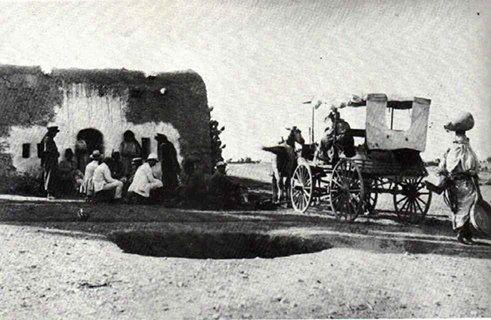
Arab Settlement Of Kakun, in the Sharon valley, with carriage of European visitors, 1911

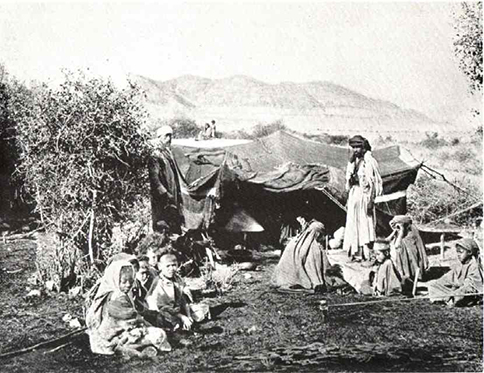
Many tourists flocked to the Holy Land in the 19th and early 20th centuries, not to mention the people who lived there. Quite a few took along cameras. There is a major archive of photographs of late Ottoman and Mandate Palestine here. The photographs are separated by area. It is well worth a look.


Bedouin camp in Jericho, 1893

Continue reading Holy Land Photo Archive

Yemeni Artists


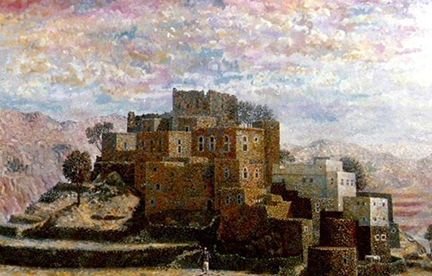
Yemeni artist Ziad Nasser al-Ansi, who won fourth place at the Dubai Cultural Innovation Awards, blends Yemeni architecture with local decoration and patterns. Above, al-Ansi’s painting that won the President’s Award in 2006.

Yemenis take home top awards at Dubai cultural competition

by Faisal Darem, Al-Shorfa, September 6, 2013

Yemeni Bassam Shamseddine was taken by surprise when his wife told him she had submitted his novel, “Laanat al-Waqif” (The Curse of the Stander), to the 2013 Dubai Cultural Innovation Awards without his knowledge.

A bigger surprise awaited him when his book placed fifth in the novel category, he told Al-Shorfa.

Shamseddine is one of three Yemenis who placed at the eighth edition of the awards.

Khaled Abdul Haleem al-Absi placed second in the short story category for his collection, “Wa Alam Adhaat Sihruha” (And the Pains Have Lost Their Magic), while Ziad Nasser al-Ansi placed fourth in the fine arts category.

The winners’ names were published in the September issue of the Dubai Cultural Magazine.

Awards were distributed across eight categories, including UAE cultural personality of the year, poetry, short story, novel, fine arts, dialogue with the West, theatre writing and documentary film.

“This is the first time I have taken part in a literary competition, and the award is a significant moral support for me to continue writing novels and stories,” Shamseddine said. Continue reading Yemeni Artists

Unbrotherly Brotherhood, Undemocratic Military

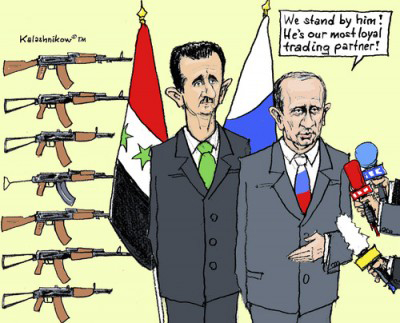
The debate over whether or not to send a cruise missile or two into Syria and spank Bashar al-Assad for adding chemical weapons to his bloody arsenal of putting down the revolt in Syria has overshadowed the continuing battle in Egypt for control of the political future. In both situations there is an alarming paradox for most Western observers: there seem to be no good guys wearing white hats, like in an early John Wayne movie. The al-Assad clan has run a security-based dictatorship that, like Saddam Hussein, tortured and killed opponents. But the major opposition, at least at this point in the ongoing civil war, includes a number of extremists who would be as bad a choice to take over. As the American experience in both Iraq and Afghanistan well demonstrates, the friendly (to us) leaders we would like to install (and did with impunity in the old days) do not work out so well these days.

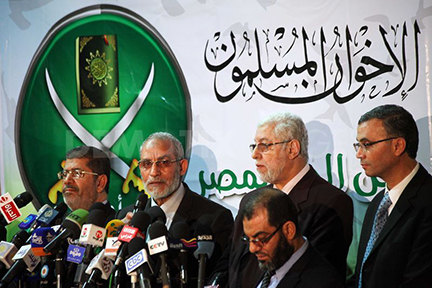
Egypt may not be today’s top story coming out of the Middle East, but it is hardly a stable situation. An article just out in the New Yorker by Joshua Hersh illustrates the clear objective of the Muslim Brotherhood to de-secularize Egypt. Those who came to power around Morsy were not very brotherly brothers and created a backlash by attempting to muscle out those who were not of their ideology. Continue reading Unbrotherly Brotherhood, Undemocratic Military

Père Etienne Renaud: In Memoriam, 3


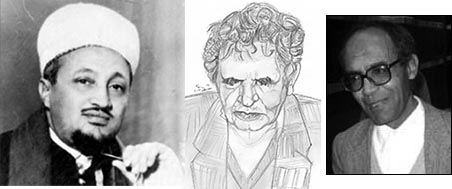
Yemeni poets Muḥammad al-Zubayrī, Abd Allāh al-Baraddūnī, Muḥammad al-Shalṭāmī, left to right

Yemeni Poetry in Translation

[This post continues a thread on the work of the late Père Etienne Renaud. The following French translations of Yemeni Arabic poetry were made by Etienne and are taken from his chapter “La vie culturelle en République Arabe du Yémen,” in Paul Bonnenfant, editor, La Péninsule arabique d’aujourd’hui (Paris: CNRS, 1982) Vol. 2, pp. 135-153.]

Nous avons refusé de vivre dans une nation
Foulée aux pieds par ses maîtres
Et nous sommes partis pour échapper à la bassesse
Fuyant la honte
Et combien de serpents rampaient autour de nous
Mais nous avons échappé à leur morsure

Muḥammad al-Zubayrī, Thawrat al-shi‘r, Cairo, 1962.

Amour et souffrance ont mêlé leurs deux âmes
Qu’est le Nord? Qu’est le Sud?
Deux coeurs qui ont rassanblé leurs joies et leurs peines
Ont été unifiés par la haine et par la souffrance,
Par l’Histoire et par Dieu.

Abd Allāh al-Baraddūnī, Fī ṭarīq al-fajr, Sanaa, n.d. Continue reading Père Etienne Renaud: In Memoriam, 3

Père Etienne Renaud: In Memoriam, 2


Père Etienne in Yemen

[In a previous post I commented on the life of Père Etienne Renaud, who rose to the position of leader of the Catholic White Fathers (Pères blanc), now known as the Missionaries of Africa. In 1987 he wrote a pastoral letter in the order’s in-house magazine, Petit Echo. This eloquent statement by a man who devoted his life to being a witness for humanity among Muslims and encouraging dialogue between Christians and Muslims deserves reading. It was originally written in French and translated into English in the same issue.]

Letter of Father General, Pére Etienne Renaud

Rome, 12 February 1987

Dear Fathers and Brothers,

Before taking up my pilgrim’s staff for West Africa, I should like to share some reflections with you.

After my election, several people asked me: “Is this going to change something in the Society’s commitment with regard to Islam?” One or another insisted more explicitly: “Is this going to increase our manpower in North Africa?” By way of riposte, I answered that a right wing government was well placed to make some left wing policy and vice-versa.

The fact remains that no one can make abstraction of his past, of all the missionary experience he has lived, and I must admit that my life in the Land of Islam, in North Africa as in Yemen, just as these last years teaching at the PISAI have deeply marked my general conception of mission.

My intention today, in this letter, is not to comment on the Chapter directives with regard to Islam, but to share with you some aspects of this conception of mission, which Islam has as it were forced me to deepen. I think that here it is a question of values important for every missionary, wherever he may be, even if they are values among others.

Respect for the other’s faith

In contact with Muslims, one is struck by the depth of their convictions, and more generally by the solidarity of the religious edifice of Islam. It is there, omnipresent. Study only reinforces this impression of massiveness, by helping us discover its centuries-old roots. Continue reading Père Etienne Renaud: In Memoriam, 2

Père Etienne Renaud: In Memoriam, 1

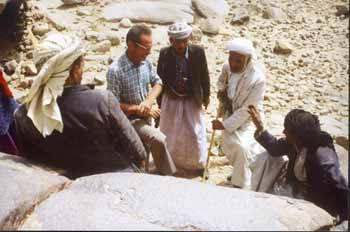
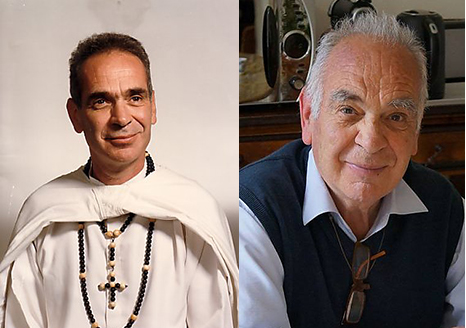
Just a few days ago I learned that a man I respected more than just about anyone else I have ever met had passed away on June 20, 2013 at the age of 76. This was Père Etienne Renaud, a man of the cloth I met in Yemen in 1978 and was able to visit in Rome in 1983. Etienne was a remarkable man, a missionary of the White Fathers (Pères blancs) teaching electrical engineering in Sanaa and ministering to the expatriate Christians in the community at the time. He was loved by all, including the many Yemeni Muslims he met, because he loved all.

His interest in Islam had evolved while serving in the French army in Algeria, after which he decided to enter the priesthood. With Arabic training in Damascus in 1968, he went to Tunisia the next year and on to Yemen in 1972. In 1980 he returned to Rome and taught Arabic at the recently formed Pontifico Instituto di Studi Arabi e d’Islamista. In 1986 he became Superior General of the order and served for six years. He visited many African countries where the White Fathers worked and spent the last several years in Marseille encouraging dialogue between Christians and Muslims.

Père Etienne was no ordinary missionary. He saw his mission as one of living his faith rather than trying to convert for conversion’s sake. In a poignant article, which I will post here in a follow-up, he noted that he was a Christian because he was born into Christianity. Although he accepted the Christian message as truth for him, he would not put himself in a position to judge another’s faith. His goal, as laudable as they come, was to be true to himself and allow others to be true to themselves, to see dialogue as an encounter that did not have to result in a zero-sum monologue. Continue reading Père Etienne Renaud: In Memoriam, 1

An 1873 Geography Lesson #1

My grandmother’s aunt, Ms. Ida Hoyt, owned an 1873 geography textbook entitled An Elementary Treatise on Physical Geography by D. M. Warren (published by Cowperthwait & Co of Philadelphia). The book itself, which I recently leafed through, is falling apart, but it is worth taking a brief look at some of the lithographic images. The text itself shows how far we have come since 1873, especially for the dated views of “race” and the ethnocentric views of the time. I will start with several of the images, as shown here.

Continue reading An 1873 Geography Lesson #1