Category Archives: Countries

Mormons in Marib


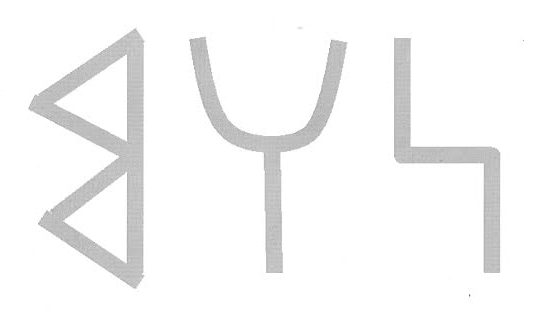
N-H-M in Sabaean

Not being a resident of Utah, I sometimes forget that there are people who take The Book of Mormon (the original and not the Broadway play) seriously. There is a passage in 1 Nephi 16:34 that suggests the place of Ishmael’s burial: “And it came to pass that Ishmael died, and was buried in the place which was called Nahom.” So where might Nahom be? Well, why not Yemen? That is the argument in an article by Warren Aston, who traveled to Yemen and found an inscription on an alter at Marib that referred to Nihm, a tribe. Thus, The Book of Mormon is verified, as innumerable Mormon websites attest, including one on Wikipedia.

There is indeed a Yemeni tribe called Nihm, part of the Bakil confederation. But why exactly would Ishmael end up getting buried in Yemen? There is certainly no indication in the Old Testament of Ishmael going to Yemen. Genesis 25:17 reads “And these are the years of the life of Ishmael, an hundred and thirty and seven years: and he gave up the ghost and died; and was gathered unto his people.” I sort of doubt that the priestly authors mention of “his people” meant the Sabaens down in Yemen. And in Islam Ishmael stops at Mecca. So either the Torah is wrong, Islamic tradition is wrong or the 19th century Book of Mormon is wrong. And, of course, given that this legendary material, they may all be wrong. There are indeed skeptics of Nephi.

The placename fallacy has a long history in pseudo-archaeology. One can rather easily manipulate major biblical placenames in Arabia. The Lebanese scholar Kamal Salibi played this game to the hilt in his imaginative The Bible Came from Arabia. Two individuals in Bahrain have continued the theme. It is difficult to dismiss the political motive (that Abraham and Moses were not herding their flocks and refugees respectively to ancient Israel) that no doubt underlies such attempts to rewrite history. Certainly there is no archaeological evidence for these bizarre claims. And just as certainly there is no end of lunatic archaeology in sight.

UPDATE:
Dr.Mohammed Maraqten, who has excavated at Marib, sends the following details about the altar:

This altar is from Barʾān Temple (Arsch Bilqis), ca. 6 Century B.C. and still in situ.
The complete filiations of the dedicator of this altar to Almaqah reads: Bʿṯtr / bn / s¹wdm / bn / nwʿm / nhmyn
The partly damaged letters are / N / and / H / (like Arabic Hirra) and the complete word is NHMYN and has for sure NOTHING to do with Biblical NḤM with / Ḥ / and the Canaanite root NḤM. The root is NHM and not NḤM.
Two possibilities to understand this word:
– NHMYN (al-NihmÄ«) is Nisbe to the very famous and many time attested in the inscriptions, in the Islamic period and still in the same place northeast of Sanaa. Also the Nisbe NHMYN is attested may times.
– NHMYN is a designation of a profession “Stonemason”, Munahhim or Muhandis, the verb NHM is well known in the inscriptions and the Arabic sources as a Yemeni term in the meaning of “to dress stones”.

Gender Issues in the New Yemen

By Samira Ali BinDaair, Sanaa

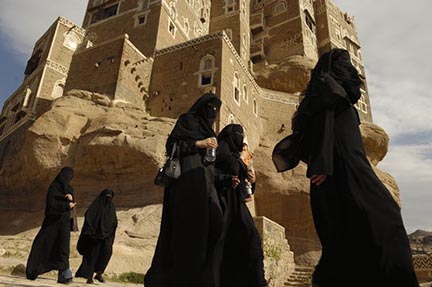
When it comes to women and gender in Yemen, I see the discussions inevitably alternating between what is happening in politics and then back again to the same old arguments about women’s rights. I think the problem is that we always look at women’s issues from a very narrow angle lens even though we profess to uphold women’s rights, whatever those are and by whosoever’s definition. After working for the past 20 years in development programmes that spanned different agendas and a variety of target groups and where gender analysis always featured largely, I can safely say that this whole concept of gender mainstreaming was introduced to Yemen without being communicated through more cultural-sensitive strategies. The result has been considerable confusion. Because it was introduced by Western agencies, it was sometimes greatly misunderstood, misimplemented and misused by people with vested interests, just as some men with vested interests have misinterpreted the role of women in Islam.

Gender, therefore, has taken on a demonic face when implemented in this way and came to be seen by some as advocating for the Western style of women’s lib from the 60s and being outside local religio-cultural norms. This ended up marginalizing women even more when the male members of society rejected it out of hand. Gender mainstreaming should be a rigorous process of examining the impact of policies on females, males and children and simultaneously defining the special needs of each category. The gender advocates simply go on repeating the same platitudes about women’s rights hinging on a two pronged concept of public life and employment. For example, in Yemen rural women constitute 70% of the labour force in agriculture so the question is not whether to work or not to work for them but how to relieve them of the many burdens that they face within an underprovided rural environment. Continue reading Gender Issues in the New Yemen →

Creating and Preserving Cultural Heritage in the Arab World


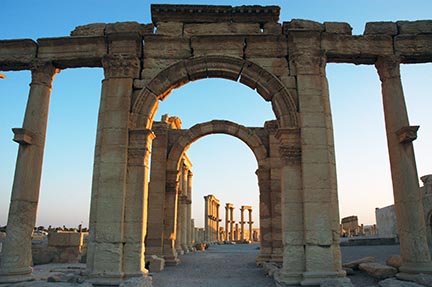
Illegal excavations and military use have recently endangered Palmyra, Syria, a UNESCO World Heritage Site. Photo: UNESCO/Ron von Oers

by Shatha Almutawa, American Historical Association, April 2014

A car bomb exploded outside the Museum of Islamic Art in Cairo on January 24, 2014. The Egyptian Heritage Rescue Team arrived on the scene and began to assess the damage and prepare artifacts to be moved to another building. Trained by the International Centre for the Study of the Preservation and Restoration of Cultural Property, the Egyptian volunteers worked with museum staff until all the artwork was safely relocated.

In Syria, following the destruction of the minaret at Aleppo’s Umayyad Mosque last spring, people made their way to the mosque to save the stones for later rebuilding. Some lost their lives in the process. The mosque had been used by rebels, the Syrian army was attacking from the outside, and fighting continued as volunteers worked to protect the stones. As political instability continues in the wake of the Arab Spring, cultural heritage sites and objects are often endangered.

Scholars and activists working on issues relating to the preservation of cultural heritage in the Middle East convened on February 28 at the Smithsonian’s Freer Gallery to discuss the Arab Spring’s impact on monuments, historic neighborhoods, and culture in the region. Lisa Ackerman, executive vice president and chief operating officer at World Monuments Fund, spoke about the importance of providing training to communities around historic sites in times of peace and after conflicts, so that locals can preserve their own heritage. She also mentioned the reality that in times of war, troops are trained to find strategic locations to use as bases; historic sites, as she explained in a later e-mail, “are often located in strategic positions with existing infrastructure, such as roads and nearby accommodations, or, as we’ve seen in Syria, are often situated at the highest points, providing a location advantage.” As an example, the US Army in Iraq chose Babylon for its Camp Alpha, which resulted in damages to its ancient walls and gates. Continue reading Creating and Preserving Cultural Heritage in the Arab World →

Milking the Marathon: Ayaan Hirsi Ali’s Brandeis Speech

by Setareh Sabety, Huffington Post, April 11, 2014

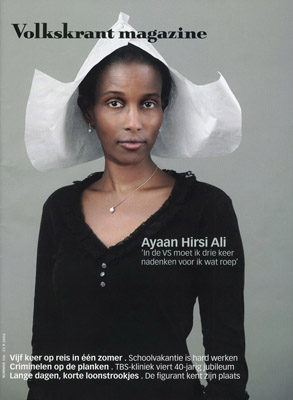
When my son, a senior at Brandeis University, forwarded me the news of the controversy surrounding the decision to grant an honorary degree to the controversial feminist Ayaan Hirsi Ali, I took her side. I knew about her. She is a Somalian feminist, a champion of banning genital mutilation of girls, and later a member of the Dutch parliament. She reached fame when Theo Van Gogh, the director of Submission, a film that Hirsi had written criticizing women’s treatment in Islam, was killed by a fanatic.

She went too far when she picked on Islam as a particularly violent religion, but as a Muslim-born feminist, I understood her anger. I too have been accused of being Islamophobic when I criticized Islamic views of women. It is easy to become angry after a video clip of a stoning or yet another story of an honor killing. It is easy to hate Islam when your husband threatens to keep you from traveling, or when the waiter tells you to cover your hair better in a restaurant. In Iran, where Sharia, or Islamic, law is imposed by force, women like me “hate” Islam on a daily basis. For Hirsi Ali, coming from the especially violent Somalia, undergoing genital mutilation herself, and witnessing the death of a colleague even in the relative safety of Europe, it must have been horrendous. I can see how her experiences could make her take sides and lose patience.That is why, initially, I supported her receiving an honorary doctorate from Brandeis. When the Muslim Student Association gathered enough signatures from both students and faculty to force a cancellation, I was impressed by the passion of the students, and by their convincing arguments about condoning hate speech. But, still, I had mixed feelings about canceling someone I considered a sister-in-arms against radical Islam. Hirsi Ali is not an Islamophobe. She is not afraid of Islam. She is fed up with it. I am too. As a woman who fled Iran because she did not want to be forced into the hijab or banned from travel by her husband, I understand Hirsi Ali on a deep and visceral level. Continue reading Milking the Marathon: Ayaan Hirsi Ali’s Brandeis Speech →