Category Archives: Countries

On The Moral Hazards of Field Research in Middle East Politics

By Sheila Carapico, Middle East Research and Information Project, July 14

* This memo was prepared as part of the “Ethics and Research in the Middle East” symposium

American political scientists studying the Middle East face ethical dilemmas not shared by most of our disciplinary colleagues. Sometimes – perhaps unexpectedly – our presence in countries or communities experiencing repression and/or political violence puts our local colleagues, hosts, or contacts at risk by association. The massive U.S. military footprint and widespread mistrust of U.S. policies and motives multiplies the risks to our interlocutors.

The trademark methodology of American Arabists is fieldwork, meaning, in political science, in-depth interviews, participant observation, data collection, document-gathering, opinion polling, political mapping, and recording events. As sojourners but not permanent residents, we rely heavily on the wisdom, networks, and goodwill of counterparts “on the ground,” particularly other intellectuals.

In any environment where agencies of national, neighboring, and U.S. governments are all known to be gathering intelligence, our research projects may look and sound like old-fashioned espionage. Even under the very best of circumstances (which are rather scarce) a lot of people are wary or suspicious of all Americans, including or sometimes especially Arabic speakers who ask a lot of questions and take notes. Immediate acquaintances probably grasp and trust our inquiries. Their neighbors or nearby security personnel may not. It is common knowledge that at least some spies and spooks come in academic disguise and that some U.S.-based scholars sell their expertise to the CIA or the Pentagon. Instead of treating whispered gossip as the product of mere paranoia or conspiracy theories, we need to recognize its objective and sociological underpinnings. Continue reading On The Moral Hazards of Field Research in Middle East Politics

Irhabis against the World Cup

By James M. Dorsey, The Turbulent World of Middle East Soccer, June 22

It’s not just soccer fans whose football fever soars during a World Cup. So does that of militant Islamists and jihadists with deadly consequences. Scores of fans have been killed since this month’s kick-off of the Cup in attacks in Iraq, Kenya and Nigeria.

The attacks by the likes of the Islamic state in Iraq and Syria (ISIS), Al Shabab in Somalia and Boko Haram appear to have become a World Cup fixture with similar random slaughter having occurred during the 2010 tournament in South Africa.

They reflect the diversity of opinion among jihadists on the merits of soccer as well as a degree of opportunism among all jihadists, irrespective of their attitude towards the beautiful game, in exploiting its popularity whether by seeking to maximise publicity by targeting fans during the tournament or using it as a recruitment tool.

The attacks occurred against the backdrop of a series of statements and fatwas, religious opinions, by militant clerics, often Salafis who seek to emulate to the degree possible 7th century life at the time of the Prophet Mohammed and his immediate successors who are not jihadists, condemning soccer as an infidel game that is intended to divert the faithful from their religious obligations or create divisiveness. Continue reading Irhabis against the World Cup

Zamzam Flim Flam

The sacred sites of Mecca have a long and rich history in Islamic tradition. One of the most important aspects is the well of Zamzam located close to the ka‘ba in the Meccan shrine. According to tradition this well flowed out miraculously when Ibrahim’s son Ismail was thirsty and scraped his feet on the ground. The well was later rediscovered by the Prophet Muhammad’s grandfather, Abd al-Mutallib. For centuries the well of Zamzam has provided the water for Muslim pilgrims to the site. Regardless of what one thinks about legendary attribution, Zamzam water has been a great marketing tool over the years. On Amazon you can even buy water allegedly bottled at the well in Saudi Arabia, only a mere $15 for 500 ml. In Germany you can buy the same amount for only 3.5 Euros, even though it appears that Saudi Arabia bans the export of Zamzam water.

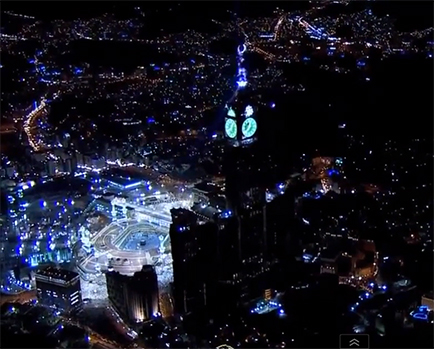
Then there is the Burj Zamzam Clock, a virtual ibn Big Ben towering over the ka‘ba and shielding a shopping mall and luxurious hotel. Such selling of holy sites has a long history as virtually every inch of Palestine can be linked to some biblical event. But by turning a sacred site into a tourist attraction, does not Zamzam become the victim of flim flam?

At hand by the Dead Sea


At the Dead Sea

Some extraordinary photographs on {Life}Buzz

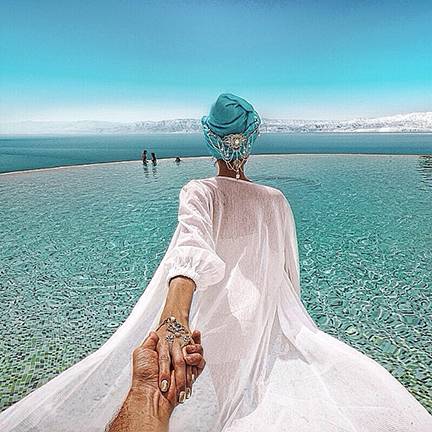
Here’s a guy who is following his love to the ends of the earth. Russian photographer Murad Osmann has been snapping photographs of his travels with his beautiful girlfriend Nataly Zakharova, leading the way since 2011. This series is called Follow Me To.

Murad said the first photo happened in Barcelona while they were away on vacation. Nataly was annoyed with him always taking photos of everything, so she grabbed his hand and pulled him forward. That’s when he took the first photo and the rest is history.

Their stunning pictures have earned them over million followers on Instagram.

Adonis on the Age of Darkness

Cairo Review, May 14, 2014

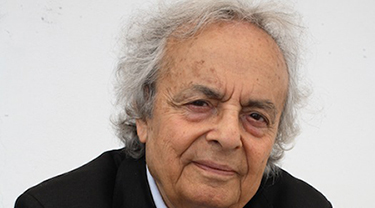
A half century ago, the poet Ali Ahmad Said Esber, better known by his pen name Adonis, left Syria for exile, first to Lebanon and then France. He lives on an upper floor of a new apartment tower in the Paris suburb of Courbevoie, steps from La Grande Arche in the modern business district of La Défense. Embroidered cushions from his homeland are on the sofa, abstract paintings on the walls; Arabic and French newspapers are piled around, next to music CDs of Bach and Mahler; Lebanese sweets are served on a platter along with cups of Nescafé. He never stays in one place for long; at the end of April, he was off to New York to open the PEN World Voices Festival with Salman Rushdie and Noam Chomsky.

Adonis, 84, is widely recognized as the greatest living Arab poet. He began writing verse as a teenager in Qassabin, a village in Syria’s Latakia province. In Beirut in the 1950s, he started a modernist revolution that the Guardian has called “a seismic influence on Arabic poetry comparable to T.S. Eliot’s in the Anglophone world.” He has published twenty volumes of poetry and thirteen books of literary criticism, reflecting on everything from love and Arab nationalism to American power; in 2011, he became the first Arab writer to win the prestigious Goethe Prize for literature. Adonis, meanwhile, has long been a leading public intellectual in the Arab world. His most recent writings are collected in Printemps Arabes: Religion et Révolution, published in France earlier this year by Éditions de La Différence. According to his English translator, Khaled Mattawa, Adonis believes that Arabic poetry has the responsibility of igniting a “mental overhaul of Arab culture.” Cairo Review Managing Editor Scott MacLeod and journalist Jonathan Randal interviewed Adonis in Courbevoie on April 11, 2014.

CAIRO REVIEW: Critics say your poems carry a lot of anger, but you have written some sweet poems. “The rose leaves its flowerbed/To meet her/The sun is naked/In autumn, nothing except a thread of cloud around her waist/This is how love arrives/In the village where I was born.”
ADONIS: Yes, romantic.

CAIRO REVIEW: How old were you when you wrote that?
ADONIS: I forget.

CAIRO REVIEW: Has Syria plunged into a dark age?
ADONIS: Well, the Arab world is living, and for a long time has been living, in a kind of age of darkness. Syria is part of that. But we can’t judge the future. I think that there are always some strengths in the people, to find solutions, escapes/exits, new horizons. I believe in that. The human being is a decent creature, who is manipulated by everything.

CAIRO REVIEW: When you were sixteen, was it a better moment?
ADONIS: Beginning when I was fifteen, we had plans. We could feel it, personally, lots of people of my generation. We had a kind of hope and vitality, a hope to change things, do something better. But from that moment of my adolescence, we also felt that there was nothing we could do in our society if the revolution was going to remain politically institutionalized. Without the separation of religion from the state, there was nothing we could do. I felt that for a long time.

CAIRO REVIEW: Was religious fundamentalism a danger at that time?
ADONIS: No. There wasn’t the ideological aspect of religion in my youth. It was almost invisible. Religion was never a problem. With my friends at school, I never asked, “What’s your religion?” Never. It didn’t exist. Continue reading Adonis on the Age of Darkness

Music of the Pearls

Check out the nicely illustrated online article by Kuwaiti ethnomusicologist Ghazi Al-Mulaifi on the music of pearling in the Arabian Gulf.

‘All the men died at sea,’ Ghazi Al-Mulaifi’s grandfather would respond, every time his inquisitive grandson questioned him about his days as the master of a Kuwaiti pearling ship during the 1930s and 1940s. Naturally, his grandfather’s ambiguity only served to exacerbate the young Al-Mulaifi’s interest. ‘Who was this grandpa-captain of mine, who didn’t want to talk to me about the sea?’
he wondered.

As Al-Mulaifi – now a 37 year old PhD candidate in ethnomusicology at New York University – became more and more interested in music as he grew older, he found himself increasingly drawn to one particular aspect of the Kuwaiti pearl diving tradition – its soundscape. For the whole article and illustrations, click here.

Frankenstein in Baghdad

International Prize for Arabic Fiction 2014: “Frankenstein in Baghdad”

Beyond good and evil

Ahmed Saadawi’s novel “Frankenstein in Baghdad” has won the 2014 International Prize for Arabic Fiction.

Khaled Hroub presents the book, from Qantara.de

Turning the final page of Ahmed Saadawi’s novel “Frankenstein in Bagdad”, the reader’s head is full of questions: who is really the monster of Bagdad? Who created it? What does it consist of and why is it so tenacious, costing so many innocent lives? Easy, generalising answers might be: the invasion of Iraq, confessionalism, politicians and their interests …

But such banal responses simplify the situation too much, for they would mean seeing only criminals and innocents in the brutality of Iraq’s daily events.

In real life, the situation in Iraq is bitterer than any black-and-white portrayal could render. Saadawi does away with such good/evil dichotomies and counters them with a dismal reality in which simplified notions soon melt away. Neither is innocence entirely innocent, nor is crime absolute.

A monster made of severed body parts

Shesma, the monster of Baghdad, is made up of body parts of innocent victims. This new play on Frankenstein’s monster goes on a mission that initially appears clear and righteous – despite its brutality – but soon comes to seem ambivalent and sacrilegious. Continue reading Frankenstein in Baghdad