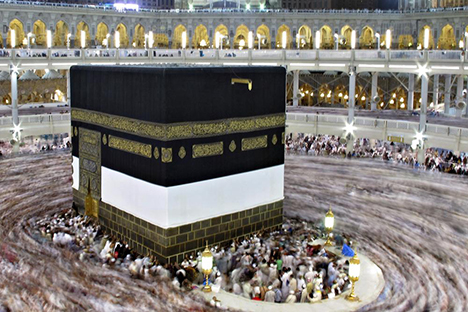
/© Muhammad Hamed / Reuters/REUTERS
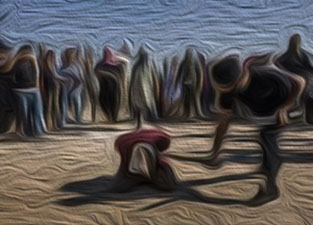
Al Jazeera has a series of photographs of this year’s hajj to Mecca.

/© Muhammad Hamed / Reuters/REUTERS
Al Jazeera has a series of photographs of this year’s hajj to Mecca.

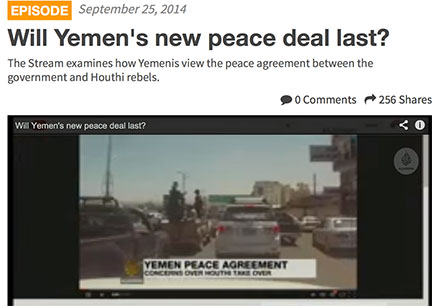
Al-Jazeera has been covering the Huthi conflict in Yemen. Here is one of their recent broadcasts.

by Antonella Vicini, Reset Doc, September 12, 2014
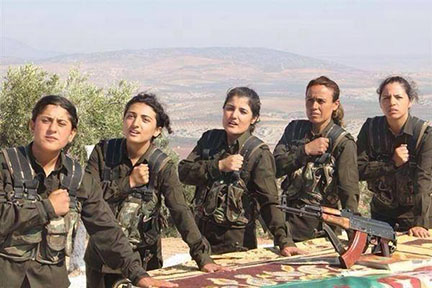
In the ‘Great Game’ developing in the Middle East and amidst constant changes in diplomatic equilibria, as well as the deployment of armed forces to try and stop ISIS’ advance, the only certainty for the moment is the role the Kurds have over time cut out for themselves and their mandate from the most important European countries and the United States. This concerns not only the often discussed Peshmerga, Iraqi Kurds who have rather effectively opposed the Islamic State’s penetration since the beginning of the summer, but also Syrian Kurds, active since at least 2012 and without doubt less visible at least from a media perspective.
Syrian Kurdistan is a region mainly inhabited by Kurds in northern Syria and also known as Rojava, effectively the western part of the nation called Kurdistan. Since the Syrian civil war started, rather like what happened in Iraq after 2003, the Kurds have gained control over increasingly larger areas and achieved greater autonomy, although there has not as yet been formal acknowledgment as happened with Iraqi Kurdistan. The Syrian Kurds, after fighting Assad’s armed forces, have clashed with Islamists so as to defend their region, in a rather fragile area bordering with Iraq and subject to infiltrations from the Al Nabar province. They have become a force, fighting the Islamic State fanatics thanks to action taken by YPG, the Yekîneyên Parastina Gel (Kurdish for the People’s Protection Unit), a regular army of about eight brigades spread throughout the area and also the armed wing of the Kurdish Supreme Committee. The female wing of the YPG is called the YPJ, Yekineyen Parastina Jin, the Women’s Protection Unit. Continue reading Syrian Kurdistan: the role of women in the battle against IS

Are the Houthis a symptom of regional mistrust?
by Abdullah Hammidaddin, alarabiya.net, Saturday, 20 September 2014
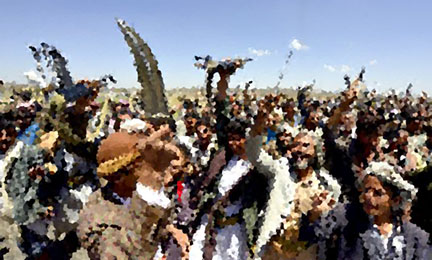
Ten years ago this month Ali Saleh had ordered the field execution of Husayn al-Houthi. This was after a three-month war between government forces and Husayn’s supporters in a remote village in northern Yemen. At the time, Husayn’s supporters were few and I believe the matter could have ended there. But Saleh decided to push on and confront the rest of Husayn’s family who then reacted by picking up arms again. They ended up surviving five wars waged by the government. Today Abdulmalik al-Houthi – Husayn’s younger brother – has forces in Sanaa and this time he is threating the Yemeni government, forcing it to make concessions.
In the past year alone, the Houthis have altered the political landscape of Yemen. They pushed the Ahmar family out of their homes and overthrew their three hundred year sheikhdom and authority in the tribal federation of Hashid. They took the al-Jawf area as a strategic last stronghold for their adversaries. They’ve forged alliances with most tribes in the northern region and also in the south. And now in Sanaa they are fighting against both the militias of the Islah party (Muslim Brotherhood branch in Yemen) and military factions loyal to General Ali Muhsin Al-Ahmar in what could escalate into a major war in the fragile capital city. Continue reading Here come the Huthis…

Throughout history in almost every culture there has been the sordid practice of beheading. John the Baptist lost his head to King Herod. Louis XVI lost his under a French guillotine. But few would argue that beheading is just today, no matter what the rationale. The recent choreographed beheadings of ISIS have brought the issue once again to a head. Unfortunately, such video propaganda only feeds Islamophobia, even though there is no legitimate justification for such a practice in Islamic law or the sunna of the Prophet. Not one of the companions of the prophet is recorded as having decapitated an enemy; certainly the Prophet himself never committed such an act. Indeed, the blood-soaked ISIS spectacles are pornographic.
I recently came across a lengthy fatwa on the Islamic Sham Organization in response to the question if beheading is sanctioned in Islam. I attached it below as it is well worth reading.
السؤال:
ما ØÙƒÙ… Ø°Ø¨Ø Ø£Ø³Ø±Ù‰ الأعداء بالسكين؟ وهل هو ÙØ¹Ù„اً سنة نبوية يمكن اتباعها؟
الجواب:
الØÙ…د لله، والصلاة والسلام على رسول الله، وبعد:
Ùقد أرسل الله Ø³Ø¨ØØ§Ù†Ù‡ وتعالى رسولَه بالهدى والعدل والرØÙ…ة، Ùكان مما شرعه Ø§Ù„Ø¥ØØ³Ø§Ù† ÙÙŠ Ø§Ø³ØªÙŠÙØ§Ø¡ العقوبات ÙˆØ§Ù„ØØ¯ÙˆØ¯ والقصاص، بأن تكون بأيسر طريقة وأسرعها، ومنعَ من كل ما Ùيه تعذيب وتمثيل، كتقطيع الأعضاء ÙˆØ§Ù„Ø°Ø¨Ø Ø¨Ø§Ù„Ø³ÙƒÙŠÙ†ØŒ ÙØ¥Ù†Ù‡Ø§ من الطرق الشنيعة والمنكرة ÙÙŠ القتل، وبيان ذلك Ùيما يلي:
Continue reading Fatwa on Beheading

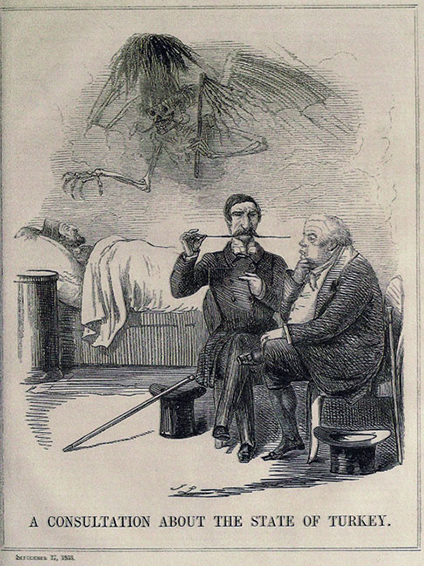
Turkey – “The sick man of Europe”, by John Leech, Punch, September 17, 1853
For a fascinating collection of cartoons, many from Punch, since 1853, check out the website “A Cartoon History of the Middle East,” compiled by Peter Casillas.

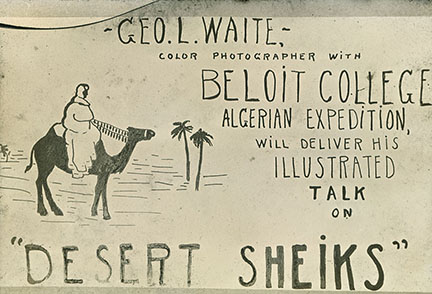
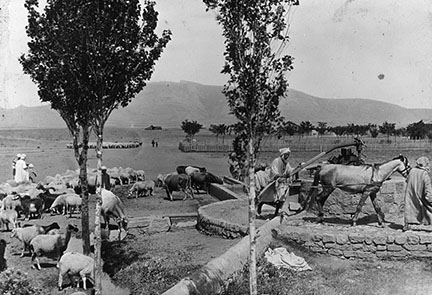
There is an extraordinary collection of 47 Magic Lantern slides from the 1930 Beloit College Logan Museum Expedition to Algeria by George L. Waite, the photographer and cinematographer. This is available in an online collection at the website of the Smithsonian Institution. Click here to access the collection.

There are many postcards on the Internet from old Aden under British control. Aden has long been a crossroads between Africa and Asia. It is not surprising that a number of early postcards feature Somalis in Yemen.