Category Archives: Countries

Engels on the Ottomans

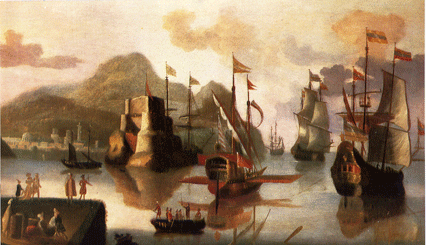
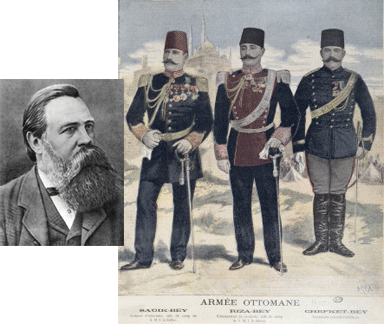
The Communist Manifesto, published by Karl Marx and Frederick Engels in 1848, stands as one of the most important political tracts ever written. It was written at a time when Europe had emerged as the dominant world force, economically and militarily. But even in the mid-19th century, the view in an Oriental direction proved more cluttered with opposition than casual readers of European history might think. The Ottoman Empire, not yet in the throes of its “sick man of Europe” stage, still thrived. In 1855 Engels published a series of articles in Putnam’s Monthly on “the Armies of Europe,” including his assessment of the Turkish army. Given the recent knocking on the EU door by modern Turkey, a re-read of Engel’s commentary is worthwhile…

I. The Turkish Army

by Frederick Engels (1855)

The Turkish army, at the beginning of the present war, was in a higher state of efficiency than it had ever reached before. The various attempts at reorganization and reform made since the accession of Mahmud, since the massacre of the janissaries, and especially since the peace of Adrianople, had been consolidated and systematized. The first and greatest obstacle — the independent position of the pashas in command of distant provinces — had been removed, to a great extent, and, upon the whole, the pashas were reduced to a discipline somewhat approaching that of European district commanders. But their ignorance, insolence, and rapacity remained in as full vigor as in the best days of Asiatic satrap rule; and if, for the last twenty years, we had heard little of revolts of pashas, we have heard enough of provinces in revolt against their greedy governors, who, originally the lowest domestic slaves and “men of all work,” profited by their new position to heap up fortunes by exactions, bribes, and wholesale embezzlement of the public money. That, under such a state of things, the organization of the army must, to a great extent, exist on paper only, is evident. Continue reading Engels on the Ottomans
Dancing in the Garden


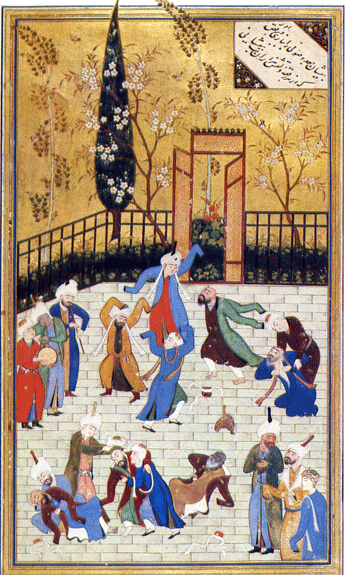
Scene from the Divan of Hafiz, Herat School, 1523, Freer Gallery of Art, Washington, D.C.

O beautiful wine-bearer, bring forth the cup and put it to my lips
Path of love seemed easy at first, what came was many hardships.
With its perfume, the morning breeze unlocks those beautiful locks
The curl of those dark ringlets, many hearts to shreds strips.
In the house of my Beloved, how can I enjoy the feast
Since the church bells call the call that for pilgrimage equips.
With wine color your robe, one of the old Magi’s best tips
Trust in this traveler’s tips, who knows of many paths and trips.
The dark midnight, fearful waves, and the tempestuous whirlpool
How can he know of our state, while ports house his unladen ships.
I followed my own path of love, and now I am in bad repute
How can a secret remain veiled, if from every tongue it drips?
If His presence you seek, Hafiz, then why yourself eclipse?
Stick to the One you know, let go of imaginary trips.

Hafiz, Divan, Ghazal 1

Ahmadinejad and the Twelfth Imam

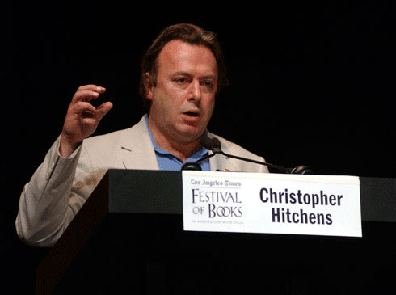
by Christopher Hitchens

[Excerpt from Christopher Hitchens, god is not Great (New York: Hachette, 2007), pp. 278-280.]

On a certain day in the spring of 2006, President Ahmadinejad of Iran, accompanied by his cabinet, made a procession to the site of a well between the capital city of Tehran and the holy city of Qum. This is said to be the cistern where the Twelfth or “occulted” or “hidden” Imam took refuge in the year 873, at the age of five, never to be seen again until his long-awaited and beseeched reappearance will astonish and redeem the world. On arrival, Ahmadinejad took a scroll of paper and thrust it down the aperture, so as to update the occulted one on Iran’s progress in thermonuclear fission and the enrichment of uranium. One might have thought that the imam could keep abreast of these developments wherever he was, but it had in some way to be the well that acted as his dead-letter box. One might ad that President Ahmadinejad had recently returned from the United Nations, where he had given a speech that was much covered on both radio and television as well as viewed by a large “live” audience. On his return to Iran, however, he told his supporters that he had been suffused with a clear green light — green being the preferred color of Islam — all through his remarks, and that the emanations of this divine light had kept everybody in the General Assembly quite silent and still. Private to him as this phenomenon was — it appears to have been felt by him alone — he took it as a further sign of the immanent return of the Twelfth Imam, not to say a further endorsement of his ambition to see the Islamic Republic of Iran, sunk as it was in beggary and repression and stagnation and corruption, as nonetheless a nuclear power. But like Aquinas, he did not trust the Twelfth or “hidden” Imam to be able to scan a document unless it was put, as it were, right in front of him. Continue reading Ahmadinejad and the Twelfth Imam

We are not that

It has been said that music is able to soothe the savage soul, so perhaps it can help reduce the bias that assume Muslim souls are innately savage. A recent video, called Yeh Hum Naheem, with several Pakistani pop stars, has been released and can be seen on YouTube.

Here is the description from the website:

Yeh Hum Naheen has become a truly unprecedented musical movement. Featuring the vocal talents of some of Pakistans biggest music artists, including Haroon, Ali Haider, Ali Zafar, Shufqat, Strings, Shuja Haider and Hadiqa Kiani, uniting to sing out the message the world needs to hear.

Written by Ali Moeen, Pakistans foremost lyricist, with music composed by Shuja Haider, its the central message of the song that has compelled so many people to become involved. It is a message of reconciliation, a message of peace and a message of truth. Capturing the imagination of people across the board, Yeh Hum Naheen has given a voice to the silent majority, those in the Muslim world who have for too long been mis-represented. These are the people who although not appearing on our television screens are saddened and shocked at the high-jacking of Islam by terrorists, and want to stand up and shout “This is Not Us”. The song is the brainchild of Waseem Mahmood, author and media consultant, who took inspiration for the project from his children. They were tired at the way a minority of misguided young people were vehemently putting forward a message of radicalization and terrorism which was at odds with what the majority of Muslims believe. It is time to re-address the imbalance, and from the smallest child to the oldest person, Yeh Hum Naheen seeks to give a voice to the voiceless.

The Letters of Badr Shakir al-Sayyab: #18


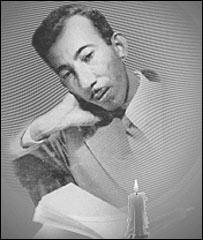
The Iraqi Poet Badr Shakir al-Sayyab

[Note: This is the 18th in a series of translations of selected letters of the noted Iraqi poet Badr Shakir al-Sayyab. For more information on the poet, click here.]

Letter #18

al-Ma’qil
20 July, 1963

My Dear Brother Abu Arwad (Adunis),

Your letter made me very happy because it came to me from my dearest friend after a long interruption. It also brought me the news that I have long been hoping for. It is rather a pity, Adunis, that the starlings should soar in the sky of poetry while the eagles remain with their wings folded and for no good reason other than incrimination and falsification.

My health is improving extremely slowly; nevertheless, there is an improvement. I hope it improves enough so I can come to Beirut this winter.

Currently, I am not writing anything. I am experiencing a period of stagnation after the period of that worthy activity in England where I produced “ Manzil al-Aqnan,” which has already been published. I will send your copy as soon as my personal copies arrive. I also have a new poetry collection still waiting for a publisher.
Perhaps it will be the best that I have written so far. [He is referring to “Shanashil Ibnat al-Halabi.”] Continue reading The Letters of Badr Shakir al-Sayyab: #18