Category Archives: Countries

Nadwi on Maududi: a traditionalist maulvi’s critique of Islamism


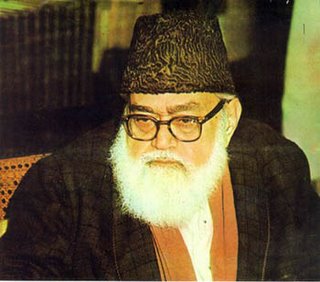
Sayyid Abul A’la Maududi (1903-1979)

By Yoginder Sikand, TwoCircles.net, May 18, 2008

The late Sayyed Abul Hasan Ali Nadwi (or Ali Miyan as he was also known) was one of the leading Indian ulema of modern times. A noted writer, he headed the famous Nadwat ul-Ulema madrasa in Lucknow from 1961 till his death in 1999. He was associated with several other Indian as well as international Islamic organisations, a mark of the high respect that he was accorded among Muslims all over the world.

Maulana Nadwi’s wrote extensively on a vast range of subjects, including on Islam and politics. On this issue, his views underwent a gradual process of change and maturation, beginning with his early association with a leading Indian Islamist formation and later making a forceful critique of some crucial aspects of its understanding of Islam. His views in this regard point to the little-known yet rich internal debate among Indian Muslim scholars about the relationship between Islam and politics, particularly on the question of what Islamists describe as an ‘Islamic state’.

In 1940, Maulana Nadwi came under the influence of Sayyid Maududi, the founder of the principal Indian Islamist outfit, the Jamaat-i Islami. Maududi, along with the Egyptian Syed Qutb, may be said to be among the pioneers of contemporary Islamism. Soon after joining the Jamaat, Maulana Nadwi was put in-charge of its activities in Lucknow. This relationship proved short-lived, however, and he left the Jamaat in 1943. He later wrote that he was disillusioned by the perception that many members of the Jamaat were going to what he called ‘extremes’ in adoring and glorifying Maududi as almost infallible, this bordering on ‘personality worship’. At the same time, he felt that many Jamaat activists believed that they had nothing at all to learn from any other scholars of Islam. He was also concerned with what he saw as a lack of personal piety in Maududi and some leading Jamaat activists and with their criticism of other Muslim groups. Continue reading Nadwi on Maududi: a traditionalist maulvi’s critique of Islamism
Hometown Baghdad

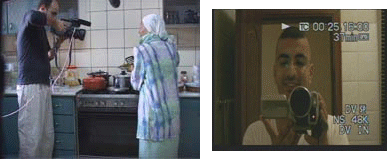
Hometown Baghdad is an online web series about life in Baghdad. It tells the stories of three young Iraqis struggling to survive during the war.

The series premiered on March 19th 2007 and the final episode went live on June 17. All episodes are viewable here.

The series was acclaimed in press throughout the world. See the press page for more.

Hometown Baghdad was produced by global youth dialogue company, Chat the Planet. Find out more about Chat here.

Mahdi Madness and the 2008 Election

For some partisans, no matter who is elected President to succeed George W. Bush, it will seem like the end of the world. We are in the apocalypse silly season once again. Take Tim LeHaye, the doctrinal inspiration of the WASP-friendly Left Behind book series (Jerry B. Jenkins provides the verbal inspiration in sci-fi style); he has been preaching the politics of biblical apocalypse for years. Indeed, since the apostle John allegedly first had his vision on the island of Patmos, the world has been teetering in the end times. This world is always going to hell; Jesus must be coming soon. Bible-belting believers and bible-belching evangelists constantly look to the heavens with rapturous delight for the mother of all shock-and-awe shows to begin. Up go the faithful in the twinkling of an eye and then it is open tribulation season on the Jews that will make the 20th century Nazi holocaust look like a sabbath picnic. Fortunately, most of the world’s Christians look at such a naive-ity scene with alarm. “Even so,” it might be said, “do not come Lord Jesus.”

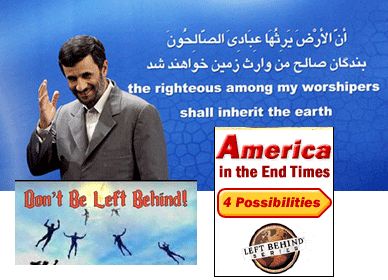
Reverends Tim LeHaye, Pat Robertson and John Hagee are not the only mega-mouths who know deep down in their saved souls that they will not be left behind. Ironically, they share theologically-maddened space with Mahmoud Ahmadinejad, the shi’a-evangelical President of Iran. As noted in a New York Times article today by Nazila Fathi, the Iranian President’s “high father” is Imam Mahdi, the hidden 12th “twelver” Imam who occulted well over a millennium ago, but whose reappearance has been looked for year after year in popular imagination. Ahmadinejad, who loves to wear his religion on his sleeves, says that Imam Mahdi guides his day-to-day decisions as a president. In gratitude, Ahmadinejad has sponsored an institute to prepare Iran for the Imam’s immanent return. This would be like Bush asking his faith-based supporters to create a special office in Homeland Security on Eternal Security Risks to those Left Behind. Continue reading Mahdi Madness and the 2008 Election

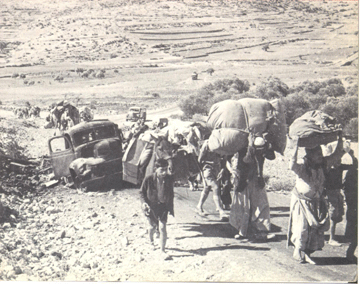
For Israelis, an Anniversary. For Palestinians, a Nakba

By ELIAS KHOURY, The New York Times, May 18, 2008

IN 1948, during the war known to the Israelis as the war of independence, the historian Constantine K. Zurayk wrote the book “Ma’na al-Nakba,” later translated as “The Meaning of the Disaster.” The title struck a resounding chord, and nakba (catastrophe) became the term Palestinians used for the cataclysm that befell them that year.

I always considered the word “catastrophe” inappropriate. It rendered the perpetrator anonymous, and it exempted the vanquished from bearing any responsibility for their defeat. Like many members of my generation, born around the time of the war, I tended to place the blame for our defeat on the traditional Palestinian leadership under the sway of the mufti of Jerusalem, and the Arab regimes of the day. Continue reading For Israelis, an Anniversary. For Palestinians, a Nakba

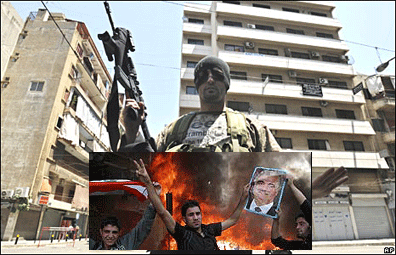
Hezbollah.. The Ugliest Picture

By Tariq Alhomayed, Asharq alawsat, 11/05/2008

Exposing falsehoods and uncovering deception; it is indeed true that a picture is worth a thousand words.

In his speech after the coup on Lebanon and its infrastructure, Hassan Nasrallah claimed that millions of dollars were spent in an effort to defame him and distort the image of the “divine party.” However it was the actions of his party that exposed the armed resistance lie and the falsehood of Hassan Nasrallah’s enthusiasm for Lebanon and the unity of its composition.

How horrible were the images carried by international news agencies, which showed Hezbollah’s gunmen and Amal forces stomping and burning pictures of the late Rafik Hariri, and then replacing them with a portrait of Syrian President Bashar Assad.

No less hideous were the images of handcuffed and blindfolded pro-government Lebanese citizens paraded in front of “Al Manar” cameras, the television channel that propagates Iran and Hezbollah venom. Moreover the images came across as if these were Israeli captives fallen in the hands of Hassan Nasrallah and not fellow Lebanese brought together by one homeland, of which the most important guarantee is that everyone has the right to live. Continue reading Hezbollah.. The Ugliest Picture

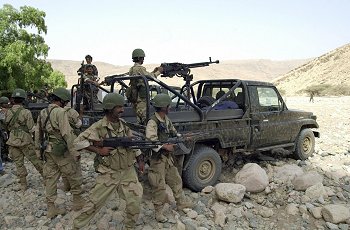
Yemen: Fighting in North Hampers Humanitarian Work


Yemeni soldiers patrolling in Saada, 150 miles north of the capital, Sana’a. A Yemeni Member of Parliament accused of being a leader of a deadly three-year uprising by the Zaidi minority in the northern mountains warned in remarks published on Feb. 25 that rebels might widen their campaign. (Photo: Khaled Fazaa / AFP-Getty Images)

Integrated Regional Information Networks, United Nations, May 6, 2007

The I.C.R.C. and Red Crescent came under attack in the Saada region of northern Yemen. (Photo: Afif Sarhan / IRIN)

A humanitarian aid convoy of the International Committee of the Red Cross (I.C.R.C.) and the Yemen Red Crescent Society came under heavy gunfire on May 2 in the governorate of Saada, north Yemen, the I.C.R.C. has reported.

The incident took place in al-Saifi area, 18 kilometers north of Saada city.

Fighting between government forces and followers of rebel leader Abdul-Malik al-Houthi in Saada governorate is still going on, causing thousands of people to leave their homes, said aid workers. Continue reading Yemen: Fighting in North Hampers Humanitarian Work

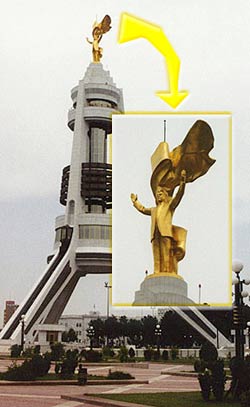
A Turkmen Dismantles Reminders of Old Ruler


Statue of Saparmurat Niyazov, Turkmenistan’s former president, soon to be removed

by By DAVID L. STERN, The New York Times, May 5, 2008

ALMATY, Kazakhstan — A 246-foot tall, rocket ship-like monument to the late ruler of Turkmenistan, topped with a golden statue of himself that rotates to always face the sun, will be removed from the center of the Turkmen capital, state news media there have reported.

A decision by President Gurbanguly Berdymukhammedov to move the monument was his latest step in dismantling the personality cult of Saparmurat Niyazov, whose often bizarre decrees turned the isolated, energy-rich country into the punch line of a bad international joke.

The president had already reversed Mr. Niyazov’s order renaming the days of the week and months of the year in honor of himself and his family. He had also ended the bans on opera, ballet and the circus, which Mr. Niyazov had decreed un-Turkmen, and lifted restrictions on the Internet. Continue reading A Turkmen Dismantles Reminders of Old Ruler

Sanaa’s Grand Mosque stands for 1400 years

by Mohammed al-Qiri, Yemen Observer, April 8, 2008

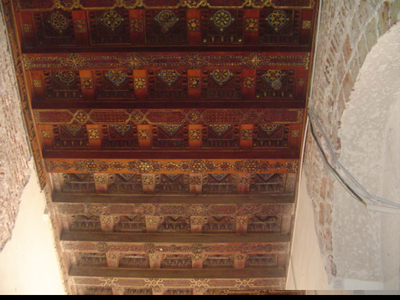
The Grand Mosque of Sana’a is considered to be the oldest in the Islamic world. It was built by order of the Prophet Mohamed (PBUH) in the sixth Hijri year, corresponding to 627 C.E.. It is located in the Bathan garden, between Ghamdan palace and the Malmlamah rock.

Over the course of history, there have been many additions made to the original building. The mosque was extended in the eighth century by the Amawi Khalif al-Walid ibn Abdulmalik (705- 715 C.E.) and at the beginning of the Abasi dynasty in the eighth century C.E., doors were added by Governor Omar ibn Abdulmajeed al-A’dawi, in addition to other overhauls in 745 C.E under his watch. Continue reading Sanaa’s Grand Mosque stands for 1400 years