Category Archives: Countries

Excommunicating Dead Terrorists


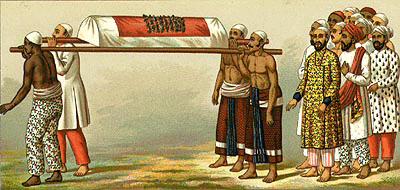
A lithographic painting depicting a Muslim funeral procession in India, circa 1888.

Excommunicating Dead Terrorists
by Leor Halevi, On Faith, Washington Post, December 29, 2008

Recently the Muslim Council of India sent an important message to the world’s Muslims. It asked one of the country’s largest Muslim graveyards, Marine Lines Bada Qabrastan, where unclaimed bodies are often interred, to deny burial rites to the nine men who died after terrorizing Mumbai. Refusal to bury the terrorists in a Muslim cemetery signifies not just that terrorist attacks are un-Islamic, a contention often heard, but that their perpetrators become, by carrying these acts, non-Muslim. “They cannot be Muslims or followers of Islam,” declared Muslim Council president Ibrahim Tai, “so they cannot have a final resting place anywhere
on sacred Mother India.”

The question then arises, what should India do with the dead bodies? Continue reading Excommunicating Dead Terrorists

Gaza: the cycle can be broken


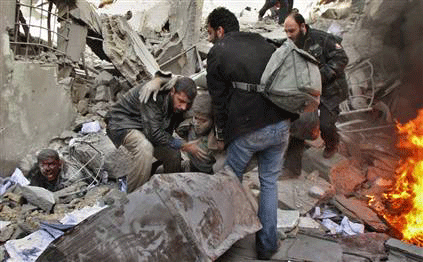
Palestinian rescue workers carry a wounded prisoner in the rubble of the Saraya prison after it was hit by a missile strike on Sunday. Photo by Majed Hamdan / AP.

Gaza: the cycle can be broken

The Independent/, Sunday, 28 December 2008

More than 30 years ago, the American political philosopher Michael Walzer wrote: “First oppression is made into an excuse for terrorism, and then terrorism is made into an excuse for oppression.” It was a good description of the Israel-Palestine problem then, and a good description of the dynamic that would make it worse over the following three decades.

It is a dynamic that operates in contravention of the simple, comforting and wrong principle that two democracies have never gone to war against each other.

The conflict between Israel and the people of Gaza is driven by democratic impulses. Hamas, the Islamic political party and paramilitary organisation, won control of the Gaza Strip in free and fair elections in January 2006. Its charter famously calls for the destruction of the state of Israel and, although that was hardly the issue on which those elections were fought, there can be little doubt about the depth and extent of hostility towards Israel felt by the majority of the population of Gaza. Continue reading Gaza: the cycle can be broken

The flower that made men mad


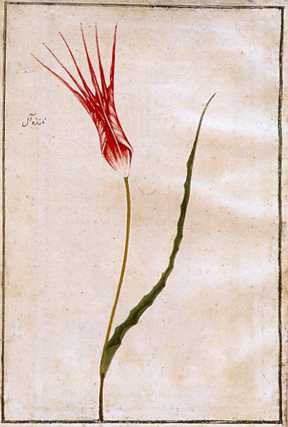
Nazende al (Flattering Red) from ‘The Book of Tulips’ ca 1725

by Anna Pavord

But as in any love affair, after the initial coup de foudre you want to learn more about the object of your passion. The tulip does not disappoint. Its background is full of more mysteries, dramas, dilemmas, disasters and triumphs than any besotted aficionado could reasonably expected. In the wild, it is an Eastern flower, growing along a corridor which stretches either side of the line of latitude 40 degrees north. The line extends from Ankara in Turkey eastwards through Jerevan and Baku to Turkmenistan, then on past Bukhara, Samarkand and Tashkent to the mountains of the Pamir-Alai, which, with neighbouring Tien Shan is the hotbed of the tulip family.

As far as western Europe is concerned, the tulip’s story began in Turkey, from where in the mid-sixteenth century, European travellers brought back news of the brilliant and until then unknown lils rouges, so prized by the Turks. In fact they were not lilies at all but tulips. In April 1559, the Zürich physician and botanist Conrad Gesner saw the tulip flowering for the first time in the splendid garden made by Johannis Heinrich Herwart of Augsburg, Bavaria. He described its gleaming red petals and its sensuous scent in a book published two years later, the first known report of the flower growing in western Europe. The tulip, wrote Gesner, had ‘sprung from a seed which had come from Constantinople or as others say from Cappadocia.’ From that flower and from its wild cousins, gathered over the next 300 years from the steppes of Siberia, from Afghanistan, Chitral, Beirut and the Marmaris peninsula, from Isfahan, the Crimea and the Caucasus, came the cultivars which have been grown in gardens ever since. More than 5,500 different tulips are listed in the International Register published regularly since 1929 by the Royal General Bulbgrowers’ Association of the Netherlands. Continue reading The flower that made men mad

Picturing Bethlehem

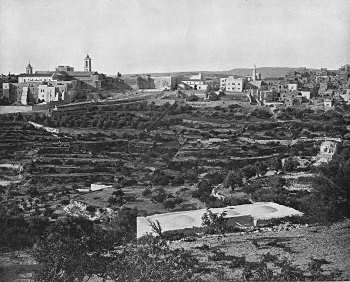
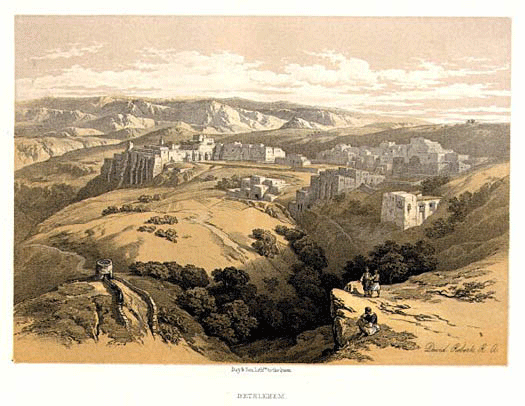
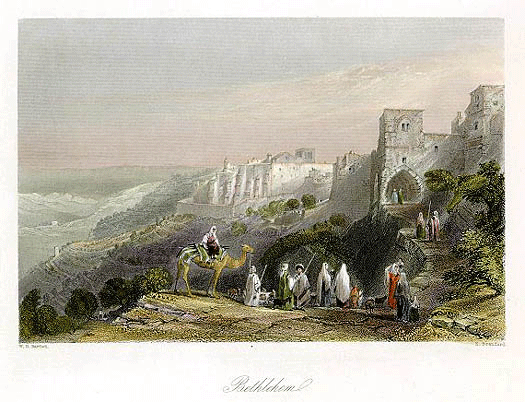
December eyes are fixed on Bethlehem, which has been an inspiration for artists over many years and indeed centuries. On this Christmas day, take a look at Bethlehem as it might have looked more than a century ago.


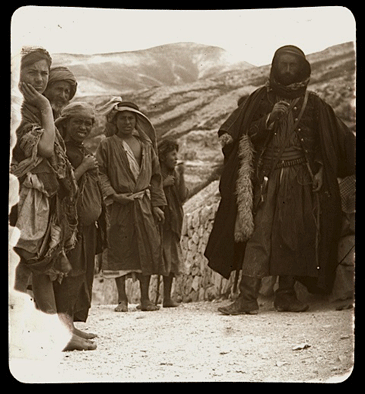
Left hand element of a stereoscopic photograph of the Bethlehem region circa 1900. Courtesy of Glenn Bowman.


Approaching Bethlehem. Source: Earthly Footsteps of the Man of Galilee.

The following two illustrations of Bethlehem can be found on the website (Jerusalem in 19th Century Art) put up by James E. Lancaster.


Bethlehem Tinted lithograph printed by Day & Son, after David Roberts, published about 1855.


Bethlehem Engraved by S.Brandard after a picture by W.H.Bartlett, published in The Christian in Palestine, about 1840. Steel engraved print with recent hand colour.

The Mothers Of The Lashkar

The Mothers Of The Lashkar

by C.M. Naim, Outlook India, Dec 15, 2008

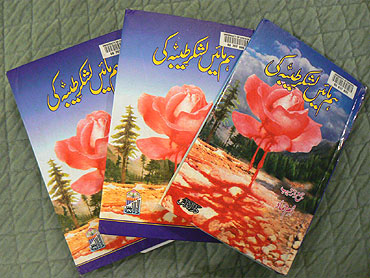
The book is titled Ham Ma’en Lashkar-e-Taiba Ki (‘We, the Mothers of Lashkar-e-Taiba’); its compiler styles herself Umm-e-Hammad; and it is published by Dar-al-Andulus, Lahore. Its three volumes have the same garish cover, showing a large pink rose, blood dripping from it, superimposed on a landscape of mountains and pine trees The first volume, running to 381 pages, originally came out in November 1998, and was reprinted in April 2001. The second and third volumes, with 377 and 262 pages, respectively, came out in October 2003. Each printing consisted of 1100 copies. Portions of the book—perhaps much of it—also appeared in the Lashkar’s journal, Mujalla Al-Da’wa.

Here is how the publisher, Muhammad Ramzan Asari, describes the book’s contents and purpose. Continue reading The Mothers Of The Lashkar

Surfs Up Da’wa

Sydney art fuses surf with Islam

By Nick Bryant, BBC News, Sydney, December 6, 2008

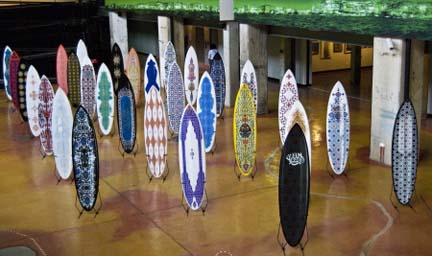
An Australian artist has produced a range of Islamic surfboards in an attempt to create a greater understanding between East and West.

Phillip George was inspired by his trips to the Middle East and by riots in 2005 when Lebanese Australians were targeted on a beach in Sydney.

He has called the range the Inshallah – or God Willing – surfboards and has put them on exhibition in Sydney.

There are 30 surfboards in all, each adorned with intricate Islamic motifs. Continue reading Surfs Up Da’wa

Tariq Ali, Pashtun Nationalism, and Taliban


By Naeem Wardag, Indus Asia Online Journal, December 3, 2008

Since the Afghan War, important power quarters in Pakistan have been propagating a particular interpretation of the security situation in Afghanistan through a variety of means ranging from the vociferous propaganda of the religious right to the more subtle works and ways of the allied experts strategically deployed here and there. Joined the campaign lately have also some ideologues of the liberal left-in particular from Punjab – whose paradigm of the class-struggle fully converge with the “cosmic struggle metaphysics” of the extreme religious right at this point of time as far as their analysis of the problem is concerned. Continue reading Tariq Ali, Pashtun Nationalism, and Taliban

Down the wrong chimney


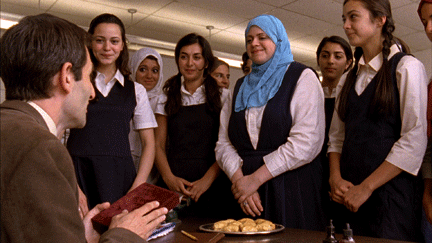
Classroom scene from “Santa Claus in Baghdad.” The book in the professor’s hand is a red velvet volume on Kahlil Gibran, published in 1984. In the film it contains an inscription from the professor’s professor dated 1949. Mixing dates is not the only cinematic sin of this problematic “educational” film.

Last week I received an email as an “educator” about a new, award-winning short feature film called Santa Claus in Baghdad. The announcement came from the filmmaker, an Egyptian named Raouf Zaki, who provided a free preview on a website called vimeo.com. The film is based on a short story of the same name, now part of a series of short stories for young adults by author Elsa Marston. I must admit that I found the title a bit strange, so I decided to look at the preview Tuesday night. But, as the old Christmas song expresses so well, “When, what to my wondering eyes should appear?” A turkey; nothing to give thanks for in battling stereotypes of Iraqis. I realize that the film intended to humanize Arab children, but it tells an emotional “what a great kid” story unrelated to the realities of living in Iraq. Iraqi children, including the thousands who died during Saddam’s regime and during the American occupation, deserve better. Continue reading Down the wrong chimney