Category Archives: Countries

Following Seward’s Folly: #1 Brits and Hindoos


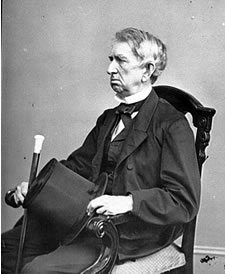
Portrait of William H. Seward, Lincoln’s Secretary of State, ca. 1865; photo by Matthew Brady

William H. Seward (1801-1872) is remembered primarily, to the extent anyone but a historian would bother to remember him, for his folly. An ardent opponent of slavery, this staunch Yankee republican might well have received the presidential nomination in 1860 instead of Lincoln, but he went on to serve as Secretary of State to both Lincoln and the first President Johnson. It was in 1867 that he pushed through the purchase of Alaska from Russia for 7,200,000 dollars, a sizeable sum for a nation coming out of a costly civil war. Horace Greeley in the New York Tribune wrote in criticism that Alaska “contained nothing of value but furbearing animals, and these had been hunted until they were nearly extinct.” Little did the man who famously said “Go west, young man” know that one day a young woman named Sarah Palin would come to power in this once Russian icebox. In 1870 Seward left politics and went on a trip around the world with his adopted daughter, who kept a record of the trip and published this in 1873. From New York to San Francisco to Japan and China to the straits of Malacca, Ceylon and British India to Egypt and Palestine and Europe and finally returning home to Auburn, New York in October of 1871: this was the folly the old man followed shortly before his death. Continue reading Following Seward’s Folly: #1 Brits and Hindoos
M F Hussain’s Aesthetic View on Islam


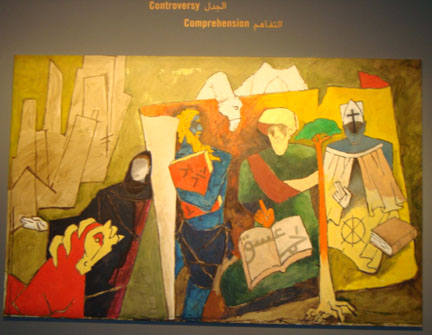
Hussain’s painting courtesy of Dr. Bruce Lawrence

One of the most famous, and at times infamous, painters in modern India is M.F. Hussain, who was born in 1915 and currently resides in London. He is perhaps best known for the controversy over his nude paintings, especially one that depicted “Mother India” and caused such a major backlash that he removed it from view. Less known, perhaps, are his paintings about Islam. Bruce Lawrence recently sent me several illustrations of paintings by Hussain on Islamic themes. Several of these were commissioned by Sheikha Mouza of Qatar for the Islamic museum in Doha. The picture above portrays the three monotheisms as “People of the Book.” As a painter it is clear that Mr. Hussain is less interested in promoting a particular religion than in celebrating the human spirit through his art.

Here is Bruce’s description of the painting above (this is an excerpt from a volume on Hussain, edited by Sumathi Ramaswamy and to be published by Routledge in October 2010): Continue reading M F Hussain’s Aesthetic View on Islam

Al-Qaeda in Yemen

[Salon Magazine recently published an interview with Gregory Johnsen on the recent attacks against alleged al-Qaeda sites in Yemen. Here is a brief excerpt from the interview. The whole piece can be found at salon.com.]

Glenn Greenwald: My guest today on Salon Radio is Gregory Johnsen, who is an expert on Yemen; he’s a Ph.D. candidate in Near Eastern Studies at Princeton University and has advised the U.S. and British governments on issues relating to Yemen. Thanks very much for joining me today.

Glen Greenwald: How would you characterize what is being called al-Qaeda in Yemen in that spectrum, and how significant of a threat it is really to the United States, not within Yemen, but outside of Yemen and in the homeland?

Gregory Johnsen: Well, let me talk about it this way, if I can. This is the second incarnation of al-Qaeda in Yemen. Immediately after September 11th, we had what I like to term the first phase of the war against al-Qaeda. This lasted essentially from, say, the USS Cole attack in 2000 and really the September 11th attacks in 2001, up through November 2003. So, in this phase, the US and Yemeni governments partnered very closely. There was the drone strike in November 2002 that I mentioned earlier, and this was largely, at least for al-Qaeda, a reactionary war. Continue reading Al-Qaeda in Yemen

Teaching at the margins

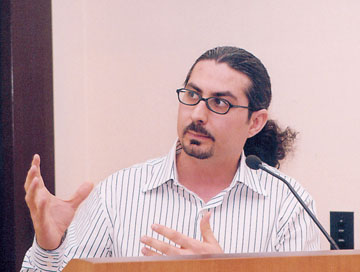
[Webshaykh’s note: Dr. Omar Dewachi, a recent graduate in anthropology from Harvard University, writes about his experiences teaching medical anthropology in Beirut. Here is the first paragraph of his essay, which can be uploaded in full as a pdf at http://www.alterites.ca/dernier.html.]

Teaching at the Margins: Experiences of Anthropology and Medicine in a Middle Eastern Setting

by Omar Dewachi, Altérités 6(2):129-135, 2009

For the last four years I have been teaching the Social Preventive Medicine (SPM) course to first year medical students at the American University of Beirut (AUB) in Lebanon. Around eighty students attend this core course, which is part of the teachin of public health within the medical curriculum. During the course of these years I have attempted to use the SPM as a platform to introduce theories and methods in medical anthropology to medical students. As both a medical doctor trained in Iraq – and an anthropologist – trained in the United States – this task has presented me with many challenges, as well as, offered me insights into tensions between the two fields. These experiences are the subject of this essay, which attempts to explore teaching at the margins of anthropology and medicine in a Middle Eastern setting. While situated at different margins, I reflect on how this course became an interesting site for exploring the complex task of teaching medical anthropology in a non-western context, while, at the same time, raising a set of paradoxes that are particular to teaching medical anthropology in a post-colonial setting. My attempt here is not to generalize my experiences or to reify the dichotomy of East and West; rather it is to situate them within their social-political, economic and historical realities.

To read the entire article in pdf, click here.

Grinding a Greater Axis of Evil


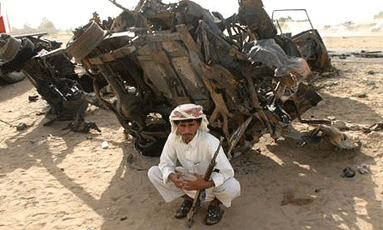
“Yemeni protesters staged a demonstration in the southern part of the country on Thursday after a raid against Qaeda militants”: Photograph from Agence France-Presse for The New York Times

In the midst of two unfinished major wars, the United States has quietly opened a third, largely covert front against Al Qaeda in Yemen. Eric Schmitt and Robert Worth, The New York Times, December 27, 2009

Terrorism takes a toll far beyond the lives lost everyday, even when a plot is thwarted. On Christmas day a 23-year-old Nigerian named Umar Farouk Abdul Mutallab attempted to set himself off as a human bomb on a Northwest Airlines flight from Amsterdam to Detroit. On the surface he hardly fit the profile of a crazed militant fresh out of a training camp in the hills of Pakistan. His father was a recently retired chairman of First Bank of Nigeria and he is an engineering student at University College London. But it now seems that his father was so concerned about his son’s politics that he warned the U.S. embassy about him just a month ago. Initial reports indicate that the explosives were said by Mutallab to be provided by al-Qaeda in Yemen. Based on this claim certain U.S. politicians, most notably Senator Joseph Lieberman of Connecticut, have called for Yemen to be added to the growing terrorist axis of evil. “So I leave you with this thought that somebody in our government said to me in the Sana’a, the capital of Yemen. Iraq was yesterday’s war. Afghanistan is today’s war. If we don’t act preemptively, Yemen will be tomorrow’s war. That’s the danger we face.” Lieberman told Fox News.

Lieberman is actually calling for Yemen to become today’s war, but the key to his thinking is best summed in another line from the same interview: “We’ve got to constantly be thinking like the terrorists here.” Well, Joe, this is the problem. You are thinking like the terrorists when you suggest going into a country you know nothing about and dropping bombs. Unfortunately, it appears we have already started doing that. Continue reading Grinding a Greater Axis of Evil

Mustafa Pasha Yamolki: From Istanbul to Suleymaniya

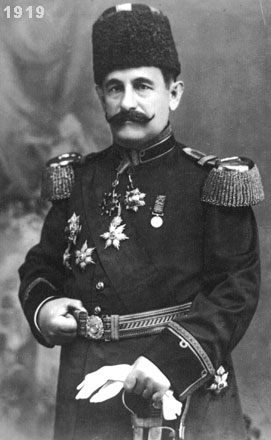
Mustafa Pasha Yamolki: his life and role in the Kurdish nationalist movement

by Dr. Rebwar Fatah, Kurdish Media, 2005

A king is just like a chess king today in the world.

From a poem by Shukri Fazli, Kurdish intellect, journalist and poet

There are countless Kurdish figures that have been denied due credit for contributing to the cause of their people. Mustafa Pasha Yamolki is but one. Attempting to name the others would risk missing some and history already excels at this.

Therefore, this article seeks to reveal some unknown details of Yamolki’s life and to reintroduce him after an absence that is unjustified for a human of such stature. It was a significant, but worthwhile, challenge to discover information about Yamolki. I depended heavily upon his immediate family, whose acquaintance I treasure a great deal.

Prior to his death on May 25, 1936 in the Alwazyrya area of Baghdad, Mustafa Pasha Yamolki asked to have this verse of poetry etched into his grave:

Etirsm ey weten bimrim, nebînim bextiyarî to

Binwsin ba leser qebrim, weten xemgîn u min xemgîn.

Which can be translated to:

My homeland, I am scared that I may die without seeing your happiness

Etch into my grave that my homeland and I are both sad.

Continue reading Mustafa Pasha Yamolki: From Istanbul to Suleymaniya

An Archic Sonnet


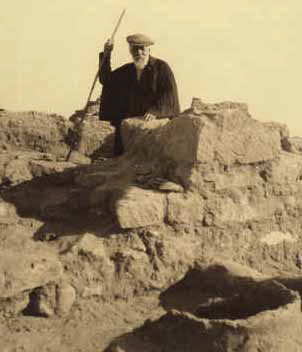
Sir Flinders Petrie, Egyptologist

An Archic Sonnet

To know what man was, ere he wrote his name,
Inscribed the laws and precepts on the rock,
And sacrificed the best lamb of the flock,
We dig the mound, and wander o’er the plain.
To learn the mysteries of the past, we fain
Would search for hidden slabs, and keep in stock
The Relics we so love. Oh, to unlock
The door, and gain an entrance to the same! Continue reading An Archic Sonnet

Grand Ayatollah Hossein Ali Montazeri Dies


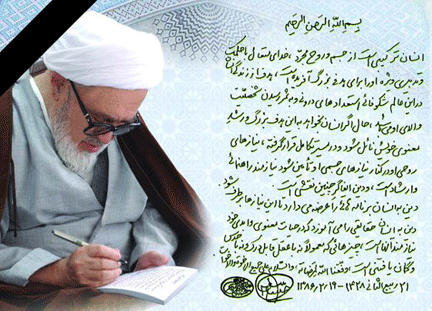
Image of the Ayatollah from his Persian website

One of the most vocal opponents of the hardliners in the Islamic Revolution and of the recent election fixing by President Ahmadinejad was the Grand Ayatollah Hossein Ali Montazeri, who has died at the age of 87. Reports of the funeral in Qum are based on eyewitnesses, since the government of Iran has forbidden journalists to cover the burial. The New York Times has a lengthy article by Robert Wirth with the following general information:

Ayatollah Montazeri was widely regarded as the most knowledgeable religious scholar in Iran, and that gave his criticisms special potency, analysts say. His religious credentials also prevented the authorities from silencing or jailing him. Last month, he stunned many in Iran and abroad by apologizing for his role in the 1979 takeover of the American Embassy in Tehran, which he called a mistake. Iran’s leaders celebrate the takeover every year as a foundational event of the Islamic revolution. Continue reading Grand Ayatollah Hossein Ali Montazeri Dies