Category Archives: Countries

By Air-Cooled Bus from Baghdad


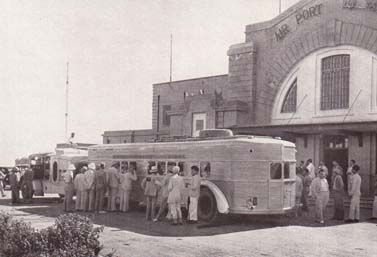
The photograph above, taken by W. Robert Moore, appeared in the National Geographic Magazine December, 1938 issue (p. 732). The caption reads:

THE DESERT-GOING BAGHDAD-DAMASCUS BUS IS AIR-COOLED AND WAS “MADE IN U.S.A.”
Temperature was 111 degrees Fahrenheit when the picture ws taken at Baghdad’s airport, but inside the stainless-steel bus, operated by Nairn Transport Company, it was only 76 degrees. Now, in a few hours, these huge high-speed cars make the trip that once took camels many days.

Covering Afghanistan


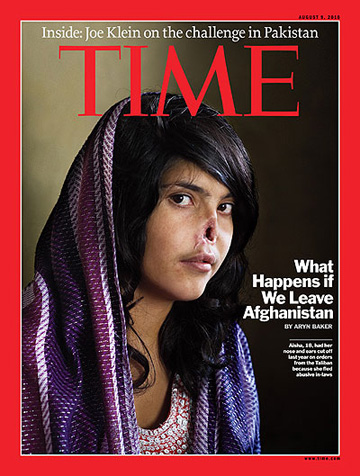
August 9, 2010 cover of Time Magazine

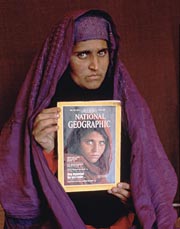
As usual for the end of the week, my Time arrived yesterday. It seems a bit unusual that I should receive the August 9 issue a week early, but then Time is not always accurate. The cover photograph is startling, haunting, disturbing and an unfortunate example of sensationalized news reporting. I cannot help but compare this to the widely traveled National Geographic photograph of an Afghan woman. I have no objection to covering a human tragedy etched in the face of young Aisha, the 18 year old girl whose nose and ears were cut off by self-righteous extremists who practice a brand of Islam that would make the Prophet Muhammad roll over in his grave. But the cover’s prominent announcement of the article inside by Aryn Baker is in fact not the title of the article, nor the main message of the author. “What happens if we leave Afghanistan” is a lot more sensational than “Afghan Women and the Return of the Taliban,” which is why it graces the cover. Tragedies, like sex scandals, sell. The issue for me is how they should be reported responsibly.


Afghan woman holding 1985 National Geographic issue with her picture on the cover

Continue reading Covering Afghanistan

Colorful Lithographic Orientalism #6: Kurds and Persians


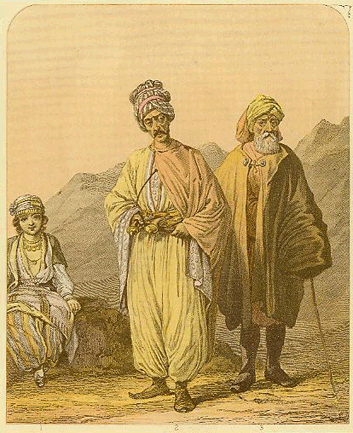
Kurds

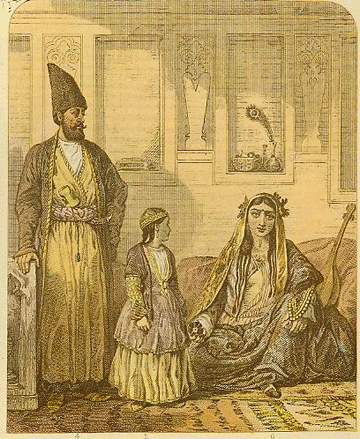
As noted in a previous post, I recently went through a late 19th century scrapbook that belonged to my great, great aunt. She had cut out pictures that interested or amused her. Several of these have Orientalist themes. Sometimes a picture is worth a thousand words; other times the picture says enough for itself. In this series, I leave the image to speak for itself. If you would like to comment on what you see or imagine, please do so in the comments section.


Persians

For #5, click here

Images from the Hadramawt

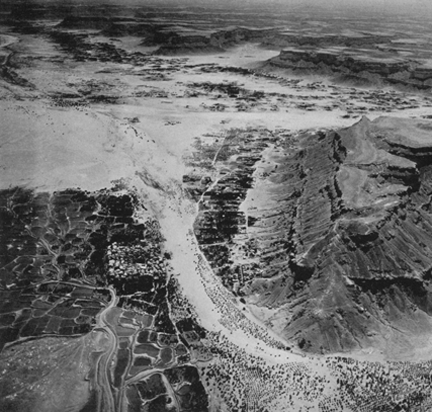
Note: The following images were taken in the early part of the 20th century when the British were in control of the Aden Protectorate.


Shibam, looking down the Wadi Hadhramaut towards Seiyun. Shibam is built on a low hill at the tip of a plateau spur and, for lack of space, grew upward; the buildings are eight to ten stories high. The landlord occupies the upper stories and these parts are whitewashed; the more whitewash, the wealthier the owner. Note the abandoned fields embanked to prevent runoff of water. The upper right-hand margin shows the plateau topography in the direction of the sea, a hundred miles distant.

Continue reading Images from the Hadramawt

Fallujah Fallout


Genetic damage and health in Fallujah Iraq worse than Hiroshima

Brussels Tribunal, Press release
July 2, 2010

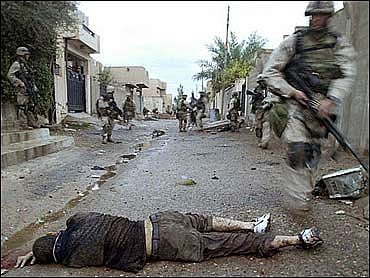
Results of a population-based epidemiological study organized by Malak Hamdan* and Chris Busby are published on 03 July 2010 in the International Journal of Environmental Studies and Public Health (IJERPH) based in Basle, Switzerland. They show increases in cancer, leukemia and infant mortality and perturbations of the normal human population birth sex ratio significantly greater than those reported for the survivors of the A-Bombs at Hiroshima and Nagasaki in 1945.

Results of a survey in Jan/Feb 2010 of 711 houses and more than 4000 individuals in Fallujah show that in the five years following the 2004 attacks by USA-led forces there has been a 4-fold increase in all cancer. Interestingly, the spectrum of cancer is similar to that in the Hiroshima survivors who were exposed to ionizing radiation from the bomb and uranium in the fallout. By comparing the sample population rates to the cancer rates in Egypt and Jordan, researchers found there has been a 38-fold increase in leukemia (20 cases) almost a 10-fold increase in female breast cancer (12 cases) and significant increases in lymphoma and brain tumours in adults. Continue reading Fallujah Fallout

Hands Up after seven decades


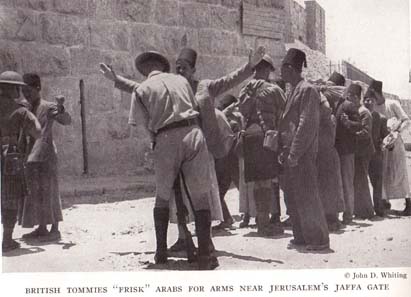
The plight of the Palestinians has a long history, one engaged on the ground before the creation of modern Israel. The photograph above, taken by John D. Whiting, is from The National Geographic Magazine December 1938 issue (p. 696). The caption reads:

BRITISH TOMMIES “FRISK” ARABS FOR ARMS NEAR JERUSALEM’S JAFFA GATE
In fighting between Arabs and Jews, hundreds on both sides have been killed and wounded from gunfire, bombs, and mines set under highways. Both peoples object to the proposed partition of the country, whereby each would be colonized in a separate district and Britain would retain control of a corridor from Jerusalem to the sea and of certain other regions.

One is reminded of Solomon’s lament that there is nothing new under the sun or the old French saw that the more things change, the more they remain the same. Regardless of who has done the frisking, the image of civilians standing in line before soldiers and with their hands up in the air is a telling reminder of the inability of politicians to resolve one of the most intractable disputes of the 20th century. The aftermath of two world wars and the thawing of the Cold War would seem more difficult to resolve than sharing space in a small corner of the Middle East. But then, this is a corner with a history of bloodshed that is unrivaled anywhere else. How ironic that the city where Christians believe the “Prince of Peace” will save the world from ultimate evil has been the site for so much continuing mistreatment of people.

Viagra for Aladdin Lovers


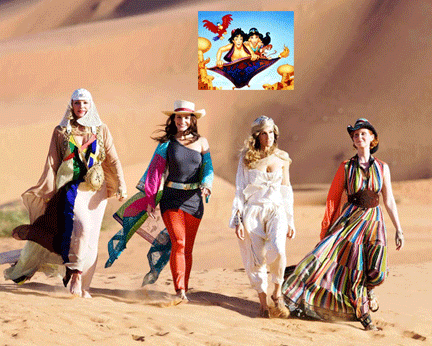
“Sex and the City 2’s” stunning Muslim clichés
It’s hard to overstate the offensiveness of the fabulous four’s exquisitely tone-deaf trip to Abu Dhabi

By Wajahat Ali, Salon, May 26

I’m a heterosexual, Muslim dude who until recently thought pleated khakis and loafers were “hip” and mistook Bergdorf Goodman for an expensive Swiss chocolate. So it is not surprising that 40 minutes into “Sex and the City 2,” a 150-minute cotton candy fantasy accessorized with materialism and fashion porn, I was comatose with boredom.

But I was defibrillated by the film’s detour into Abu Dhabi (really Morocco and studio sets) and what can only be described as an Orientalist’s wet dream. After discovering they will visit the Middle East, the ladies whip out hall-of-fame Ali Baba clichés: References to “magic carpet” (a double entendre, naturally), Scheherazade and Jasmine from “Aladdin” come in rapid succession. Upon hearing a stewardess give routine flight instructions in Arabic, Samantha behaves like a wild-eyed child hearing a foreign language for the first time. “I wonder what she’s saying. It sounds so exotic!”

Michael Patrick King’s exquisitely tone-deaf movie is cinematic Viagra for Western cultural imperialists who still ignorantly and inaccurately paint the entire Middle East (and Iran) as a Shangri La in desperate need of liberation from ignorant, backward natives. Continue reading Viagra for Aladdin Lovers

Worth a Response: Why Yemen is not Afghanistan


“The village of Rihab in Wadi Dawan, a valley that is the ancestral home of Bin Laden”; Simon Norfolk/Institute, for The New York Times

Yemen hardly ever makes the news unless a journalist wants to rail against the green-dribbling khat habit of grown men who wear skirts or trump with the terrorism card. In the Sunday Magazine of The New York Times, Robert F. Worth asks the provocative question: “Is Yemen the Next Afghanistan?” For an article that begins with a photograph of the valley “that is the ancestral home of Bin Laden” and mentions an American cruise missile in the first line, it hardly takes a Ph.D. to figure out what the answer is most likely to be in the mind of the reader. Worthy reporter that he is, The New York Times Middle East correspondent does not directly answer the question. He does not need to, since the Al Qaeda-laced narrative itself hinges on the comparison. The article ends with a visit to an “old man with a deeply lined face” and who walks with a cane. When asked if his son, an Al Qaeda figure described in the story, was really part of the plot in the 2000 bombing of the U.S.S. Cole, the father responds:

‘No,’ he said, ‘ I don’t believe this.’ He was silent for a long time, staring at the closed door of the house, which was illuminated at its edges by a bright rectangle of afternoon sunlight. then he spoke again.
‘He is a mujahid,’ he said, or holy warrior. ‘He is fighting those who occupy Arab lands. He is fighting unbelievers.’

I have read a number of articles by journalist Worth, usually with a favorable view of his ability to introduce nuance into what is generally a black-and-white portrayal of things Arab and Islamic. For this article, he contacted diplomats (former Ambassador Hull) and scholars (Gregory Johnson) who are knowledgable about recent political events in Yemen. He is also to be commended for learning some Arabic, although I am not sure his year-long training in classical will be of much help in casual conversation in dialect. Yet he visited Yemen and actually talked to local people and not just the other reporters in the pool. In this sense, the reporting is not bad, certainly not like The Daily News or Fox News engineering. The problem is that neither is the article very good. The question in the title, which perhaps was not the journalist’s choosing given the control of editors, is blatantly rhetorical, not a genuine search for an answer that goes beyond the verbal War on Terror jousting on all sides of the aisle in Washington and in much of the media. Continue reading Worth a Response: Why Yemen is not Afghanistan