Category Archives: Countries

Buried Texts Recovered: An American Consul in the Holy Land

“The author’s object in accepting an appointment under the United States Government was not the honor or emoluments of office, but a desire to visit the lands of the Bible, that he might see for himself how far the manners, customs, and traditions of the people and topography of those countries agreed with the inspired word.”

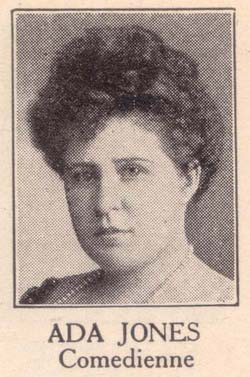
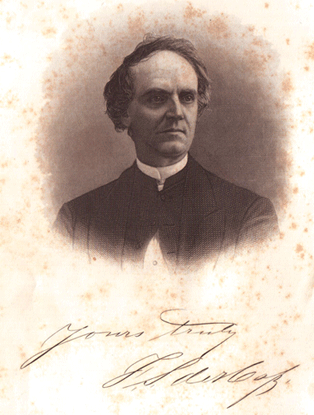
So begins one of the numerous 19th century Bible customs travel accounts by Christian enthusiasts able to travel to their “Holy Land.” The author is Frank S. DeHass, who served as the United States Consul in Palestine in the mid 19th century. His text is aptly entitled Buried Cities Recovered, or, Explorations in Bible Lands, giving the results of recent researches in the Orient, and recovery of many places in sacred and profane history long considered lost. My copy, handed down from my grandmother, was published in 1886 in Philadelphia by Bradley & Company; the tenth edition no less! This is a wonderful read and you can read the entire book online, thanks to Google Books.

Like so many other Bibliophiles of his generation, DeHass extols the virtue of actually visiting the land where Jesus was born and died. In his own words:

Recent explorations in the East have resulted in the recovery of many places in sacred and profane history long regarded as lost; and as the facts brought out by these researches are not accessible to the general reader, the author has compiled them in this concise form, and at the request of numerous friends gives them to the public, not as a scientific work for the antiquarian, but as a humble contribution to Biblical archaeology for the home circle, believing that such a volume will add greatly to the elucidation of the Scriptures, and serve to correct some of the errors which many travellers have fallen into by a too hasty or superficial view of the places visited. Continue reading Buried Texts Recovered: An American Consul in the Holy Land

What’s Cooking in Yemen 2

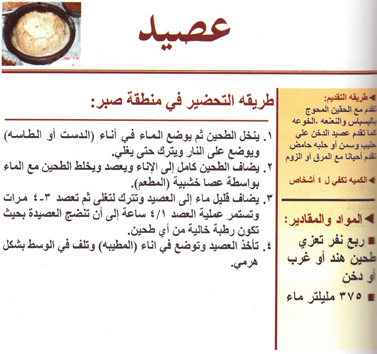
In a recent post on Yemeni cooking the steps for making barley bread were illustrated. One of the staple dishes of the Yemeni highlands, and one that I enjoyed while living in a rural setting in al-Ahjur in the late 1970s, is the sorghum porridge called ‘asîd. The recipe is above and the steps illustrated below. Sorghum flour is available in the United States, most easily at Indian food stores, but also on the Internet. Continue reading What’s Cooking in Yemen 2

Tulip mania


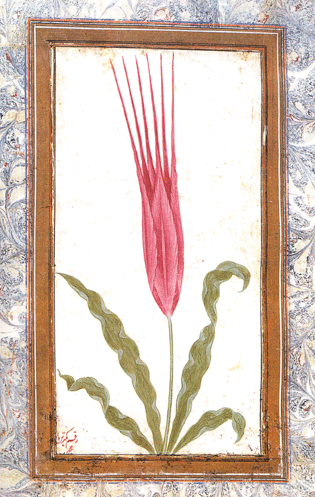
Unnamed tulip from the Turkish ‘The Book of Tulips’, ca. 1725

Webshaykh’s Note: With winter snow buffeting Europe and the Middle East, what better time to think about tulips, an Ottoman treasure that took Europe by storm almost half a millennium ago. There is an excellent book on The Tulip by Anna Pavord (Great Britain: Bloomsbury, 1999), but one of my favorite articles is one that Jon Mandaville wrote for ARAMCO World over three decades ago. The full article is available online, but I provide the first part below.]

Turbans and Tulips
Written by Jon Mandaville. ARAMCO World Magazine, May/June, 1977

Tulips come from Holland. Right? Wrong! Or at least, they haven’t always. Tulips come from Turkey, the only country in the world to call one of its major eras of national history—the years 1700 to 1730—the “Tulip Period.” And how that era got its name . . . thereby hangs a tale.

Tulips, even in the early 18th century, were nothing new to Turkey. Along with other bulbous plants such as the narcissus, the hyacinth and the daffodil, tulips had grown there for centuries, both wild and domesticated for house and garden. The Tulip Period took its name from an established hobby, which started as court fashion, grew into a generalized fad and fancy, and finally became an explosion of unrestrained international speculation in bulbs which buyers never even saw.

It all began when tulips first went to Europe. In 1550, no one in Holland had heard of tulips. Different varieties do grow wild in North Africa and from Greece and Turkey all the way to Afghanistan and Kashmir. Very occasionally they are even found in southern France and Italy, usually in vineyards or on cultivated land, which has led some botanists to speculate that they may have been brought back by the Crusaders.

The Persians were familiar with tulips, but they didn’t domesticate them as thoroughly as the Turks. For centuries they admired the flowers wild. Even as decorative motifs in Persia, they were never as popular as the narcissus, iris or rose.

In Turkey it was different. Continue reading Tulip mania

Discovering fashion and identity in Yemen


Photographs by Boushra Al-Mutawakel

by Yazeed Kamaldien, Yemen Times, December 16, 2010

A packed crowd swarmed around the Sana’a Styles: Fashion and Identity photo exhibition and artworks event earlier this week, when it opened at the House of Culture on Al-Qasr Street in Sana’a.

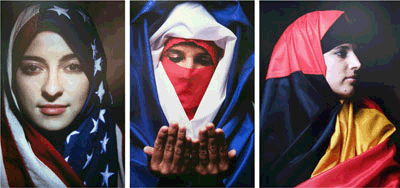
Striking photographic essays plastered the venue walls. Large color portraits of Muslim women wearing the hijab, or Islamic headscarf, photos showing women in black veils surrounded by contemporary fashion and snapshots of ordinary Yemenis making a statement with their everyday clothes.

Photographer Sophie Elmenthaler showed a series of photos under the title ‘Hijab and High Heels’. These pictures showed fashion for women that would reveal skin if worn in public, but that Yemeni women would only wear in private. The images included clothes labeled the “cheapest goods from China and India” sold in Sana’a.

A short film showed Yemenis talking about the clothes they wear and what motivates their sense of style. Another series of photos showed women in various uniforms and cultural dress, commenting on how clothes ensured that individuals became part of the communities where they live.

“People with a strong sense of assertiveness accept identities of their social group,” reads the statement from this series of photos. Continue reading Discovering fashion and identity in Yemen

Heroic, Female and Muslim


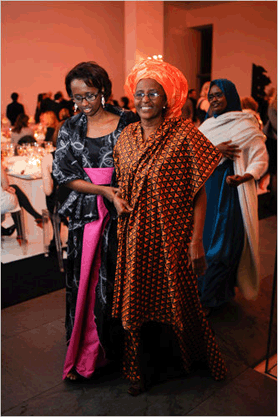
Dr. Hawa Abdi runs a hospital in Somalia and stands up to extremists there; photograph by Casey Kelbaugh for The New York Times.

By NICHOLAS D. KRISTOF, The New York Times, December 15, 2010

What’s the ugliest side of Islam? Maybe it’s the Somali Muslim militias that engage in atrocities like the execution of a 13-year-old girl named Aisha Ibrahim. Three men raped Aisha, and when she reported the crime she was charged with illicit sex, half-buried in the ground before a crowd of 1,000 and then stoned to death.

That’s the extremist side of Islam that drives Islamophobia in the United States, including Congressional hearings on American Muslims that House Republicans are planning for next year.

But there’s another side of Islam as well, represented by an extraordinary Somali Muslim woman named Dr. Hawa Abdi who has confronted the armed militias. Amazingly, she forced them to back down — and even submit a written apology. Glamour magazine, which named Dr. Hawa a “woman of the year,” got it exactly right when it called her “equal parts Mother Teresa and Rambo.”

Dr. Hawa, a 63-year-old ob-gyn who earned a law degree on the side, is visiting the United States to raise money for her health work back home. A member of Somalia’s elite, she founded a one-room clinic in 1983, but then the Somalian government collapsed, famine struck, and aid groups fled. So today Dr. Hawa is running a 400-bed hospital. Continue reading Heroic, Female and Muslim

A Persian Anatomy Lesson

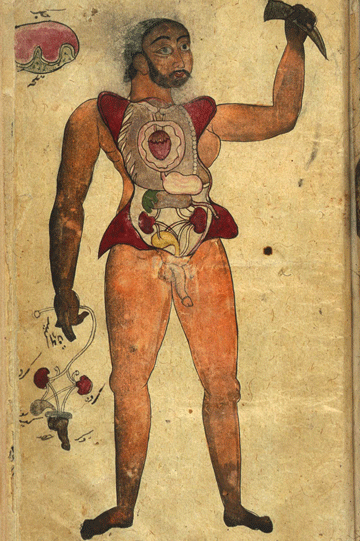
The National Library of Medicine has a splendid manuscript collection, including an 18th century Persian text with illustrations. Here is the information from the webpage, with two of the illustrations provided here.

Anonymous Persian Anatomical Illustrations. [Iran or Pakistan, ca. 1680-1750].
Anonymous Persian Anatomical Illustrations.

The National Library of Medicine owns approximately 300 Persian and Arabic manuscripts dating from the eleventh to the nineteenth centuries. Most of these manuscripts deal with medieval medicine and science and were written for learned physicians and scientists. Among them are a number of anonymous anatomical treatises or groups of anatomical drawings.

The two featured here consist of a Persian bloodletting figure and a venous figure, probably drawn in the 18th century but based on earlier models (MS P 5 fol. A); and six early-modern anatomical drawings showing some European and Indian influences (MS P 20, item 2).

Six Early Modern Anatomical Illustrations

Six anonymous anatomical drawings occur on folia 554-559 at the end of a volume containing Tibb al-Akbar (Akbar’s Medicine) by Muhammad Akbar, known as Muhammad Arzani (d. 1722/ 1134) in an undated copy probably made in the 18th century. The paper on which these figures are drawn, however, is distinct from that of the main text, though similar in many respects. The illustrations appear to be unrelated to the accompanying text and to draw upon Indian and early-modern sources.

One full-opening of the manuscript, folia 554b-555a, contains two full-figure anatomical illustrations, one of a female and one of a male. Continue reading A Persian Anatomy Lesson

Iraq, Islam and Sweden


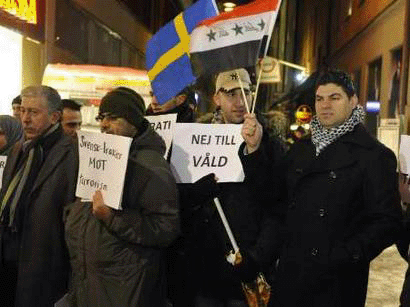
Swedish-Iraqi immigrants protest in central Stockholm, where a car bomb exploded two days ago December 13, 2010. The placard on left reads, “Swedish Iraqis against terrorism”. REUTERS/Bertil Ericson

The recent bomb attempt in Sweden has been linked to an Iraqi who grew up in Sweden. Not much has been written about the influx of Iraqis to Sweden, whose open door policy in the past has led to it being a haven for refugees. However, one of my students, Sarah Skiold-Hanlin conducted an ethnographic project on Swedish reactions to the Iraqi community in the summer of 2008. Her research paper, an Honor’s Thesis in the Department of Anthropology at Hofstra, is available online and I recommend it for anyone wanting more information on the subject of Iraqis in Sweden.

I attach Sarah’s introduction below, but encourage you to read her entire paper:

“One place where many Iraqis have found refuge from the war is Sweden,” stated Renee Montagne, the host of NPR’s Morning Edition. This was her opening line as she introduced the news story titled: Sweden Begins Sending Iraqi Refugees Home. The story aired March 25, 2008. Renee goes on to explain how the “many Iraqis” numbered somewhere in the range of 20,000. A momentary flash of elation followed this opening as my mind began turning over the meaning, estimating its possible weight. Perhaps Sweden, a nation with which I have close family ties, could help rectify the political actions of my country of birth. But like trying to dam the Mississippi River with a box of pop sickle sticks and a bottle of Elmer’s Glue, the flow of refugees fleeing the war in Iraq is far to numerous for one small Scandinavian country to hold. Renee’s voice fervently interjected as she continued washing away my melodic dreams of relief and solution to the persistent humanitarian crisis plaguing so many civilians. “The Swedish government is stopping that flow of Iraqi refugees and sending some back home against their will,” she reported. Continue reading Iraq, Islam and Sweden

The Liberation of Erotic Literature


Interview with Salwa al-Neimi
in al-Qantara, 7/2010

The novel The Proof of the Honey by Syrian author Salwa al-Neimi is celebrated by some as a milestone of modern Arabic literature and condemned by others as scandalous prose. In an interview with Rim Najmi, the author explains that despite the lightness of its literary style, her novel poses fundamental intellectual and political questions

Your first novel, The Proof of the Honey, attracted a great deal of attention from both readers and critics alike. The most frequent response had more to do with your “courage” in tackling one of the greatest taboo themes in Arab culture and less with the literary qualities of your novel. What do you think was the decisive factor for all the attention?

Salwa al-Neimi: Thank you for this question. I always say the success of the book is primarily based on its language and style. I make this claim even though most of the critics tend to emphasize the theme of the novel and the fact that it crosses the red line. Unfortunately, they have little interest in the actual text itself. Some critics constantly talk about freedom of expression, although this often turns out to be just an end in itself. When it comes to a contemporary text, it is often judged in terms of moral categories, which is just another form of censorship.

By Arab standards, your novel, The Proof of the Honey, sold in record numbers in only a short time. It has also been translated into many languages. What does the international publication of your work mean to you?

Al-Neimi: First and foremost, I wrote The Proof of the Honey for Arab readers. Continue reading The Liberation of Erotic Literature