Category Archives: Countries

Orientalist Images #1: Berbers of Algeria


[With this post I start a new series dedicated to photographs in an “Orientalist” mode. In addition to Reading Orientalism (which is also the title of my last book), the creation of an imagined Orient is very much a pictorial voyeuristic voyage. In this series I focus on Western images of the Middle East and North Africa, both those that perpetuate stereotypes and those that chip away at the bias. Readers of the blog are welcome to send in images they have found and want to share.]

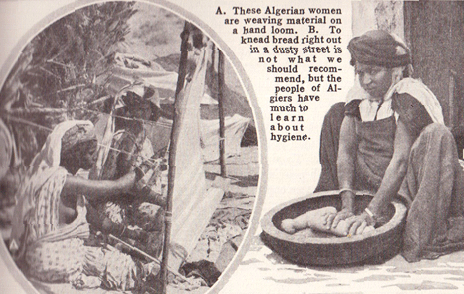
I start with images from a 1933 edition of Richards Cyclopedia, with 24 volumes published in New York by J. A. Richards, Inc and edited by Ernest Hunter Wright and Mary Heritage Wright. This is an unusual encyclopedia, arranged by topics in a more or less arbitrary order but replete with images. One of the articles is called “The Green Girdle of the Sahara” (vol 18, pp. 4631-4636). The subtitle is: “What Men Live Now along the Northern Strip of Africa, Where the Egyptians Started the Clock of History and Where Grim Carthage Used to Frown across the Sea at Rome?”

The article starts out by describing the Barbary coast and then adds this comment:

Although the Barbary Coast is not an Eastern, or oriental, country, lying as it does due south from Europe, it seems to visitors from Europe and America like a corner of the Orient. It has a religion out of the East, Mohammedanism (mô-hâm’êd-ân-îz’m). Among the farming peoples who make their living from its soil are many restless Jews and fierce Arabs, whose Eastern ways have been taken up by the native peoples. Thus the Berber of this small fertile strip treats his women folk as an oriental might treat them, and he has an oriental’s indifference to dirt. Yet the Berbers are cousins of the northern races, many of them having blue eyes and fair hair.

To be an Oriental outside the literal Orient, to have an indifference to dirt and to be a Mohammedan: such is the fate for the Berber in 1930’s stereotyping. The image above illustrates the sentiment of an Algerian woman who has “much to learn about hygiene.” Given the Islamic duty of ablutions before prayer and the long history of anti-bathing practice in Europe, this is a very narrow put-down indeed.
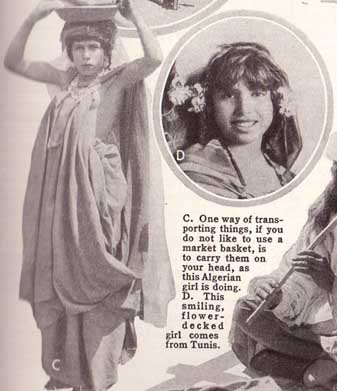

The picture immediately above shows both the hardship of being female (carrying market items on one’s head) and the beauty of the maid with flowers in her hair. Exotica über alles.

to be continued

Daniel Martin Varisco
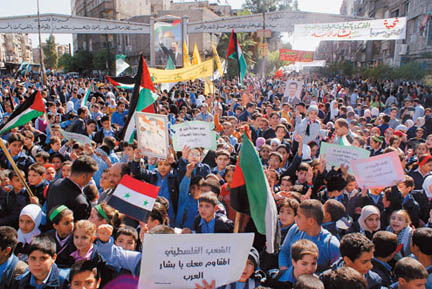
What Syrians want …


What do we want?

by Amina A., A Gay Girl in Damascus, May 9, 2011

The regime claims that they have no idea what we in the opposition want. I find that hard to believe … haven’t they been watching us, listening to our slogans, reading what we write? Do they have facebook? Seriously, it’s spelled out there: “The solution is simple: Stop shooting at demonstrators, allow peaceful demonstrations, remove all your photos and those of your father, release all political prisoners, allow political pluralism and free elections in six months.”

And for Asad? “You will be the pride of contemporary Syria if you can transform Syria from a dictatorship into a democracy. Syrians would be grateful for that, and it is possible to do”
But maybe they do not get it. Maybe it is too simple. Didn’t Emma herself claim in that awful Vogue article that they practice democracy inside the royal household?
Well maybe more specifics would help …

We want an end to dictatorship. We want free and fair elections. We want freedom. Continue reading What Syrians want … →

Geographers and Osama

UCLA Geographers Weren’t Far Off the Mark in Predicting Bin Laden’s Location

By Ben Wieder, Wired Campus, The Chronicle of Higher Education, May 3, 2011

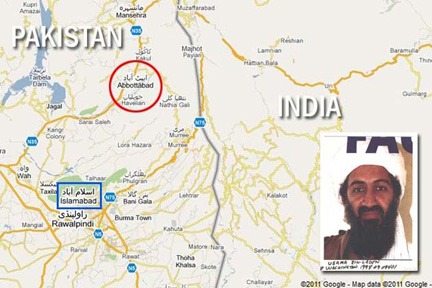
Osama bin Laden’s hiding place in Abbottabad, Pakistan, came as a surprise to many when U.S. forces located and killed the former Al Qaeda leader early Monday. It was less of a surprise to two geographers at the University of California at Los Angeles.

According to ScienceInsider, a geography class taught by Thomas W. Gillespie, an associate professor, and John A. Agnew, a professor, predicted in 2009 that there was an 88.9 percent chance Mr. bin Laden was hiding in a city less than 300 kilometers from Tora Bora, his last known location. That swath of Pakistan would include Abbottabad, Mr. bin Laden’s actual hiding place. Continue reading Geographers and Osama →

India Orientalized for War, 2

During World War II the Smithsonian Institution issued a number of “War Background Studies.” I recently came across #18 in this series entitled Peoples of India by William H. Gilbert, Jr. (Washington D.C.: Smithsonian Institution, April 29, 1944). I was struck by the archaic presentation of images and the overtly Orientalist writing of Gilbert, who is billed as a “Specialist in Sociology and Anthropology, Legislative Reference Series, Library of Congress” and posted an excerpt from his Introduction in a previous post. The following comments are in reference to this earlier post.

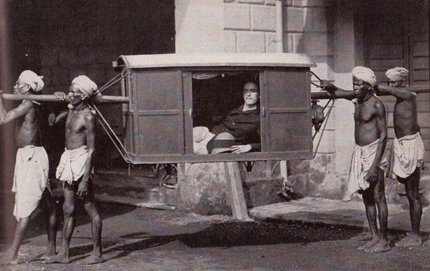
First, the old saw that a picture is worth a thousand words is as apt today as ever. In the last post the image provided there (and again above) of a British “sojourner” in a palanquin shows the Brit, prone and pith helmut at his side, staring outside his box of privilege, while there are two bare-chested bearers in front and two behind. What a compelling metaphor for the colonial view of India. There is no direct engagement between the foreigner and the people; they are merely there to take him from place to place by hand. Ironically, the caption notes that the palanquin is no longer used since the arrival of the railroad, so this image becomes a vestigial reminder of how the present occupies the past for its own comfort. Int his case the white man’s burden is turned upside down; the white man is quite literally the burden here.

Second, notice the adjectival mode in the paragraphs cited in the previous post. Continue reading India Orientalized for War, 2 →

Illuminated Verses: The Poetries of the Islamic World


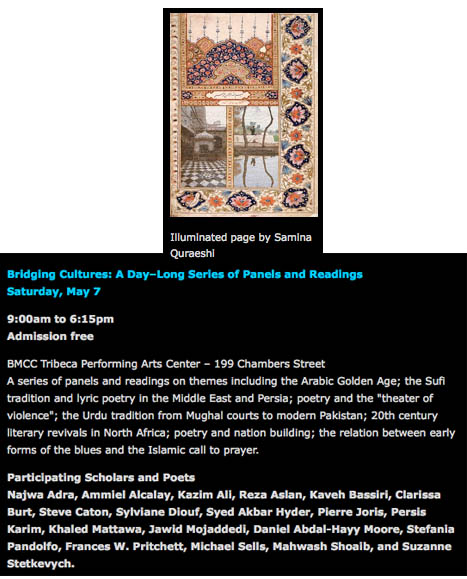
Illuminated Verses explores some of the rich and varied poetic traditions of the Islamic world. For a schedule of panels, click here (and scroll to bottom to download pdf of program).

Here is the program for Saturday, May 17, 2011:

Detailed Schedule

•9:00-9:15am
Welcome by Poets House Executive Director Lee Briccetti and City Lore Executive Director Steve Zeitlin

•9:20-9:55am
Illuminated Verses: the Poetries of the Islamic World
An opening panel setting up large questions and contexts with Reza Aslan and Michael Sells.

•10: 00-11:00am
Origins and Orality: the Poetry of the Arabian Peninsula
An examination of the poetries of the Arabian Peninsula from the Golden Age to contemporary oral tribal poetry. With anthropologists Najwa Adra and Steve Caton and literary scholar Suzanne Stetkevych. Continue reading Illuminated Verses: The Poetries of the Islamic World →

Orientalism: Veiled and Unveiled


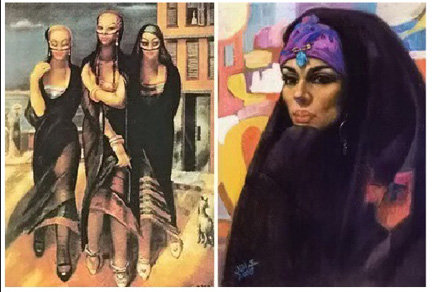
Mahmud Saʻid,The Girls of Bahari; and an untitled portrait by Abdelal Hassan (2000; current location unknown)

[Note: The following is an excerpt from a fascinating discussion of Orientalist art by the philosopher, cultural critic and poet Pino Blasone, whose knowledge of both European and Arab cultures brings a fresh lens to the discussion of the genre. The article is entitled “Orientalism: Veiled and Unveiled” and is available in its entirety online.]

In an online weekly supplement to the Egyptian newspaper Al-Ahram (17-23 May 2007, Issue No. 845), we can read an interesting article by Mohammed Salmawy, entitled“Dialogues of Naguib Mahfouz: A passion for the Arts”. Notoriously Naguib Mahfouz, or Nagib Mahfuz, is the best Egyptian novelist of the 20th century, died in 2006 and received the Nobel Prize for Literature in 1988. Salmawy reports and comments a late interview to him. In particular, let us consider a passage from that: “My first exposure to the plastic arts was in the late 1920s… I remember reading an article by Al-Ê»Aqqad about an artist called Mahmud SaÊ»id. This was kind of unusual, for art wasnʼt really big back then. So for someone like Al-Ê»Aqqad to write a whole article about an artist was a bit of a shock. After that, I learned that SaÊ»id came from a prominent family and had a brilliant career in the judiciary, a career that he abandoned to dedicate his life to art. From then on I made a point of going to all SaÊ»idʼs exhibitions. […] Some of SaÊ»idʼs paintings are still imprinted on my mind: The Girls of Bahari, The Liquorice Merchant, and those splendid portraits of countryside women”. Continue reading Orientalism: Veiled and Unveiled →